Sunday, April 08, 2012

The Home Team

As regards animated features, it's not all about Disney and DreamWorks elbowing their way into the Middle Kingdom:

... Imagi -- a company that almost went bankrupt after the dismal failure* of its take on the Japanese TV series " Astro Boy" in 2009 -- is home to the champion of China's animation industry: Pleasant Goat and Big Big Wolf.

... [T]he franchise has produced four films in the past four years taking a combined domestic box office haul of 548 million yuan ($87 million).

In terms of animated films screening in China, that amount has only been bettered by DreamWorks' Kung Fu Panda franchise, whose two films have commanded takings of 744 million yuan since the original's release in 2008. ...

China's theatrical market is growing by double-digit percentages year by year, so there's probably room for multiple players in the cartoon marketplace, but an $87 million gross isn't going to allow for BIG budgets. Unless, of course, those domestically produced features earn healthy amounts of dollars in other global localities.

* As we all know, the fact that Imagi's Astro Boy underperformed in the world marketplace is a serious black mark on the entertainment tastes of mankind.

Click here to read entire post

The First Union Rep

During these holy days, let us remember ...

Exodus is a story about cruel labor conditions, workers' rights, and strong leaders, making Passover's hero a shop steward for the ages ...

Millions of families around the world, including my own, will sit down together this weekend for Passover Seder to read and celebrate the story of the Jews freeing themselves from enslavement. Independence is an important and powerful part of the story. But I think we're also celebrating something else: the first great moment in labor history.

Seriously.

The parallels come easily. The workers (Israelites) asked their union rep (Moses) to stand up to the boss (Pharaoh) about their terrible working conditions. In Exodus: Chapter 5, the boss denied Moses and doubled the workers' load. ...

Labor issues are remarkably similar through time.

Too much work. Too little rest. Brutal labor conditions. Meager pay.

Through much of human history, most people's lives have been brutish and short. The Top Dogs might live in splendid luxury, but everybody else is down in the muck and mire, scratching out a living. And dying at thirty-five.

It's recorded that a Roman Centurion, between wars, lived on a one acre farm with his wife and five kids, trying to make ends meet. The centurion's life was not untypical of how the lower classes lived.

The Dark Ages were a time of poverty for most. The Renaissance ... and rising incomes ... happened because plagues wiped out so much of the population that wages rose for the few survivors. (When workers are scarce, salaries go up. Adam Smith's supply and demand thingie.)

In the twentieth century, labor laws in the U.S and Europe helped unions get a toe hold, spread pensions and health care to the huddled masses yearning to make a buck, and generally strengthened the Middle Class.

That era has now receded somewhat, and the strong middle with it. So it's good to remember that the struggle between the many and the wealthy few have been going on for a lengthy while now.

"Oh Mary, don't you weep, don't mourn,

Oh Mary, don't you weep, don't mourn*,

Pharoah's army got drownded, oh Mary don't you weep."

* Although the subtitles say "... don't you weep no more," I believe Springsteen is singing "... don't mourn."

Click here to read entire post

Your Overseas B.O.

Though Wrath of the Titans remained in first place, animation was no slouch:

Dr. Seuss’ The Lorax elicited $11.8 million from some 4,000 situations in 49 territories, lifting its international gross total to $59 million. ...

Sony Animation/Aardman’s coproduction of The Pirates! Band of Misfits grossed $10 million on the weekend, playing at a total of 3,890 venues in 29 markets, and raising its early oversea gross total to $25.2 million.

Lorax has no taken in a grand total of $257.2 million around the globe, while Pirates! has yet to be released stateside.

Click here to read entire post

Saturday, April 07, 2012

Worst ...

Per those who profess to know.

Electronic Arts just won the type of college basketball-style tournament that no company wants to be associated with. EA was voted the worst company in America by Consumerist.com. The consumer site is published by Consumer Media LLC, a not-for-profit subsidiary of Consumer Reports, and takes no outside advertising. ...

Over its three-week run, the seventh annual Worst Company in America tournament drew more than 260,000 total votes, setting yet another contest record, from people fed up with the poor consumer policies of the 32 companies nominated from a range of industries, including airlines, telecommunications, retailers, financial institutes and more. Gamers drove the final vote to a tournament record 50,575 total submissions. ...

So consumers are ticked. Maybe it's better inside the company, and EA employees are happy campers with good salaries and better working conditions.

But a few years ago, TAG got contacted by a sizable number of Electronic Arts employees who griped about the long hours and flat pay. At the time, the video game industry had a deserved reputation for long work-weeks, and lawsuits were percolating over unpaid overtime and other unsavory things.

... Word of the lawsuit comes as an anonymous blog posting ... blasted EA and generated a flurry of complaints about punishing work hours in the industry. "The current mandatory hours are 9 a.m. to 10 p.m.--seven days a week--with the occasional Saturday evening off for good behavior (at 6:30 p.m.)," read the post, whose author claimed to be the "significant other" of an EA employee. ....

That was then and this is now. If memory serves, some of the troubles were ultimately resolved. But as a game employee said to me a while back:

"The game industry wants employees who are fresh out of school and eager. It's good to be twenty-two or twenty-three. When you hit thirty, they don't want you anymore. They're back at the university campuses recruiting more twenty-two year olds. ..."

Issues of overwork never go away. Thirty-five years ago, my supervisor at Disney (who'd been there off and on since 1930) complained to me about the free overtime at Disney's Hyperion studio, where the wages for a Saturday of work were a lunch voucher at the corner diner.

In 2138, I'm confident there will still be long work hours and employees who don't get paid for them. And the worst company then? Probably hasn't been formed yet.

Add On: Michael Pachter, game analyst, thinks EA's new award is silly.

Click here to read entire post

Bows and Arrows

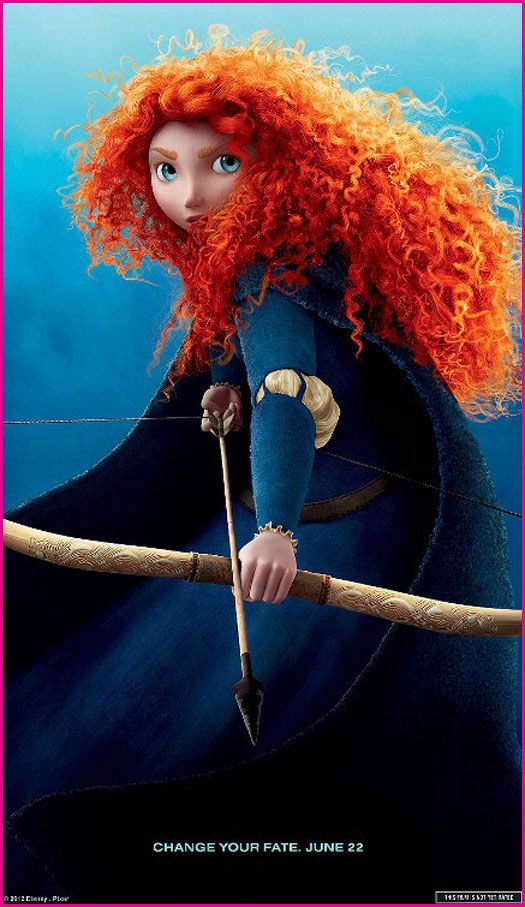
Jennifer Lawrence isn't the only woman who knows how to stretch a bow string ...

Diz Co. has released a cluster of new Brave posters.

Click here to read entire post

The Derby in Springtime

The big ship take third place, horn dogs second, and spunky teen with bow and arrow (who's not "Brave") hangs onto first. (Here is the Friday to Thursday chart):

The Hunger Games -- $12.9 million (Total $282.2 million)

American Reunion -- $9.2 million

Titanic -- $7.1 million ($15.5 mill ... this time 'round)

Wrath of the Titans -- $5.4 million ($49.3 million)

Mirror Mirror -- $4.6 million ($30 million) ...

We're informed:

The Hunger Games is now starting to show off some of its stamina, as the sci-fi survival thriller dropped only 31 percent for an estimated $12.9 million on Friday. ...

Meantime Dr. Seuss's creation continues to hold up at the box office, gaining 11% on Good Friday. The Lorax has now collected $195.5 million domestically.

Add On: Time Magazine analyzes the first quarter's box office totals:

Everything about early 2012 was bigger, better, more than the year before. Twelve of the first 13 weekend grosses of 2012 have been higher, often far higher, than those of the same weeks last year. ...

The Lorax, in its first weekend, secured the biggest opening for any movie based on a Seuss book, for any nonsequel since Tim Burton’s Alice in Wonderland exactly two years before ... and for any animated feature since Toy Story 3 in June 2010. Still percolating, The Lorax is certain to pass $200 million, becoming the first animated feature to exceed that mark since Tangled, released in Nov. 2010. ...

Add On: Hunger Games again comes in first ... with the iceberg and the boat coming in third.

Click here to read entire post

Friday, April 06, 2012

Uncanny Uneasiness

I don't know if this is true, but it sounds plausible:

When Pixar screened a computer-animated short film called "Tin Toy" in 1988, test audiences hated the sight of the pseudo-realistic baby named "Billy" who terrorized the toys. Such a strong reaction persuaded Pixar to avoid making uncannily realistic human characters ...

If scientists don't know why the Uncanny Valley bothers humans, I have a few ideas about it.

Flesh and blood humans know how their counterparts on a screen are supposed to look. And digital "almost" humans aren't it. The face is off. The eyes resemble glass. Skin textures are too android-like.

Try this mind experiment: Think about the movie entitled Titanic. (It's out now at an AMC near you in genuine fake 3-D, so it's easy to get a quick memory freshener.)

Now think about Titanic if it had been done, stem to stern, with mocap actors and digital sets.

Still a grabber for you? Still emotionally involving? I'm betting "nope." Seeing digital replicas of Leo DiCaprio, Kate Winslet, Kathy Bates and the rest of the passengers would have pushed audiences away.

"Evolutionary history has tuned us to detect minor distortions that indicate disease, mental or physical problems," [psychologist Thalia] Wheatley explained. "To go after a human-looking robot or avatar is to go up against millions of years of evolutionary history." ...

Dr. Wheatley's analysis goes a long way toward explaining why America didn't clasp The Adventures of Tintin to its heart. As with Titanic, there was adventure on a ship. And there was a narrow escape in a life boat with a kid about Mr. DiCaprio's age. But there were no actual human beings.

So people watched the near-duplicates on a big, 3-D screen and squirmed in their seats. Why? Because the prehistoric parts of their brains whispered "sick ... sick ... sick."

Click here to read entire post

Not Getting Cancelled

Nickelodeon's Cartoon Network's ongoing hit:

Adventure Time returned Monday night with its fourth season, scoring as the #1 telecast of the day among all targeted kids—ages 2-11, 6-11 and 9-14—earning double and triple-digit growth vs. last year’s time period, according to Nielsen Media Research. The season’s first half-hour episode “Hot to the Touch” also out-paced all kids competition, by double and triple digits ranging between 20% and 353% ...

As it happens, I talked to AT crew members this week. One of them, who also worked on the pilot, said he was glad for the work, and glad that it looks like the series will continue for awhile. Fifth season ... sixth season ... and beyond?

Click here to read entire post

Thursday, April 05, 2012

Round Two

The IA's boys and girls have known about this for awhile, but it's now hit the media.

The International Alliance of Theatrical Stage Employees and Hollywood studios have agreed to return to the bargaining table on April 12. ...

The sticking point is how to pay for the rapidly rising cost of health coverage and to bolster the IATSE pension fund over the next three years. According to consultant estimates, the Motion Picture Industry Pension & Health Plans face a funding shortfall of as much as $500 million over that span for the workers represented in the talks.

The studios have already met with negotiators of individual guilds to discuss demands specific to each union, primarily concerning work rules. The upcoming talks will focus on wage and benefit issues and how to bridge the $500 million health and pension gap. ...

There have been other "sticking points" if memory serves. Sadly, I'm not at liberty to say what they are/were.

What I can say is: When were were deep into the festivities a couple weeks ago, the parties were closer to a deal than they'd been half a week before, but had not reached a deal. At 3:30 on a Monday morning, the labor unions at the table decided to put a pin in the talks and try again later.

April 12 is the later. When there is resolution, we will let you know.

Click here to read entire post

Foreign Labor

And as there is free labor via eager students, so are there foreign alliances with overseas super powers.

China may finally be opening up its animation market to foreign investment, with the latest word that none other than Disney (NYSE: DIS), arguably the world’s most famous brand in the field, is in talks with Internet leader Tencent (HKEx: 700) for a tie-up in the lucrative but largely undeveloped space. The media reports are rather vague, saying only that Tencent, China’s largest Internet company, is “communicating” with Disney about a potential animation development tie-up ...

This makes sense on any number of levels.

1) DreamWorks Animation has already done a deal with the Middle Kingdom.

2) We're talking a HUGE market here, and Disney is already building an amusement park in Shanghai (so why not this?)

3) John Lasseter is probably itching to fly to China and show the folks how cartoon-making is done.

There will be the inevitable It's going to China!" but I tend to think not. The idea with these budding alliances is to create domestic content and make money from a huge population base.

Besides which, I've watched "runaway production" for thirty-odd years, and it never works out the way originally planned. It took thirty years to achieve the first foreign-created animated theatrical hit, and it arrived from France, not Asia.

I don't expect California to be drained of animation work much before 2185.

Click here to read entire post

Free Labor!

Hey kids! Pay a big fat animation studio/visual effects house to work on their movie! It's all the rage!

We've been following this issue with VFX Soldier for some time now. (And we've commented on variations of this charming practice multiple times before.)

My own thought: In 2012, nothing surprises me anymore. When there are politicians beating the drum to get rid of Medicare and Social Security and the minimum wage, why would it be a surprise that a Chief Executive Officer is touting the joys and advantages to having twenty-year-olds pay for the privilege of working on a big-budget feature?

Sort of shreds the idea of minimum rates, but ... oh well.

Click here to read entire post

Wednesday, April 04, 2012

The Bob Schaefer Interview -- Part II

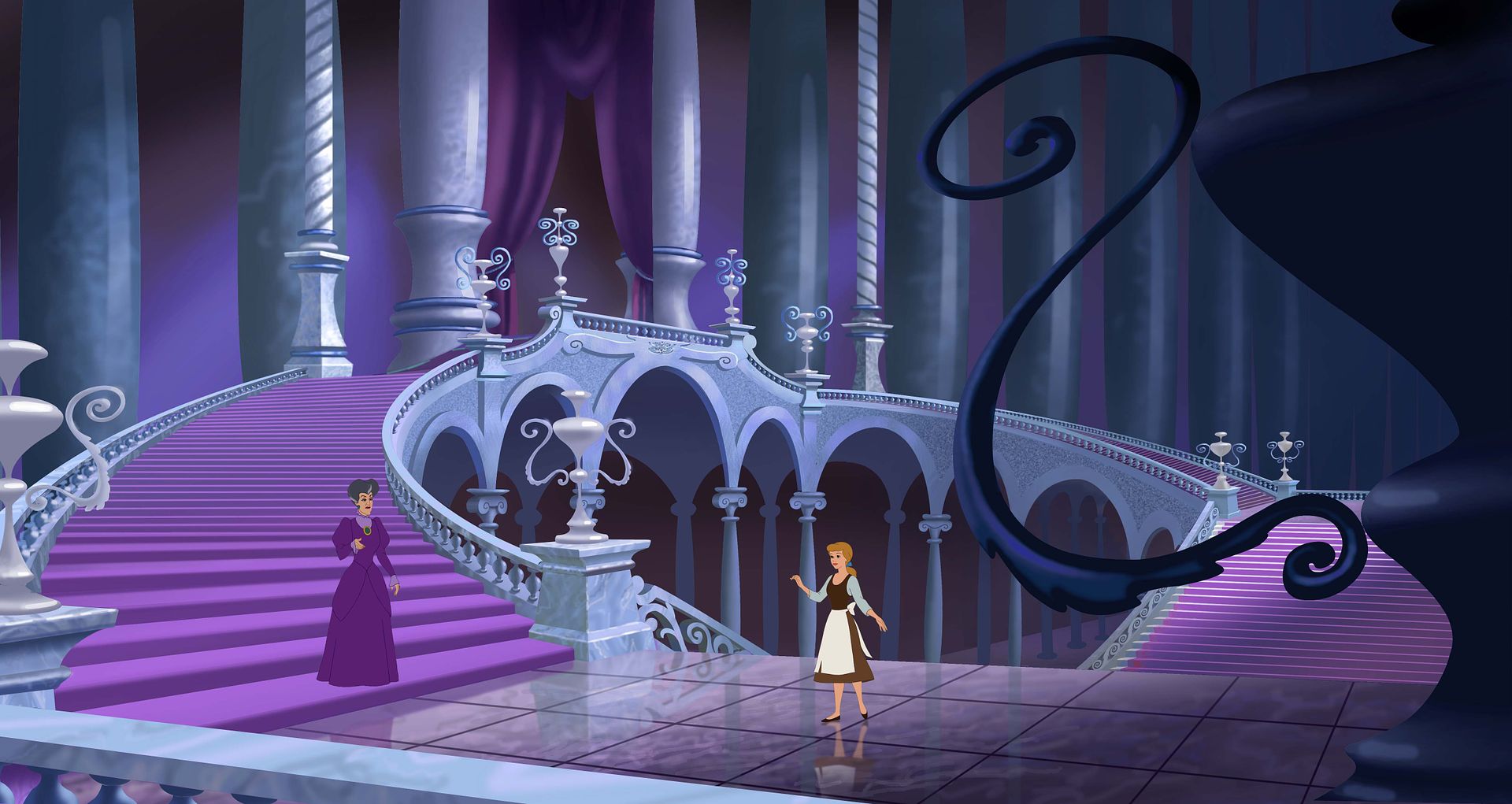
(c) The Walt Disney Co.


TAG Interview with Bob Schaefer

Find all TAG Interviews on the TAG website at this link

Bob Schaefer began his career in backgrounds with work on "The Flintstones" in the 1960s. "Doing the insides of the caves was simple. A little sponge work for texture, a few wall cracks, and you were there" ...

Bob was more interested in complex and realistic work, and found that in abundance when he worked on many of the animated sequels that Disney Toons was producing in the 1990s:

"On Lady and the Tramp: Scamp's Adventure and Cinderella III we had to duplicate the work of the older films. On L and T I had to paint a master setup of the parlor, which they didn't do in the original. It was a challenge, but I like challenges."

You can view a bit of Bob's handiwork up top, and the video of the interview below.


Click here to read entire post

The Bob Schaefer Interview -- Part I

There are a bajillion different goat paths into the scented uplands of the animation business, but veteran background artist Bob Schaefer's entryway was probably unique ...


TAG Interview with Bob Schaefer

Find all TAG Interviews on the TAG website at this link

Bob was a young man with a sign company in Bakersfield, California, gifted with a steady hand and a keen eye. Also a knack for pinstriping, sign painting, and applying gold leaf to windows.

He was making an okay living at his trade, but thought he should stretch for something more. And lo, a friend who worked at a cartoon studio in distant Hollywood called to say that the studio was in need of a title painter, and fast. So Bob loaded into his sign truck and drove to Southern California.

Over a long and hectic weekend Bob turned out a lot of title art for Hanna-Barbera. On Sunday, Bill Hanna came in and looked at what he was doing, liked what he saw, and offered Mr. Schaefer a longer term job on the spot.

For the next four-plus decades, Mr. Schaefer was seldom out of work, moving from titles to background work within a few years. Bob credits his success to hard work and a natural gift for painting all manner of surfaces, first evidenced while he was a teenager in Bakersfield.

Click here to read entire post

Tuesday, April 03, 2012

Angry Birds, the series

When the wave is still tumbling toward shore, ride it.

The 52-episode animated Angry Birds series - each between two to three minutes in length - is being produced by Rovio at its in-house production studios in Finland but co-production partners are being sought, Rovio’s head of animation Nick Dorra told the Mip TV audience in Cannes. ...

I'm one of the few upright, carbon-based life forms that hasn't seen or played Angry Birds. But I know a big hit when I see it.

And in 2014, Angry Birds, the Feature.

Click here to read entire post

Monday, April 02, 2012

Game Developer Salaries

Game Developer magazine rolls out its salary survey:

... The average salary across the entire U.S. 'mainstream' games industry was $81,192, only a marginal increase to last year's $80,817 reported average. Nevertheless, 66 percent of survey respondents made more money in 2011 than they did in 2010, compared to 56 percent from 2010 to 2009. ...

It's wonderful that salaries are rising in these troubled times. But what I'd like to know is: What the hell kind of hourly rate are people making? Did salaries go up because employers are paying more? Or did the climb happen because because employees are working more?

As I found out seventeen years ago, to make $2000 per week working a hundred hours in a seven-day span isn't really as good as making $1400 by laboring, say, forty hours.

(On the other hand, if the work load is such that you sleep under your monitor and consume coke and hot dogs off the roach coach for daily sustenance, maybe you'll have more money when the gig is over, because you won't have had time to go out and spend any of the generous wages. ...)

Click here to read entire post

Not the Best Weekend

From the Nikkster's site:

... Sophomore Bob’s Burgers (1.6/4) and veteran Family Guy (2.5/6), which debuted the trailer for Seth MacFarlane’s first feature, Ted, were down double-digits — 20% to a series low and 11%, respectively. American Dad (2.0/5) was flat. ...

Two weeks ago the story was somewhat different:

The Matt Groening animated sitcom amused 5.2m (2.4) at 8pm, after which Bob's Burgers also soared, with 4.4m (2.1) tuning in for its latest edition.

Family Guy (5.7m/2.8) and American Dad (4.6m/2.1) capped a solid evening's work for Fox. ...

The last time I visited Fox Animation, American Dad hadn't been picked up, although to the outside world new episodes spin merrily on. I suppose we will see what half-hours of Fox's Animation Domination get new produced episodes ... and which don't.

Click here to read entire post

Mega Crockett

If you're of a certain age (borderline geezerhood?) then David Crockett, King of the Wild Frontier, might have a certain resonance with you ...

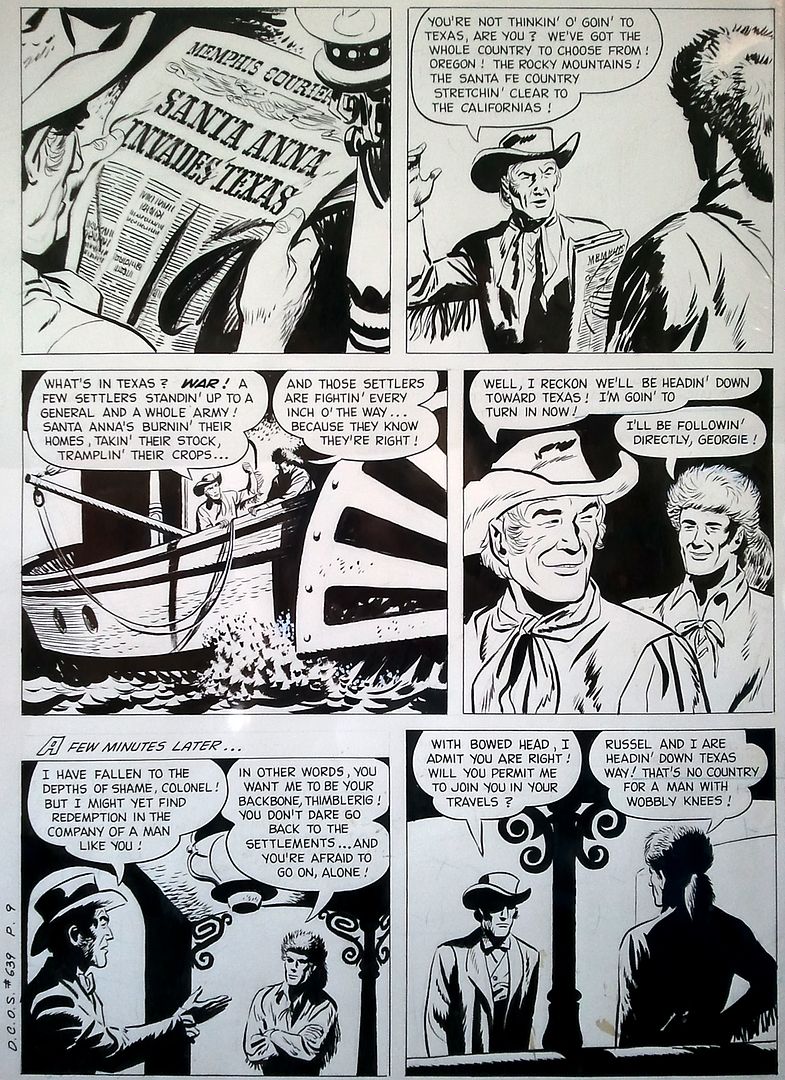
As it happens, Mega Collector is recently the proud owner of a large panel from "Davy Crockett, the Comic" that was drawn in 1955 to aid and abet the television mini-series/ theatrical movie of the same name ... when Davy Crocket wasn't just a craze but close to a national religion.

Meg doesn't know who the artist of these panels is, but he knows that the comic is uber nostalgic for a chosen few ...

Click here to read entire post

Sunday, April 01, 2012

Of Birthday Parties, Leverage, and Picket Signs

Disneyland Paris notes a milestone with Disney-type festivities:

Disneyland Paris celebrated its entry into adulthood in spectacular style this weekend, with a 20th birthday extravaganza replete with celebrities, parades and a new state-of-the-art show.

The resort 35 kilometers (about 22 miles) east of Paris has a lot to celebrate. After overcoming a rocky childhood, the "Magic Kingdom" now makes up a chunk of the French economy and of Disney's own revenues. ...

It's nice to see that the parks have stabilized, in contrast to the horrid days of 1994 when the place was in financial free-fall. (The '94 drama presents us with another fine lesson in "You get what you have the leverage to get.")

By the start of 1994, with the company [EuroDisney] in serious financial difficulties, and rumors circulating the the park was on the verge of bankruptcy a series of emergency crisis talks were held between the banks and backers.

Everything came to a head during March 1994 when Team Disney offered the banks an ultimatum, that Disney would provide sufficient capital investment for the park to continue to operate until the end of the month, but unless the banks agreed to restructure the $1bn debt that the park's construction and operation had run up, the Walt Disney company would close the park, and walk away from the whole European venture, leaving the banks with a bankrupt theme park and a massive expanse of virtually worthless real estate.

EuroDisney then forced the banks' hands by calling the annual stock-holder meeting for March 15th. Faced with no alternative other than to announce to the stock holders that the park was about to close, the banks started looking for ways to refinance and restructure the massive debts. Then to further increase the pressure on the banks, Michael Eisner, Disney's CEO, went public shortly before the stock-holder meeting and announced that Disney were planning to pull the plug on the venture at the end of March 1994 unless the banks were prepared to restructure the loans.

Finally on March 14th, just before the annual meeting the banks capitulated, and agreed to Disney's demands, effectively writing off virtually all of the next two years worth of interest payments, and a three year postponement of further loan repayments. ...

Back to 2012: No bankruptcies in sight, but there appears to be some discontent percolating at the Magic Kingdom, Paris.

Unions representing workers at the Disneyland Paris complex, operated by Euro Disney SCA (EDL), have called for a 48-hour strike, starting today, in a dispute over salaries and benefits, French newspaper Les Echos said, citing union representatives.

The strike was called by a group of four unions that are seeking a pay increase of at least 4 percent, while the company has proposed a 1.5 percent raise, the newspaper said.

I've no idea if the unions have the kind of leverage Michael Eisner did eighteen years ago, but this is France, so I guess we'll see.

Click here to read entire post

PIMCO Predictions

Sunday night's investment post, where Mr. William H. Gross of Newport Beach, California -- and the commander of the TAG 401(k)'s PIMCO Total Return -- gives us his thinking.

* When interest rates cannot be dramatically lowered further or risk spreads significantly compressed, the momentum begins to shift, not necessarily suddenly, but gradually – yields moving mildly higher and spreads stabilizing or moving slightly wider.

* In such a mildly reflating world, unless you want to earn an inflation-adjusted return of minus 2%-3% as offered by Treasury bills, then you must take risk in some form.

* We favor high quality, shorter duration and inflation-protected bonds; dividend paying stocks with a preference for developing over developed markets; and inflation-sensitive, supply-constrained commodity products. ...

At the end of the piece, Mr. Gross gets down to brass tacks about what investors should focus on:

For bond markets: favor higher quality, shorter duration and inflation protected assets.

For stocks: favor developing vs. developed. Favor shorter durations here too, which means consistent dividend paying as opposed to growth stocks.

For commodities: favor inflation sensitive, supply constrained products.

And for all asset categories, be wary of levered hedge strategies that promise double-digit returns that are difficult in a delevering world.

... [S]econdly, be mindful of investment management expenses. Whoops, I’m not supposed to say that, but I will. Be sure you’re getting value for your expense dollars.

I encounter a number of 401(k) participants who say they know little to nothing about investing, and have little interest in learning. (Totally understandable, but a wee bit short-sighted, since it's their future to which they are giving short shrift.)

Happily, inside TAG's 401(k) Plan, there are some strategies that hit many of Bill Gross' points. And they don't take a lot of heavy research or work to implement.

1) If you use PIMCO total Return, you will get a successful, actively managed bond fund that has had good performance numbers for multiple years.

2) If you use any of the Vanguard Target Fund series, you will acquire intelligently-constructed "Funds of Funds" that have ultra low-cost asset allocations of less than 1/5 of a percent (PIMCO, despite its success, is considerably higher than that.)

My basic recommendation has stayed pretty much the same over time: If you're at a loss over where to stick your money, think about the Vanguard Target Retirement Income Fund. It gives you a 30% exposure to broadly diversified stocks, a chunk of Treasury Inflation Protected Securities (which Bill Gross recommends) and a big slice of the Total Bond Market Index*, which concentrates on high-quality bonds and doesn't have a super-long duration (Five years.)

But what kind of portfolio can you build from TAG 401(k) pieces that hits most of what Mr. G. is talking about? How about ...

50% -- Vanguard Target Retirement Fund -- (cost: .17%)

25% -- PIMCO Total Return -- (cost: .69%)

25% -- American Funds Euro Pacific Growth Fund -- (cost: .55%)

Like most 401(k) Plans, TAG doesn't offer a fund that is a pure developing market play. (Common wisdom deems this too risky.) But over-weighting foreign stocks will capture a slice of emerging markets.

As for investing in commodities, you'll have to do that outside a 401(k) Plan. Because all or most Defined Contribution plans stay away from them.

* PIMCO and Vanguard Total Bond Index are both intermediate bond funds. PIMCO is actively managed; Vanguard is passively managed, tracking a bond index. To lower costs for the above three-fund suite directly above, you could simply allocate 75% to Vanguard Target Income, and 25% to the Euro Pacific Growth Fund.

Click here to read entire post

Foolish Foreign Derbies

... The Lorax gallops along.

Blanketing the foreign theatrical circuit over the weekend, Wrath of the Titans easily displaced The Hunger Games as the No. 1 box office attraction overseas, opening to an estimated $78 million at some 13,900 screens in 60 territories. ...

Dr. Seuss’ The Lorax, Universal’s 3-D animation adapted from the classic children’s book, finished No. 3 after opening in 17 markets including Mexico (No. 2 with $2.7 million from 542 sites). Weekend overall provided $14.5 million drawn from 4,100 playdates in 43 markets. Overseas cume stands at $37.7 million. ...

Lorax has now made $227.3 million globally, more than triple its production cost.

Click here to read entire post
Site Meter