Showing posts sorted by relevance for query recession. Sort by date Show all posts

Monday, September 22, 2008

Interesting Times

Another short detour away from animation.

Economist Nouriel Roubini, who has been pretty much dead-on about all things economic over the past few years, held forth in yesterday's Financial Times:

The shadow banking system is unravelling

By Nouriel Roubini

Last week saw the demise of the shadow banking system that has been created over the past 20 years. Because of a greater regulation of banks, most financial intermediation in the past two decades has grown within this shadow system whose members are broker-dealers, hedge funds, private equity groups, structured investment vehicles and conduits, money market funds and non-bank mortgage lenders.

Like banks, most members of this system borrow very short-term and in liquid ways, are more highly leveraged than banks (the exception being money market funds) and lend and invest into more illiquid and long-term instruments. Like banks, they carry the risk that an otherwise solvent but liquid institution may be subject to a self­fulfilling and destructive run on its ­liquid liabilities.

But unlike banks, which are sheltered from the risk of a run – via deposit insurance and central banks’ lender-of-last-resort liquidity – most members of the shadow system did not have access to these firewalls that ­prevent runs.

A generalised run on these shadow banks started when the deleveraging after the asset bubble bust led to uncertainty about which institutions were solvent. The first stage was the collapse of the entire SIVs/conduits system once investors realised the toxicity of its investments and its very short-term funding seized up.

The next step was the run on the big US broker-dealers: first Bear Stearns lost its liquidity in days. The Federal Reserve then extended its lender-of-last-resort support to systemically important broker-dealers. But even this did not prevent a run on the other broker-dealers given concerns about solvency: it was the turn of Lehman Brothers to collapse. Merrill Lynch would have faced the same fate had it not been sold. The pressure moved to Morgan Stanley and Goldman Sachs: both would be well advised to merge – like Merrill – with a large bank that has a stable base of insured deposits.

The third stage was the collapse of other leveraged institutions that were both illiquid and most likely insolvent given their reckless lending: Fannie Mae and Freddie Mac, AIG and more than 300 mortgage lenders.

The fourth stage was panic in the money markets. Funds were competing aggressively for assets and, in order to provide higher returns to attract investors, some of them invested in illiquid instruments. Once these investments went bust, panic ensued among investors, leading to a massive run on such funds. This would have been disastrous; so, in another radical departure, the US extended deposit insurance to the funds.

The next stage will be a run on thousands of highly leveraged hedge funds. After a brief lock-up period, investors in such funds can redeem their investments on a quarterly basis; thus a bank-like run on hedge funds is highly possible. Hundreds of smaller, younger funds that have taken excessive risks with high leverage and are poorly managed may collapse. A massive shake-out of the bloated hedge fund industry is likely in the next two years.

Even private equity firms and their reckless, highly leveraged buy-outs will not be spared. The private equity bubble led to more than $1,000bn of LBOs that should never have occurred. The run on these LBOs is slowed by the existence of “convenant-lite” clauses, which do not include traditional default triggers, and “payment-in-kind toggles”, which allow borrowers to defer cash interest payments and accrue more debt, but these only delay the eventual refinancing crisis and will make uglier the bankruptcy that will follow. Even the largest LBOs, such as GMAC and Chrysler, are now at risk.

We are observing an accelerated run on the shadow banking system that is leading to its unravelling. If lender-of-last-resort support and deposit insurance are extended to more of its members, these institutions will have to be regulated like banks, to avoid moral hazard. Of course this severe financial crisis is also taking its toll on traditional banks: hundreds are insolvent and will have to close.

The real economic side of this financial crisis will be a severe US recession. Financial contagion, the strong euro, falling US imports, the bursting of European housing bubbles, high oil prices and a hawkish European Central Bank will lead to a recession in the eurozone, the UK and most advanced economies.

European financial institutions are at risk of sharp losses because of the toxic US securitised products sold to them; the massive increase in leverage following aggressive risk-taking and domestic securitisation; a severe liquidity crunch exacerbated by a dollar shortage and a credit crunch; the bursting of domestic housing bubbles; household and corporate defaults in the recession; losses hidden by regulatory forbearance; the exposure of Swedish, Austrian and Italian banks to the Baltic states, Iceland and southern Europe where housing and credit bubbles financed in foreign currency are leading to hard landings.

Thus the financial crisis of the century will also envelop European financial institutions.

The writer, chairman of Roubini Global Economics (www.rgemonitor.com), is professor of economics at the Stern School of Business, New York University .

Roubini predicts that the hedge funds -- all of them leveraged to the gills -- will be taken down next, and we'll be slogging through a dandy recession (We're traipsing through the shallow end already.)

There be rough seas, ahead, maties. Plan accordingly.

Click here to read entire post

Friday, May 03, 2013

British Austerity and Tax Breaks!

F*ck, YEAH!

... While TV and animation legislation is being implemented in the UK, the introduction of the games tax break was dealt a set-back two weeks ago when the European Commission said it would investigate whether developers in the UK really need one.

“There is no obvious market failure in this dynamic and growing sector,” said the EC at the time.

But Osborne brushed aside any concerns, calling the games element of the new subsidies package as simply an “unfinished story” that will go on to grow the overall creative sector’s £36bn value and vast 1.5m employment base. ...

Tax breaks form an important part of the current UK government’s overall economic policy.

While implementing a deep austerity strategy, the coalition is pursuing international investment as an answer to domestic debt problems, hence the allure in fighting to win back TV productions, animation deals and game studio jobs.

It's a fine, double-barreled approach to Britain's double dip recession. Subsidies for companies, benefit cuts for the poors. The U.K.'s GDP is growing, after all.

Britain’s economy avoided entering an unprecedented — and politically damaging — third recession in five years, according to official estimates released Thursday. ...

Although the economy has been broadly flat for the past 18 months, Britain’s chancellor of the exchequer, George Osborne, was able to argue on Thursday that there were reasons to be encouraged by the small uptick in the country’s gross domestic product.

The rise in G.D.P. was in comparison to the previous three-month period, when the economy contracted by the same amount, the Office for National Statistics said. Two consecutive quarters of contraction constitute a recession. ...

Make no mistake, the confidence fairies have returned and surging economic growth is finally on the way!

Subsidies forever!
Click here to read entire post

Sunday, November 09, 2008

IATSE and AMPTP Negotiations Get Reanimated

In case you hadn't heard, our Mother International and the Alliance of Motion Picture and Television Producers return to the negotiating table on Monday next. For those just tuning in, this isn't the maiden voyage for these particular set of contract talks:

The AMPTP and IATSE held the last round of talks in April -- more than a year before the conclusion of the current deal, which expires in August 2009 and covers about 25,000 West Coast workers in 18 locals. Both sides said at the the time that those talks covered new media, minimums and the pension and health plans.

The IA hosted an informational meeting for local union reps last week. Nobody needed to know what proposals were on the table, because everyone found that out last April when the negotiations started. (Here's a five-word hint if you might be wondering: wages, benefits, new media.)

What we were (mostly) there for was an update on how the Motion Picture Industry Pension and Health Plan was faring.

The Good News: The Plan is doing better than most. Its investment assets are conservatively invested, and the billions now residing in stocks, bonds, real estate and a few other things haven't taken the hit that the broad U.S. and foreign stock markets have.

The Bad News: Plan investments have taken a hit. They're down roughly 12-15% from the beginning of the year.

The Other News: The Motion Picture Industry Health Plan is experiencing an increase in costs of around 9% per year. Going forward, this will probably mean some changes are going to happen over the next contract cycle. (This has been the standard mantra for as long as I've been doing this. Costs hardly ever go down.)

One of the questions asked during the meeting: Is the big corporate downturn of the last two months going to impact the talks?" One of the older and wiser heads noted:

"Sure, they'll use the recession and downturn as a reason not to give us anything, as a reason for rollbacks. But look, the producers always have a reason they want rollbacks. If it isn't a recession, it's something else, like the business model is changing, or they're overstretched, or that we've got get along with less for the good of the industry.

"It's always some reason or another. The song and dance never changes, so don't expect it to be any different this time."

And of course the SAG talks are still hanging out there like a sagging branch on a diseased elm, and that won't likely be changing anytime soon.

The IATSE-AMPTP talks will occupy a good chunk of next week, and I'll be in attendance. But don't expect any details unveiled here until there's a deal in p;lace and all the mouth gags are removed.

Click here to read entire post

Saturday, October 04, 2008

Our Booming Economy

Robust economic activity for September. Not:

The U.S. economy lost 159,000 jobs in September, the worst since March 2003, the Labor Department reported Friday.

The economy has now lost 760,000 jobs this year, further evidence that the economy was in a recession even before the financial market crisis of the past few weeks.

Now that we've nationalized all the bad debts that investment banks and the rest of the gang created the past five years, I've got a fine solution.

We do what Sarah and John prescribe: Cut taxes.

If we cut those suckers to zero, especially for the upper brackets, we'll get this sorry-ass economy moving again. We're just not reducing taxes fast enough.

(Happily, the entertainment business is "recession proof". Everybody says so. And we believe that, right? Right?)

Click here to read entire post

Saturday, April 02, 2011

Working for the Conglomerates

The monster Hollywood companies are doing well.

The opening quarter of 2011 saw the shares of a range of entertainment conglomerates hit new multiyear highs as double-digit gains for all sector biggies except Sony Corp. outpaced the broad-based S&P 500 stock index.

The conglomerates' gains, led again by CBS Corp., continued the upward trend that many entertainment stocks had seen in 2010 and even 2009 ...

Of course, many entertainment employees further down the food chain aren't doing so nicely. The big unions and guilds (DGA, SAG, WGA, IATSE) have been taking 2% pay boosts and negotiating to protect their pension plans. TAG tracks wages of members and guess what? Nobody has been getting increases the last few years. Mostly it's "cut this" and "lower that" and "Don't you know we're in the middle of a recession?"

Well, yeah. We are in a recession (or were very recently.) And all the companies are happy to take advantage of the fact that the people working for them are hunkered down in defensive crouches.

"You want to drop my take-home pay by 15%? Sure, why not? I'm just happy I've got a job ..."

In the 1930s, workers got pushed to the wall long enough and hard enough that they finally started pushing back. In 2011, push-back is happening in Wisconsin and some other places, but it isn't yet happening in Tinsel Town. Everybody knows what the unemployment statistics are, and not rocking the boat is the Thought for the Day. I even had one animation artist, working at a small, non-union studio tell me:

"I know I'm not getting great pay, and that the health bennies are weak, but I like working at a little place. Less pressure, you know? More friendly. I never liked working for a conglomerate anyway. They're too big, too impersonal. I like the vibe here."

Of course, the guy was working for a shop that sub-contracted work from a conglom, so in reality he was working for the same multi-national that the hard-pressed union employees were. He was just earning less money and benefits.

But I was polite, and didn't point these things out. It would have just ticked him off. But I'll be talking to him again when he fully processes how he's getting hosed and he's ready to push back. When that day comes -- and the way things are rolling the date will occur sooner rather than later -- I'll give him a representation card.

Click here to read entire post

Friday, February 06, 2009

Layoffs ... Micro and Macro

Now with fine, stimululated Add On ... now including the fine chart above, from Calculated Risk.

While theatrical animation still employs many and the work situation hasn't declined precipitously (unlike other segment of the U.S. of A.), television staffing at many local studios remains spotty. Nick has a goodly number of projects, but other studios? Not so much.

TAG records show that 2,506 people are employed by contract studios, but of course those stats wouldn't reflect the 150 employees of Imagi who are recently unemployed.

Imagi's staff is still on layoff, the company still floundering. Word reaches us that some employees have been asked to come into work on Monday and will be paid, but misinformation is rampant. Some employees wonder if the studio will reopen.

Meanwhile, unemployment nationwide is grim and getting grimmer ...

• Total job losses since the recession started in December 2007: 3.6 million;

• Over the past 12 months, the number of unemployed persons has increased by 4.1 million;

• Losses over the last three months: 1.8 million (Jan = 598, Dec = 577k, Nov = 597k);

• Unemployment rate for full-time workers spiked to 8%;

• For the first time since records began in 1939, there were three consecutive months of 500k + job losses;

• Job losses were broad based, with the diffusion index down to an all-time low of 25.3%;

• Household survey showed a record 1.24 million job plunge (Since data began in 1950)

• The calendar year 2008 saw 3 Million Job Losses;

• The employment-population ratio fell to 60.5%, down from 62.7% at the beginning of the recession, — the lowest rate since 1986.

• Unemployment rate: 16-year high (1992);

• January’s payroll drop of 598,000: most since December 1974;

• Payroll Revisions for 2008 were 400,000 more than initially announced;

• The 3.5 million job loss since January 2008 is the largest 12-month decline since the government started compiling those figures in 1939;

• U-6 Marginally attached and involuntary part-time workers: 13.9% last month — up almost five percent;

• The employment-to-population ratio was the lowest since 1986.

Happily, it looks like a stimulus bill is near at hand. Unhappily, it will probably need to be larger than it is.

Add On: Short Stimulus Tutorial.

There's a lot of hot air wafting through Congress right now as left and right battle over what kind of "Stimulus Package" provides the best stimulus. The GOP argues that tax cuts will do the trick; the Dems feel that direct government spending is the way to go.

First, let's hear from left-leaning Nobel economist Paul Krugman on where we are:

According to the CBO’s estimates, we’re facing an output shortfall of almost 14% of GDP over the next two years, or around $2 trillion. Others, such as Goldman Sachs, are even more pessimistic. So the original $800 billion plan was too small, especially because a substantial share consisted of tax cuts that probably would have added little to demand. The plan should have been at least 50% larger.

Now the centrists have shaved off $86 billion in spending — much of it among the most effective and most needed parts of the plan. In particular, aid to state governments, which are in desperate straits, is both fast — because it prevents spending cuts rather than having to start up new projects — and effective, because it would in fact be spent; plus state and local governments are cutting back on essentials, so the social value of this spending would be high.

The more conservative Mark Zandi agrees the stimulus by the government must be large, but he's not as adament as Krugman regarding the size and spending/taxing breakdown:

The stimulus must be large, approximately $750 billion, equal to a little less than 5% of GDP ... The mix of tax cuts and spending boosts ... should be designed to provde both quick relief and a substantial boost to the struggling economy ...

Of course, Zandi wrote his piece a month ago, and the economy has continued to deteriorate. So what packs a bigger punch? Tax cuts or government spending. This Moody's chart -- also from Zandi -- is instructive.

Fiscal Bang For the Buck

One-year $ change in real GDP per dollar ($) reduction in federal tax revenue or increase in spending.

Tax Cuts

Non-refundable lump sum tax rebate: $1.02

Refundable Lump sum Tax Rebate: $1.26

Spending Increase

Extend Unemployment Insurance Benefits: $1.64

Temporarily Increase Food Stamps: $1.73

Increase Infrastructure Spending: $1.59

Me, I come down on the side of spending, because that's what is going to lift us out of this fetid trench and get us back on a growth track ... get people back to work. The data is pretty compelling. When you get two high-powered economists -- one a liberal and one an advisor to John McCain's recent presidential campaign -- in agreement about the stats, how could it be otherwise?

Click here to read entire post

Tuesday, December 02, 2008

Market Wisdom

Yesterday the TAG 401(k) Plan had its quarterly board meeting. Along with other board business, trustees reviewed Plan assets.

Lord God but they've taken a beating.

Domestic and foreign equity funds are down 20%, 30%, and 40%. One look at the Plan's bar graphs showing where investment money is going and it's obvious that participants are retreating into fixed income investments and bailing out of anything that has the word "stock" attached to it.

This is totally understandable and completely human. Also mostly wrong. Economist John Hussman explains why:

The bottom line is simple. Stocks are a claim on a long-term stream of future cash flows. Even if one allows for a terrible and surprisingly deep continuation of the current recession, stocks appear reasonably priced or undervalued based on a careful analysis of long-term cash flow prospects ...

It's easy for people to forget this underlying reality when the market is going to hell in a major way. (Dr. Hussman has a lot more to say on the subject, so click through and read his entire post.)

If you're in the mid fifties or the first half of your sixties, you've got every reason to be a little ... ah ... concerned about the $250,000 that you so carefully and painstakingly tucked away melting down to half that. Because like, you don't have thirty years of career left to build it back up again.

But if you're on the sunshine side of forty, then hey. The tanking of worldwide equity markets is a fine buying opportunity. Your time horizon stretches out for decades, and buying pieces of top-flight companies at deep-discount prices might never come again. Take advantage of it while you can.

Of course, it's hard to remember this when you turn on your Apple in the morning and discover that you've lost another two thousand dollars over the previous twenty-four hours. You start to get queasy. All you want to do is put your dough in some money market account paying 2.5% and stay in bed until the recession is over.

But try to remember Dr. Hussman's analysis and act on it. Long term, you can profit from the current economic crapfest -- assuming your stomach is strong enough -- if you start dollar cost averaging back into the stock market.

Click here to read entire post

Thursday, September 08, 2011

Employment, Unemployment

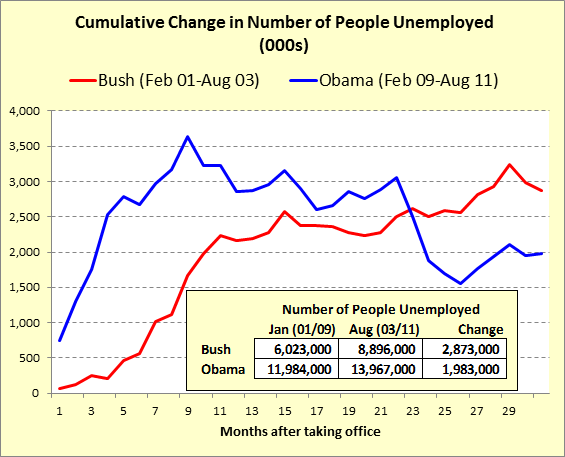
One of my best friends, economist John Hagens (also a former Republican council member for the borough of West Chester, PA) sent me this handy chart and short article today about Presidents Bush and Obama's performances over their first two years in office. Since "Jobs, JOBS, JOBS!" is much in the news right now, I pass it on for your review:

... Pundits are evenly divided over whether or not we have entered another recession, but pundits almost never get the future right. What we do know is that 14 million people were defined as unemployed by the Bureau of Labor Statistics in August 2011. Millions more have stopped looking for work or have taken part time instead of full time positions. As the months go by, we digest the economic news and wonder when matters will brighten. It is sometimes forgotten that just ten years ago, before the boom-boom years of the housing market, but also as the nation recovered from the shock of 9/11, the U.S. jobs machine was sputtering. The attached diagram compares the unemployment record during the first 31 months in office for Presidents Bush (red line) and Obama (blue line) ...

President Bush entered office In January 2001 with 6 million people unemployed, steadily rising first rapidly then more slowly to almost 9 million people by August of 2003. During this mild recession period the unemployment rate rose from 4.2% to 6.1% as 2.9 million people became unemployed. President Obama began his term when the economy was in freefall as the collapse of the financial market in 2008 took its toll. The number unemployed was already a staggering 12 million in January 2009 and continued to rise rapidly before peaking at 15.6 million in October of 2009. In total 3.6 million jobs were lost during the first 10 months of Obama’s presidency. Since then, the number unemployed has dropped, in fits and starts, by 1.5 million.

Determining the right policies to battle unemployment are debated endlessly, likely without resolution. Is a shortage of demand for goods and services the problem and will another round of fiscal expansion get employment growing again? Or is it uncertainty and excessive regulation and taxation that are holding back businesses from hiring more people? Or has the U.S. economy undergone a structural change, with the jobs lost unlikely to return as our workers are replaced by less costly foreign workers? What seems true is that the U.S. economy has recently taken a very long time to heal after a downturn and that finger pointing and holding to strident policy positions aren’t productive in getting people back to work. Deploying policies that address all three questions seems most productive.

-- John Hagens | Managing Director | International Planning & Research (IPR)

We'll get to see over the next several months and years how America manages its recovery. But this is a pretty good representation of what's happened in the recent past.

Click here to read entire post

Wednesday, April 06, 2016

Cartoon Troubles on the Iberian Peninsula

Things might be ducky for animation in the U.S. of A., but there's some turbulence just now over in Spain.

... Spain ranks as the fifth-largest animated feature producer in the world, making 28 movies over 2010-14, when its animated pics sold more tickets outside Spain (11.3 million) than France (8.6 million) did.

Wracked by economic recession, Spain’s TV animation sector is something of a different story. Its main broadcasters aired close to 2,400 hours in 2009 and under 500 hours in 2013. The economic crisis, which halved TV advertising, and shows migrating to niche channels for children could be reasons. ...

But Spanish companies are looking to markets beyond Europe: the U.S. and China. Spain’s Ilion Animation Studios is producing a 3D tentpole animated feature for Paramount Animation. A China-Spain project was announced on March 5 — “Bikes the Movie,” directed by Manuel Javier Garcia (“Tombatossals, la leyenda”) and co-produced by Valencia’s Animation Bikes AIE and Chinese conglom CVC Group. ...

A lengthy Spanish recession that takes money out of consumers' pockets might be some of the reason for Spanish animation's doldrums. Four years ago, unemployment was 27%, horrific by almost any standard. It's slowly come down since then, but it still stands at 20%.

Like lots of other countries (and states) Spain is banking on tax breaks -- the every-popular Free Money gambt -- will help goose the domestic animation industry.

Click here to read entire post

Saturday, March 07, 2009

Meltdown on a Personal Level

Lately, the financial news has been uniformly crappy. When companies run out of customers and cash, they tend to implode. And as economist Noruierl Roubini notes, we're imploding:

The global recession may continue until the end of 2010 as the response by governments to rectify it is “too little, too late,” said Nouriel Roubini, the New York University professor who predicted the financial crisis.

“Governments are falling behind the curve,” Roubini said at the India Today Conclave in New Delhi today. “This recession can end up becoming even worse.” ...

The cratering economy has treated me like everybody else, and I've taken painful hits right in the middle of my retirement funds. As an added treat, I also get to field phone calls from members who are freaking out ...

A week ago, an artist close to retirement called and told me, "I don't know a lot about investing, and my brother talked me into using a broker he said was very good. The man made me money for seven years, but the last nine months, I've lost half my savings. He's got me 100% in stocks, and when I call to ask him to move some of it to bonds, he yells at me to stay with what I've got, that I'll be fine, and stop watching financial news since it gets me upset."

I pointed out to him that the broker works for him, not the other way around, and that it's his money, not the stock jockey's. Also that it was unwise to be totally in stocks when you were on the cusp of retirement. He didn't disagree.

Another member wanted to take her 401(k) money and buy a house. I said that since home prices were still going down, she might want to wait a while on the big purchase.

Tonight I talked to one of my oldest friends, an economist with a PhD from Cornell and a going consulting business. He's been on the President's Economic Council and he keeps up with the policy makers in Washington. He told me the following:

"Anybody who tells you they know where the market is going is full of it. Roubini has been predicting disaster for years, and now he's right, and that makes him the man of the hour. I've got most of my money in cash, sitting on the sidelines. I don't know where the bottom is, and nobody else does either."

"I listened to Geithner, the secretary of the Treasury, on C-Span last night. Listened to him for hours. He does a good job of explaining overall government policy but a bad job of explaining how to rescue the banks. They're trying hard not to nationalize the financial sector, but the marketplace thinks they will nattionalize, so the marketplace has taken bank stocks down to almost zero. There's no confidence."

We're in a fustercluck and I think we're going to be there awhile, but I sure as hell don't have a PhD to back my opinions up. The one thing I do know: artists have got to educate themselves about basic investing so they can make semi-inteligent decisions all by themselves.

What I've told people for freaking yours is, invest at your comfort level. If you freak out over losing momney with stocks, maybe you should be in a money market and maybe a few bonds. It's better to get lower returns and be able to sleep at night. But here's a few basic rules that I'd follow in March, 2009:

If you're in your mid fifties or older, be weighted more to bonds and cash. (60-90%, depending on your intestinal fortitude.)

If you're forty to fifty-five, have a bond/stock split of 50%/50%.

If you're thirty to forty, have a bond/stock split of 40%/60%.

And if you're somebody that just can't take the whipsaws of the stock market, can't stomach it going down, down, DOWN, then keep everything in money market funds, stable value funds, and bonds. You won't get much in the way of returns if the stock market spikes, but you won't be in the bathroom hurling, either.

The thing of it is -- and I write this to give you comfort -- almost everybody has taken it in the shorts. A trustee on the Motion Picture Industry Pension and Health Plans recently told me: "A year ago, the Plan's money managers said something funky was happening with the markets, and the trustees voted to shift investments to more conservative investments -- which was, as it turned out, a good thing to do.

"But I listened to these guys and I didn't do the obvious thing with my persona accounts. I should have gone home to my wife and said: 'Honey, let's move all this stuff to money market funds and C.D.s, wait a year and see what happens.'

But I didn't do it. Even with all the expert advice I was listening to on the Pension Plans, I kept my own investments where they were. Turned out to be a not great thing to do ..."

The point of this long ramble is: Nobody has the final answer. Nobody knows where stocks or bonds will be in a year, nobody can say with certainty if the banks will be solvent. But you can educate yourself, make informed estimates about where the economy is going, and protect yourself with some knowledge. In the end, only you can know what's best for you.

Simply saying: "I'm an artist, I'm no good with numbers, I'll turn my investments over to somebody else" is not a good option. Investment advisors might be smart and well-informed, but their long-term needs and goals probably don't align with yours.

Be the captain of your own ship. Have a "Plan A" at the ready, also a "Plan B", "C", and "D". Because, when you scrape away al the media hoo ha, all the blather from various economic gurus, it comes down to this: your personal future is too important and valuable to subcontract out to somebody else.

Click here to read entire post

Saturday, October 10, 2009

Pension Plans, Pension Saving

Now a short side trip into the land of retirement pensions.

Time Magazine has a new article out about how 401(k) Plans aren't all they're cracked up to be:

The ugly truth ... is that the 401(k) is a lousy idea, a financial flop, a rotten repository for our retirement reserves. In the past two years, that has become all too clear. From the end of 2007 to the end of March 2009, the average 401(k) balance fell 31%, according to Fidelity. The accounts have rebounded, along with the rest of the market, but that's little help for those who retired — or were forced to — during the recession. In a system in which one year's gains build on the next, the disaster of 2008 will dent retirement savings long after the recession ends ....

I'm not as down on 401(k) Pensions Savings Plans as TIME-Warner is, although I concede that if you think a 401(k) and Social Security are going to be all you'll need for a comfortable, secure retirement, you're kidding yourself.

Animation artists who manage to work twenty or thirty years in the Motion Picture Industry Pension Plan and tuck away money in a 401(k) are going to be in relatively good shape when they hit sixty-five and their high earning years have drifted astern.

They'll end up with three Pension accounts plus Social Security. That won't land them at parity with their industry salary, but they'll (hopefully) be at the 60% mark. Of course, my advice is monotonously the same, year in and year out: Put as much loot away as you can, as early as you can. Diversify. And try like hell not to touch your core retirement stuff, because you don't know what the morrow brings.

Plan for the Best and expect the Worst.

Click here to read entire post

Monday, December 22, 2008

Why Organized Labor Is Kind of Important

I should have caught this days ago, but didn't:

...In the immediate aftermath of Pearl Harbor, [Walter] Reuther, then head of the [UAW] union's General Motors division, came up with a detailed plan for converting auto plants to defense factories more quickly than the industry's leaders did. At the end of the war, he led a strike at GM with a set of demands that included putting union and public representatives on GM's board ...

In 1949, a pamphlet was published that argued that the American auto industry should pursue a different direction. Titled "A Small Car Named Desire," the pamphlet suggested that Detroit not put all its bets on bigness, that a substantial share of American consumers would welcome smaller cars that cost less and burned fuel more efficiently.

The pamphlet's author was the research department of the United Auto Workers ...

The UAW not only built the American middle class but helped engender every movement at the center of American liberalism today -- which is one reason that conservatives have always held the union in particular disdain ...

Now you can believe what Meyerson writes, or you can dismiss him as another pinko lib, but here's the reality of what's going on today:

For the past thirty years, there has been a general philosopy that everybody would be better off if "government got out of the way." If regulations were lightened or, better yet, eliminated.

If market forces were allowed to work their magic and make the country bigger, better, and richer. No need for regulation or any horrid redistribution of wealth. Markets were magical ... and self-correcting.

Republicans believed it. Lots of Democrats believed it.

And here we are.

The financial and economic crash of 2008, the worst in over 75 years, is a major geopolitical setback for the United States and Europe. Over the medium term, Washington and European governments will have neither the resources nor the economic credibility to play the role in global affairs that they otherwise would have played. These weaknesses will eventually be repaired, but in the interim, they will accelerate trends that are shifting the world's center of gravity away from the United States.

A brutal recession is unfolding in the United States, Europe, and probably Japan -- a recession likely to be more harmful than the slump of 1981-82. The current financial crisis has deeply frightened consumers and businesses, and in response they have sharply retrenched. In addition, the usual recovery tools used by governments -- monetary and fiscal stimuli -- will be relatively ineffective under the circumstances ...

So how the hell did we get here? How did it come to this?

There were lots of causes; here are a few of the major drivers of the debacle:

We stripped away the rules that kept banks and investment companies honest. (When the government allows Godlman Sachs to leverage investments 40 to 1, GS is delighted to do it, figuring they're smarter than everybody else, and if things start to head south, they'll get out and let the suckers hold the bag of crap. Didn't exactly work out that way, of course. Goldman Sachs got swept up in the disaster it helped create, and has now converted its businesses so it can receive Federal handouts. Socialism for the Investor Class! Fuck Yeah!)

We allowed the minimum wage to become ludicrously low relative to the purchasing power it had forty years ago.

We undercut unions' abilities to organize newer businesses by non-enforcement of labor laws. Since unions tend to drive wages up, pay rates stagnated.

We provided financial incentives to ship manufacturing offshore, ship service jobs offshore, ship brainpower offshore.

No doubt people will argue about specific causes, whether it was more of this and less of that. What's hard to argue is that we are today in a deep, deep economic hole ... and sizable sections of the American middle class are melting away.

What's also hard to argue is that without a middle class, the "American Standard of Living" will cease to exist, because without a population that has money to buy things and send their children to college and generally make their lives better ... thereby lifting the American economy ... we turn into Mexico, India, or Brazil.

We end up with a wealthy oligarchy that lives well in gate-guarded communities and drives expensive cars, with everyone else eking out their various meager existences in small, rented houses and one-bedroom apartments, eating a lot of meatloaf sandwiches.

But enough sweeping generalizations. Let me boil it down to specifics in this narrow, neck of the woods known as the Animation Industry.

When I rolled in here nineteen years ago, the Animation Guild and the cartoon business were on their mutual keesters. We had about seven hundred active, working members. General unemployment was high. Non-union animation work was everywhere (DIC at the time was huge, paying $500 a week for storyboard work, half the union minimum.)

Over the next few years, through happy accidents, also the efforts of various artists, we ended up signing contracts with a lot of studios and repping about 85% (give or take) of the cartoon business. Plus the business was roaring, and a lot of the cut-rate 'toon factories were forced to raise wages in order to hire people qualified to get needed work done.

Like I say, happy accidents.

And then the business went really crazy, and industry wages went through the roof and then the upper atmosphere, and people said to me:

"Heey now! What do we need union minimums for? I'm earning double the damn minimums! And my best friend's making triple! Hot damn!"

People began thinking it was the natural order of things. And would last forever.

But it wasn't ... and didn't. And now we're paddling along in the year 2008, and nobody thinks high wages are a birthright anymore.

In fact, a lot of people are pretty grim. Scared shitless, in fact. And grateful to have a job, any job. I know, personally, animation professionals bagging groceries and doing secretarial work and laboring as security guards at one-fifth their old salaries.

And every studio I know about, union and non-union, is cutting their labor costs every way they can. The non-union places are below the union minimums that they used to be above, and the union places are hiring at scale. But because a large number of skilled artists still work under union contracts, and we still have critical mass, the overall wage structure hasn't collapsed.

Over in auto-building land, the situation is a little different. The UAW, that long-ago builder of the American Middle Class, hasn't been able to organize foreign auto plants in Tennessee, in Alabama, and a number of other southern states that have "right to work" laws. The slope is just too steep for them to get the Toyota, Honda and Nissan plants organized, and so the foreign companies are happy to match UAW pay rates, even as they lowball benefits. And the UAW gets pretty much nowhere in making those Camry, Accord and Altima factories union.

But Senator Mitch McConnell and company are trying their best to disembowel what's left of the UAW. They've made a nice run at it the last month or so, and for a little while, it looked like they would succeed in taking the Auto Workers out. (Of course, it would have meant the Big Three Auto Makers would have gone bye-bye with the UAW, what's known on the battlefield as "collateral damage," but what the hell. Sometimes you gotta destroy an industry in order to save it.)

Now, happily, President Bush has decided he doesn't want to add "Goodbye to the Big Three" to the rest of his sparkling legacy, and so has overruled his Republican cohorts in the Senate and cut a deal with Chrysler and GM. So the companies will survive ... at least for another few months.

But who knows? Maybe Senator Mitch and those other Sons of the South will yet be successful in driving the UAW over a cliff. Maybe Ford, Chrysler and General Motors will slide into insolvency and oblivion anyway, and the Japanese and German car companies will have the United States all to themselves.

When and if that day comes, I'm reasonably certain the foreign car makers won't be paying wage rates that match UAW's workers, for those workers will be gone. They'll be paying less, probably far less, even though labor costs now are only 10% of a car's costs.

Why? Because the union that kept wages up will be gone, along with one more segment of the American middle class.

Click here to read entire post

Wednesday, December 31, 2008

Really Bad Predictions

...from Business Week (since we're in the finger-pointing mode down below in comments):

"A very powerful and durable rally is in the works. But it may need another couple of days to lift off. Hold the fort and keep the faith!" —Richard Band, editor, Profitable Investing Letter, Mar. 27, 2008

Good call, Dick. Except the markets had been gently declining for six months at that point ... and we know where they are now, don't we?

"I'm not an economist but I do believe that we're growing." —President George W. Bush, in a July 15, 2008 press conference

One more of the President's beliefs unsupported by ... you know ... facts. GDP shrank at .5% from July to September. And of course we were in a recession then, as we are in a recession now.

And to be fair and balanced -- we're not being partisan here -- there is Congressman Barney Frank's wrong analysis of Fannie and Freddie:

"I think this is a case where Freddie Mac (FRE) and Fannie Mae (FNM) are fundamentally sound. They're not in danger of going under…I think they are in good shape going forward." —Barney Frank (D-Mass.), House Financial Services Committee chairman, July 14, 2008

Sixty days further on, the companies were in receivership ...

And one more prediction, not from Business Week.

Bolt will do $120 million domestic, and double that overseas. It's gonna come close to $400 million in world box office." -- Steve Hulett

The dude was a tad optimistic on that one. The way it looks now, the white doggie won't hit the $120 million or $400 million markers.

Click here to read entire post

Monday, December 15, 2008

My Disney Q & A

So early last week I get a number of phone calls from staffers at Disney Animation Studio ... which pretty much goes like this:

"Hi. We've had some meetings over here, in the theatre. And management is telling us that the studio is going to a 45-hour workweek, but nobody is going to get their salaries rolled back, and some people will be getting wage bumps, and that some production support people are getting let go.

"Can they like, do that?"

My answer is yes, with a long-winded explanation. Then I get asked to come over and visit, and a few days later I do ...

When I walked into the hat building last Friday morning, most everyone I encountered had similar questions about the meetings earlier in the week, about why the studio is doing the 45-hour thing. I responded to questions for an hour and a half, the same way I did over the phone; below is a compilation of my answers, attached to the employee questions:

Q: At our meeting, they told us the studio's moving to a mandatory 45-hour week on our next picture. I thought the regular work-week was forty-hours. What gives?

A: I assume the studio's going to a forty-hour week with five hours of required, pre-paid overtime. They have the right to demand "reasonable" amounts of overtime from employees, so the forty-five hour work-week is certainly doable. (Unlike DreamWorks Animation, most Disney Feature employees work without personal service contracts and are "at will.")

Q: They told us that a lot of employees would be getting the same pay, but some of us would be getting pay hikes. What's up with that?

A: Based on what I've been told, over-scale employees are getting their hourly wages cut, since they are now working an extra five hours of overtime (calculated at 1 1/2 times their hourly rate) at the same weekly salary. So, their previous hourly rates -- based on the old forty-hour week -- would have to be trimmed to accommodate the new five hours of o.t. being built into the same weekly wage.

Q: Can the studio do that?

A: Sure the studio can do that, if you the employee remain above the collective bargaining agreement's minimum hourly rate for his or her classification. What they're doing -- and this is a rough calculation -- is cutting above-scale employees hourly wages by around 15%-18% when they build in the extra hours.

Q: And some people are getting a bump because ...?

A: Because they're working at scale ... or close to scale. And the studio has to increase their weekly salary because it's adding five extra hours at time and a half, and everybody has to stay above the minimum rates. So ... more money for them.

Q: Why is the studio making these changes?

A: I think they want to cut labor costs as much as possible. But they have to make the cuts within the parameters of the Collective Bargaining Agreement. Hence, scale employees receive more weekly pay, over-scale employees get lower hourly rates.

Q: They're not framing it quite that way.

A: I'm assuming they're putting a sunny spin on it. But they haven't confided in me, so I'm making an educated guess about their inner thoughts and motivations.

Q: Well, I'm happy I at least still have a job.

A: A lot of people have mentioned that. Great times we live in, huh?

Disney isn't alone in its Hollywood belt-tightening. We're in a recession, and every entertainment conglomerate is hack-hack-hacking away.

Click here to read entire post

Monday, March 19, 2012

Shrinking Health Coverage

I've been a part of the Motion Picture Industry Health Plan since the 1970s. And for the past decade-plus I've watched MPI insurance get more costly and less comprehensive year .. by year ... by year. Which isn't to say the insruance is bad, just ... less.

But participants in the MPIHP aren't the only ones who have been eating it:

The share of children and working-age adults who had insurance through an employer fell 10 percentage points during the last recession, according to a study released on Thursday by the Center for Studying Health System Change, a nonpartisan research group in Washington.

From 2007 to 2010, the share of children and working-age adults with employer-sponsored coverage fell to 53.5 percent from 63.6 percent, according to the study. ...

Employer-anchored health coverage started during World War II, got enshrined in law by President Eisenhower and a Republican Congress in 1953, and is now (pretty much) a shadow of its original self.

During the oncoming week, the IA and the AMPTP will arm-wrestle over who gets MPI Health coverage, who pays for it, and how extensive the coverage will be over the next three-year contract cycle.

Fun times.

I'm guessing, in a half-educated way, that participants will be doing premiums for the first time, the Plan's health offerings will be a bit skimpier, and that most people will learn (somehow) to live with it.

For as national trends go, so go we.

Click here to read entire post

Sunday, January 04, 2009

'Toons Beyond the Seas

As the world sinks into recession, animated features keep racking up big numbers:

Over the first weekend of 2009, "Madagascar 2" continued the trend of major returns on highly recognizable franchises as it easily won with $32.2 million at 6,771 playdates in 60 territories. Par's animated sequel has led foreign biz for three consecutive sessions and cumed $340 million in overseas coin -- $2 million ahead of the original "Madagascar." ...

Disney's "Bolt" with $11.9 million at 2,870 in 25 markets. ..."Wall-E," its top 2008 entry, led in Japan with $3.7 million in its fifth weekend, up 180%, to push foreign cume to $298 million ...

Univeral ... ended 2008 modestly with "The Tale of Despereaux" taking $5 milion at 1,815 in ten markets to push the 'toon's foreign cume to to $7 million ...

You will note that the big winners here were the domesticaly made features, most in California. ("Horton Hears a Who" -- created on the right coast -- did nicely for Fox).

As we've mentioned, Tinsel Town won't stop making movies that generate three-figure returns domestically and overseas. They are, after all, in the business to make money. As U.S.-produced animated features continue to rake in Big Bucks, domestic animated features will continue to get made.

Click here to read entire post

Wednesday, June 10, 2009

Should I Cash Out My 401(k) and Buy a House Now?

Uh ... no.

[Patricia] Hynes bought her three-bedroom home in Lancaster brand-new for $119,000 in 1989 ... Her home is an island in a sea of repos. Houses on both sides have fallen into foreclosure; one is priced $10,000 less than the amount she paid 20 years ago.

Nearby, a four-bedroom, 2,100-square-foot home sold in May for $89,000 ...

Another tsunami of foreclosures is threatening to swamp an already saturated market. In Palmdale and Lancaster, 903 homes were sold in April, but according to ForeclosureRadar, more than 7,500 are in some stage of foreclosure.

Some buyers who thought they were getting bargains didn't ...

I bring this up here (and now) because I've TAG had members call to ask if now is a good time to liquidate retirement funds to purchase a new abode.

I've told them: "Not yet. We're not at the bottom of this fustercluck, so why cash out of funds that have probably lost a bit of money so you can buy some real estate that will lose money faster?"

There will be a time to buy the new house or condo, but I don't think we're there yet. Give it another year. Maybe two.*

* For those of you unfamiliar with So Cal, Lancaster and Palmdale are out in the Antelope Valley, in the desert. There is lots of empty land out there, and whenever we go into a recession, the area's property values always tank.

Click here to read entire post

Wednesday, August 12, 2009

Cartoons Lift France

So even with the global recession, the French have flocked to their local cinemas ... but not to see the local product:

Ticket sales jumped 51.6% compared with July 2008 thanks to popular animated hits "Ice Age: Dawn of the Dinosaurs" and Disney/Pixar's 3D "Up," plus Warner Bros.' "Harry Potter and the Half Blood Prince." .

It's been 2 1/2 animated movies that have made all the difference in overall box office.

Good to see the sons and daughter of Napoleon appreciate the finer things.

Click here to read entire post

Tuesday, November 04, 2008

TeeVee Animation and Ratings

Okay, so Fox cancels, King of the Hill, and then:

... the animated laffer posted its best ratings in a year, averaging a 4.3 rating/10 share in adults 18-49 on Sunday night.

Oh my ...

It's a tough time for the conglomerates. There's a recession on. They want to cut costs down to the gristle and marrow. And then the cast-off series that they calculated had run its course goes on performing well.

At a time when shows are being renewed while earning modest 2.4 adult demo ratings, the current 13th season of "King" is averaging a 3.4 -- nearly as much as CBS' breakout freshman drama "The Mentalist" ...

And of course, it's not just the Judge animated shows that continue to perform. There's also this well-roasted chestnut:

The annual "Treehouse of Horror" episode of Fox’s "The Simpsons" generated the show’s best demo score in nearly five years on Sunday ...

Now in its 20th season, "The Simpsons" (6.2 rating/15 share in adults 18-49, 12.5 million viewers overall) racked up the best demo score of the night, according to Nielsen prelims. It fared even better, of course, in adults 18-34 (7.3/20) and teens (4.2/12).

Overall, it was the best 18-49 score for the animated vet (excluding its post-Super Bowl airing in 2005) since January 2004, and its largest total audience since February 2004 ...

One of the conundrums for Fox is, it now has hundreds of episodes for both these shows in the well-stocked corporate library, all of which News Corp. can cycle and recycle on various platforms into infinity: Broadcast syndication, DVDs, cable, the internet, foreign. The options are close to unlimited. And it's all gravy.

So one of the issues for execs is: When is enough enough?

Unless I badly misjudge the upper echelons at Fox, it will probably be a minute after the last drop of turnip juice has been squeezed from the mushy pulp of The Simpsons and King of the Hill.

Click here to read entire post

Friday, May 15, 2009

Our Schizoid Business

There are two dynamics going on in Animationland just now. And they're pulling in opposite directions.

On the one hand, there's a lot of employment. It isn't centered in the formerly booming area of television, but in c.g. theatrical features, visual effects, and digital games, which explains why I'm getting a cascade of calls from television production board artists and designers complaining about lack of work at the same time TAG receives 2-3 foreign visas per week for jobs in theatrical c.g. animation.

It seems borderline shizophrenic, but here's an example showing why it's not:

Advancements in animation technology and consumers' insatiable appetite for stylized robots, animals and monsters have propelled the industry. The momentum isn't likely to slow down anytime soon, industry watchers say.

"If you look worldwide, there are 45 or 50 fully 3D feature-length, computer-animated films in production today, ready for release over the next couple of years," says Terrence Masson, an industry veteran who has worked at George Lucas' Industrial Light & Magic and consulted for Disney and DreamWorks.

See what's going on? At the same time production rockets upward, the fierce competition for production gigs amid a global recession have caused animation salaries to go south.

International competition in the visual effects industry is intensifying and ambitious German companies, exploding onto the scene with upcoming pics like Sony's apocalyptic thriller "2012" and Warner's "Ninja Assassin," are looking for a bigger piece of the action.

... Germans are used to working with "very low overhead. The money all goes into the work." ...

It's little wonder that, with the money squeeze and eagerness of hungry foreign contractors, the dynamics of the business are what they are.

Over the past three weeks, I've heard complaints about shorter schedules and heavier workloads. I've listened to veteran animators talk ruefully about their shrinking salaries, even as the projects on which they work make big money. Four days ago, a staffer at a well-known studio told me:

"They've let us know that when the current project is done next month, we're out the door. They don't want anybody to think they're going to be held over until the next project gets going. A bunch of us told them, 'Yeah, we know. You don't have to keep rubbing it in.'"

Day before yesterday, an IA representative said to me over lunch: "It's a damn good thing we've got contracts at most studios. Otherwise they'd be paying everyone eight bucks an hour."

The rep was talking about live action, but I knew what he meant. Nobody in the cartoon business gloats to me anymore about their weekly salaries at double and triple contract minimums. Most of those jobs have gone away.

Of course, a chosen few at the top don't have to tighten their belts. This is, after all, America.

Click here to read entire post
Site Meter