Saturday, October 10, 2009

Cloudy Hangs In

Cloudy with a Chance of Meatballs appears on its way to bust the $100 million curse Sony Picture Animation has so far endured at the domestic box office.

Auds looking for laughs found their fix in "Couples Retreat" Friday as the Universal pic raked in $12.3 million, breaking the opening day record for an October live-action comedy ... Sony’s pics "Zombieland" and "Cloudy With a Chance of Meatballs" filed second and third respectively yesterday with $4.8 million and $3.1 million while Disney’s toon double feature "Toy Story" and "Toy Story 2" ranked fifth with $2 million ...

Feature Cartoons now hold down the third and fifth positions in the box office derby. Cloudy dropped a minimal 15%, while Toy Stories declined 39%. Apparently the 3-D enthusiasts have gawked at the TSes and moved on.

1. Couples Retreat (Universal) NEW [3,000 theaters] $12.3M Fri, Est Wkd $37M

2. Zombieland (Sony) Week 2 [3,038] $4.7M Fri (-50%), Est Wkd $15M

3. Cloudy/Meatballs (Sony) Week 3 [2,992] $3.1M Fri, Est Wkd $13M

4. Paranormal Activity (Paramount) Week 3 [159] $2.5M Fri, Est Wkd $5.5M

5. Toy Story 3D (Disney) Week 2 [1,752] $1.9M Fri, Est Wkd $8.5M

6. Surrogates (Disney) Week 3 [2,992] $1.2M Fri, Est Wkd $4.5M

7. Invention Of Lying (Warner Bros) Week 2 [1,743] $1M Fri, Est Wkd

8. Whip It (Fox Searchlight) Week 2 [1,738] $885K Fri

9. Fame (MGM) Week 3 [3,110] $780K Fri

10. Capitalism: A Love Story (Overture) Week 3 [995] $760K Fri

Add On: And at the derby's wire, Cloudy and Toy Stories 3-D end up in the 3rd/4th positions, with CLoud-Meatballs just shy of the $100 million mark, and TSes at $22.6 million.

The big news, to my mind, isn't that Vince Vaughn triumphed in a comedy that collected lousy reviews, (Vince does that almost every Fall, bless his heart), but that Paranormal Activity swept up $7 million from 160 theaters.

Talk about a front-loaded horror flick.

Click here to read entire post

Friday, October 09, 2009

My Afternoon Romp at Cartoon Network

I spent the after-lunch hour bouncing between buildings at the Network of Cartoons, where there is work going on with different series within the skyscraper adjacent to CN's regular studio, even as the third floor of the original facility stands mostly empty.

A young artist informed me:

"The seventeen Cartoonstitute shorts that the studio hadn't released showed up on You Tube a bit over a week ago. Cartoon Network (or somebody) hauled them down, but many of us think they were put up by a person who got their hands on the DVD disk the studio had made up.

"Half of them popped back up on You Tube real fast, because people liked them and ripped them from the internet. Some of the shorts are really funny. Uncle Grandpa got a huge number of hits before it was taken down the first time. The interesting thing is that all these cartoons are now eligible for Emmys because they appeared on the internet. And there's a new Emmy category for animated shorts ..."

I've got no idea if any of these shorts will win a pretty gold statue, but I certainly hope one of them gets the nod. You Tube is a pretty good distribution system.

Click here to read entire post

Political Post I: Michael Moore, Union Buster

In the interest of being fair and balanced, let me here snark on Michael Moore for stiffing IA crew members on his most recent film:

Michael Moore used some non-union crewmembers when union workers were available in the production of his latest film "Capitalism: A Love Story," a documentary that argues the capitalist system allows for greedy corporations to exploit working-class people.

"For all of the different jobs on the movie that could have used union labor, he used union labor, except for one job, the stagehands, represented by IATSE," said a labor source ...

In a statement issued to ABCNews.com, Moore's agent, Ari Emanuel, said the filmmaker wished the union included more documentary crew people -- but he did not deny that IATSE members were snubbed in favor of non-union employees.

"This is a Writer's Guild, Screen Actors Guild and Directors Guild film, as all of Michael's films are. He is a proud, dues-paying member of all three of these unions," said Emanuel.

So you got that, everybody? Big Mike is hooked up with the important labor organizations. But the one that reps editors, camera people, makeup artists, costumers, animators, grips, people like that?

Not so much.

Click here to read entire post

Political Post II: Astro Boy a Leftie??

Moviefone raises the horrid spectre of brave little Astro Boy being a commie simp:

Crude posters of Lenin and Trotsky adorn the threadbare walls of an office in a desolate part of town, and a group of outcast revolutionaries hatch a scheme to overthrow the ruling powers and bring equality and a classless society to mankind. The beginning of an Eisenstein film? Bunuel? Renoir?

Try 'Astro Boy,' the upcoming animated film featuring the voices of Nicolas Cage and Kristen Bell about a boy robot (Freddie Highmore) that leaves his scientist father after finding out he isn't human.

This is, of course, a sad turn of events for America's youth.

But ... I donno ... the fact that the movie is produced in communist China could have something to do with it, right?

Happily, our corporate masters teach us that Red China is a good communist country, as opposed to Cuba, which is a bad Communist country.

It's important that we keep out good commies and bad commies straight. Otherwise we might get stress headaches and hypertension.

Click here to read entire post

Thursday, October 08, 2009

On Arbitration

A commenter says:

This arbitration business has been in the news lately, and it doesn't seem like a particularly fair, equitable setup ...

Third party arbitration has been the standard way to resolve union/company conflicts since forever. Are they fair and equitable? I would tell you that on smaller issues they're not too bad. TAG has won as many arbitration as it's lost; in fact, it's probably won more.

But on big ticket items, group grievances that impact a division, company or a whole part of the entertainment issue, guilds and unions are rodents, and conglomerates are the equivalent of a T. Rex. They seldom if ever win those arbitrations ...

...Since I've never had any experience with [arbitrations], I'm curious as to your experience, and whether you feel there is any built-in advantage to the studios over the employee/union. Do you feel the system is fair, and a level playing field?

Forget the "level playing field" thing, and "fair" is a word I'm always suspicious of, since it's in the eye of the beholder.

There was only a ten-year period in U.S. history when the turf wasn't heavily slanted against labor, and that was from the time of the Fair Labor Standards Act in the mid 1930s, to the Taft-Hartley Act in 1946. Aside from that one decade, companies have had the upper hand.

As I say, TAG has won its share of garden variety grievance arbitrations. (There's the wrinkle that many potential grievants fear getting black or gray-listed, and so don't file full-bore grievances, but that's a slightly different issue.) However, the one huge grievance that the local has had, an Disney-TAG grievance/arbitration that took two years and cost (on TAG's side) $200,000+ dollars. The grievance was over the layoffs of 200 Disney staffers in 2001-2002, and whether those layoffs were actually "technological change" displacements that required x number of weeks of "displacement pay."

The grievance went on for the better part of two years, and I won't bore you with endless details. In the end, we lost.

The arbitrator was a very nice person from northern California. Drove a Prius. Was a college prof. And he ruled against us. After his ruling, a Vice-President at Warner Bros, a lawyer, took me to lunch. The Veep told me:

"Steve? Do you know that unions have never won a big, sweeping grievance? Never? The Writers Guild of America just finished a big arbitration about payments for rewrites. The same arbitrator who did your case did the writers' case too. And he ruled against the WGA, just like he ruled against you.

"Unions have never won a big award against companies. It just doesn't happen."

I'm a strong union guy (duh). I believe in what unions do, believe in their mission. But one thing I'm not is delusional. Corporations benefit from an arbitration system. (To be fair, unions also benefit in many instances. Going through courts is time-consuming and expensive.) And arbitrators aren't stupid. They know that if they hand down too many rulings against a given company, that company won't agree to use them on future arbitrations. (Unions and companies choose arbitrators off a list of people acceptable to both sides.)

Here's the bottom line: If the arbitration system in union collective bargaining agreements weren't helpful to corporations, they wouldn't be there. And unions find arbitrations useful as well, because the alternative -- lots of court cases -- would be way more costly. And labor organizations are not creatures with endless amounts of money.

We live in a corporatist age, and I don't think union arbitration is going to change anytime soon. The arbitration system in place is the arbitration system we'll continue to have.

Click here to read entire post

Simpsons and Film Roman

I wandered around the Starz/Film Roman facility this morning, asking about this:

Simpsons creator Matt Groening has revealed that the Simpson family will have to wait a while for their second big-screen outing.

"It took 18 years to get around to doing the movie, we got very frustrated, we thought it would take two years but it ended up taking four - some day maybe we'll do another one, but don't hold your breath" ...

I got mostly blank looks from the crew when I mentioned Matt G.'s comments. One artist perked up when I mentioned that Mr. Groening doesn't know how much longer the series will run. (They're commited to two more years.)

"I've been here five years now and I didn't think it would last this long! I thought I would have a job for a couple of years, then it would be over."

But a savvy animation veteran at Film Roman had a different take on Matt G.'s "no new feature" quote:

"I read what Groening said at MIPCOM, but I think Fox might have other ideas. They made a lot of money with The Simpsons Movie. I don't think Fox wants to wait forever for a second one, because the first feature really extended and strengthened the brand around the world.

"I think this 'no new movie' quote is a shot across Fox's bow. I think maybe this is Groening's way of angling for an incentive to start a movie sooner rather than later ..."

I've got no take on this subject. But I do know this: large entertainment conglomerates aren't in the habit of letting profitable movie tent poles lie inactive for seven or eight years. My guess is Rupert and Co. will start applying pressure for a new ninety-minute extravaganza of the Yellow Family in short order.

Of course, I could be completely wrong.

Click here to read entire post

Another Reason They Make Animation

In our recent negotiations, the studios asserted (and I every so slightly paraphrase):

"DVD sales have taken a real hit. You've got to give us some relief because we're hurting here, bro."

They got some relief, but then there is this:

"Monsters vs. Aliens," the DreamWorks Animation film ... easily captured the top spot on all three home video charts the week ending Oct. 4.

A Warner release, the direct-to-video animated feature "Superman/Batman: Public Enemies," debuted at No. 3 ...

It's true that DVD sales are down from the heady days of ... oh ... 2003. But animated features have held up considerably better than your garden variety live-action epics.

Which, of course, provides studios with plenty of motivation to produce animated product.

Click here to read entire post

Wednesday, October 07, 2009

More Oscar Slots

Craven, hungry-for power labor rep that I am, I find this to be a good thing:

It may not be just best picture increasing the number of its nominees this year. There's a good chance the best animated feature category could jump from three to five nominees for the first time since 2002, the only year to feature more than three contenders since it was created in 2001.

Academy rules state if there are 8 to 15 qualified animated features it triggers the category in any given year, and if there are 16 or more the nominee count can climb from three to five.

Oscar consultants for Disney, Focus, Sony, Fox and nearly every other distributor with a dog in this hunt are looking closely at the developing numbers and seem to be in general agreement that there are (barely) enough potential films there -- at least on paper. With "Up," "Ponyo," "Coraline," "Ice Age: Dawn of the Dinosaurs," "Monsters Vs. Aliens" and "Cloudy With a Chance of Meatballs" it has been a banner year for the genre, both critically and especially at the box office. Now with Wes Anderson's eagerly awaited "The Fantastic Mr. Fox" about to debut followed by another trio of films from Disney, it would seem an expanded field is a distinct possibility ...

More nominees for "Best Animated Feature" means more cost-efficient publicity, which means (ultimately) more eyeballs staring at feature-length, artist-created whimsy on big silver screens.

Which means (inevitably) more animated features made for those hungry eyes.

There are those who wish for no "best animated feature" category because they think that animated features should be in competition with their live-action cousins. They believe strongly that animation is every inch the equal of that other kind of movie-making.

Well hey. I believe that too. But I am also one who chooses not to ignore reality by stuffing my head far up my large intestine, for I can tell you the date and the time that an animated feature will actually win the "Best Picture" Oscar.

12 noon on the 12th of NEVER.

That being the case, bring on the "Best Animated Feature" category. And the more full-length cartoons that get nominated for the honor, the better.

Add On: In another section of the digital L.A. Times, Steve Pond reflects on yet another "Best" list:

The magazine and website Time Out London, in collaboration with director Terry Gilliam, has just published a list of the 50 greatest animated films of all time. The Japanese film “My Neighbor Totoro” is number one, Disney’s “Snow White and the Seven Dwarfs” is number two, and “Toy Story” and “Fantasia” and “Yellow Submarine” and “The Triplets of Bellville” and “South Park: Bigger, Longer and Uncut” are also in the top ten.

Plus, two films from 2009 round out the list. One of them must be “Up,” right?

Wrong ...

Steve is perplexed that Up isn't listed anywhere on Terry's list. Not at number 4. Not at Number 49. Just ... not listed.

But it's simple. Everyone is entitled to her or his opinion. And Mr. Gilliam, a man with a distinguished directorial track record*, chose not to put Pixar's latest on his "Best" list. Just like some people don't like DreamWorks's animated features.

"In matters of taste there can be no dispute..."

Nevertheless, Mr. Pond believes that we'll see Up as an Oscar nominee when the next Academy Awards ceremony rolls around.

My guess at this point [the Oscar nominees for "Best Animated Feature"] would be “Up,” “Coraline” and “Ponyo,” which might well be the strongest lineup the category has ever had. But I haven’t seen “The Fantastic Mr. Fox” or “The Princess and the Frog,” both of which have real potential. And I have a genuine fondness for “9.” And obviously, I now need to catch up with “Cloudy with a Chance of Meatballs.”

* A generation ago, the young staffers at Walt Disney Productions' animation department tried to get the company to pick up and distribute Gilliam's Time Bandits. The company declined, and some other company ended up reaping profits from Mr. G.'s movie.

Click here to read entire post

At the Diz Co.

Inside the hat building, the last of "The Princess and the Frog" support crew departs on Friday. As for the oncoming Rapunzel, it continues to ramp up toward full-bore, pedal-to-the-medal production. One staffer said to me:

"I saw the new story reels today. The picture has improved a lot since the last time I saw it, twelve weeks ago at the last screening. The directors have done a good job with it.

"Sometimes story reels change but don't get any better. This time it's gotten better ..."

I had an animator show me some animation of Rapunzel's love interest, a swashbuckling kind of guy with a swashbuckling name. (Won't reveal it since I don't think it's out yet, but think "Famous screen swordsman.")

On a separate note, a word about the George Nelson lamps that are in abundance on the second floor of the hat building. They came in with the Pixar management team, and they look like this:

My folks had one of these lamps, a big one, in the living room of our La Crescenta house. They hang in the coffee bistro area of the hat building, also all around the second floor of Disney Toons in Glendale, and they are terrific.

Click here to read entire post

Tuesday, October 06, 2009

Animation Employment, Fall 2009

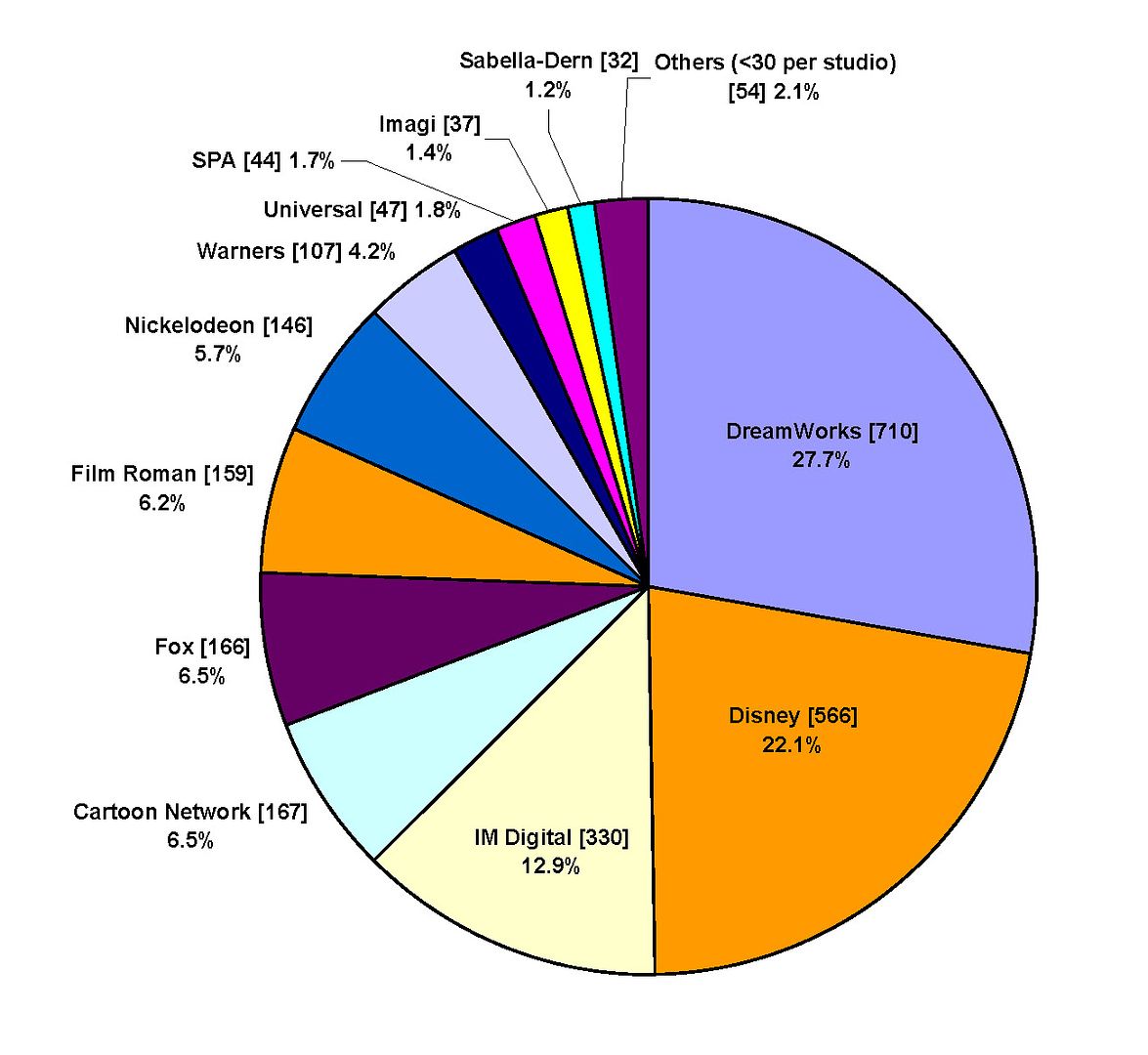
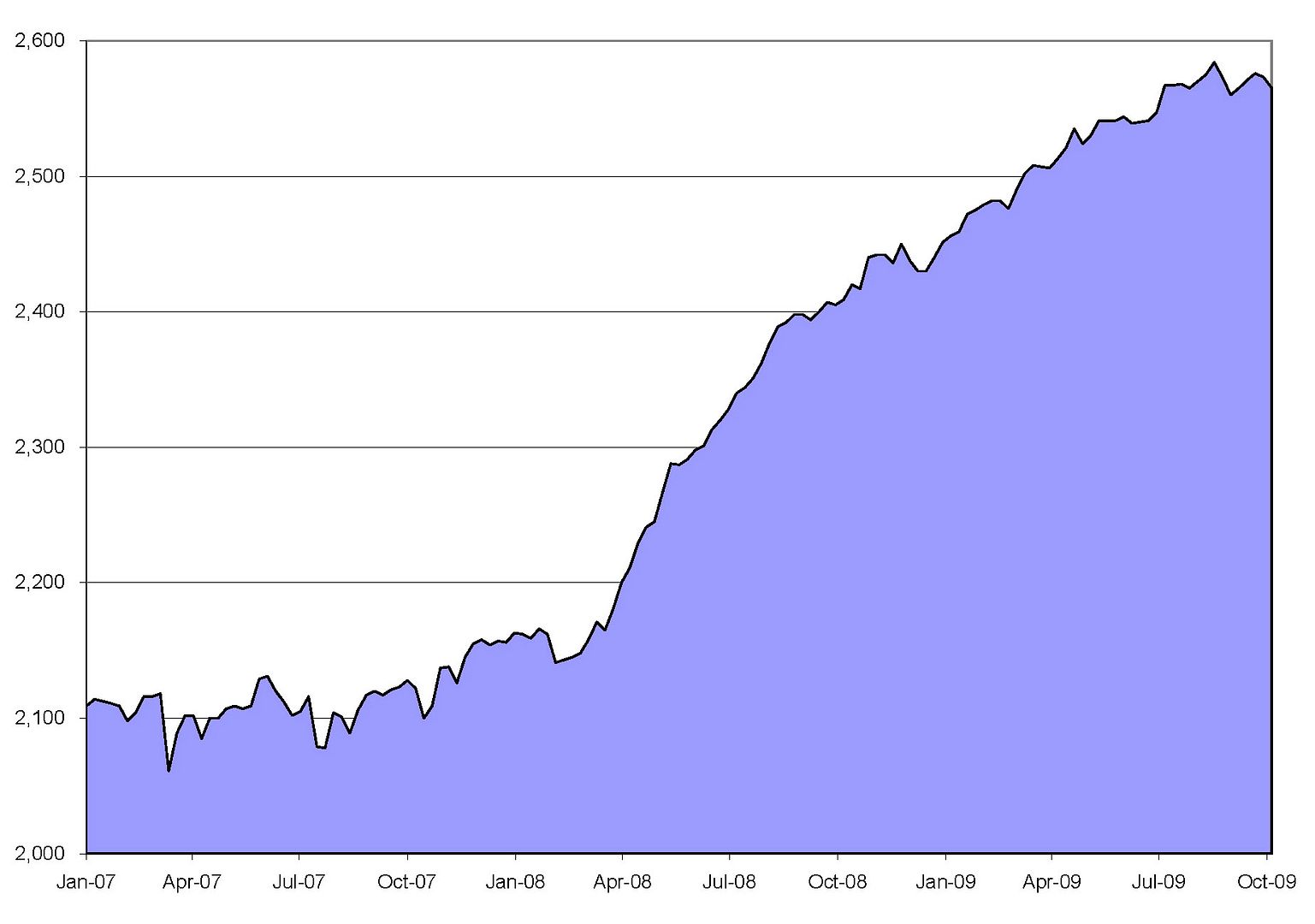
As of today our records show 2,565 active members employed at various union shops. Here is the breakdown by employer; the figures in brackets are the number of members employed (click the thumbnails for a full-sized version of these charts.)

Like we've said before, animation has become a more dominant part of the entertainment and movie/t.v. business of the past two decades. It's way beyond being a sleepy little niche inside the industry, as it was for the first four or five decades of its existence.

There was a time in the nineties when animation studios resembled miniature versions of the old live-action studio system, circa 1930-1950. Artists, designers and technical directors would be hired, signed to long-term contracts, and would then work for years at a single company.

Today, only DreamWorks Animation owns that business model. For everybody else, the visual effects "project to project" model dominates the profession. People are hired during production ramp up, work strenuously until the feature or television show is finished, and are then sent on their way to the unemployment office.

But you can see a lot of folks are working, if only for a few months.

(Here is the employment chart from June 2006. As you can see, trend lines go up and trend lines go down. By way of contrast, in the Fall of 1989 -- twenty years ago -- TAG had 700 active members. We've done better since.)

Click here to read entire post

Henry Bids Adieu to Laika

Henry S.

The studio to the north has just parted company with its premiere director.

Highly regarded within the animation community, [Henry] Selick joined Laika five years ago as Knight sought to give his studio, Laika, artistic credibility. Its first film, "Coraline," was an unexpected hit and racked up worldwide ticket sales topping $120 million in the eight months since its release.

... The studio did not explain the departure other than to say that Selick's contract has expired.

The studio's tersenes today contrasts with Laika founder Phil Knight's comments earlier this year:

“We hope he’s found a home ...”

Half a lifetime ago, I knew Mr. Selick at Disney's. At the time, I found him intense, mercurial, and talented.

Since I don't think people change one hell of a lot as they get older, but only become more of what they were in the first place, I'm betting he's the same Henry I knew way back when.

Whether or not Selick and Mr, Knight said "goodbye" to each other because of creative differences, or a pay dispute, or because Henry lost an arm-wrestling match in the boss's office, I have every confidence that Mr. Selick will shortly be making another film elsewhere.

Click here to read entire post

Overseas Toonage Scorecard

The foreign derby race, in a nutshell:

Up -- $11.6 million generated from 3,579 locations in 27 territories, pushing overseas cume to $231.2 million.

Cloudy With a Chance of Meatballs -- rained $6.8 million from 1,933 locations in 31 markets, pushing overseas cume to $21.6 million.

G-Force -- muscled its way past the $100 million mark overseas ($100.8 million) on the back of a $5.7 million weekend at 2,221 sites in 36 markets

Ice Age: Dawn of the Dinosaurs -- $684 million

9 -- $16.1 million

The congloms are now clued to animation's commercial possibilities. Sadly, the Mainstream Media too often treats cartoons as the bastard step children of the entertainment world, but we'll just keep pummeling away until attitudes change.

Click here to read entire post

Monday, October 05, 2009

Dick's Successor

So the boss of Diz Channel ascends to Mr. Cook's catbird seat.

... [Disney Channels Worldwide chief Rich] Ross earned his promotion by proving to be a master brand builder at the Disney Channel and its myriad worldwide offshoots. His appointment signals the Mouse House plans to focus heavily, though not exclusively, on franchises that not only drive B.O. but can also generate biz for other divisions like TV, licensing and merchandising, homevid and online ...

Ross will oversee all production, distribution and marketing for the company's live-action and animated feature labels, including Walt Disney Pictures, Touchstone, Miramax and Disney/Pixar. He'll also oversee its music group and theatrical productions ...

... Ross is now the second high-ranking Disney exec to come from the Disney Channel fold, as his boss Anne Sweeney was elevated from Disney Channel prexy in 2004 to head all of Disney-ABC's TV operations, other than ESPN. Ross has been closely aligned with Sweeney for much of his career, having worked with her at Nickelodeon and FX in the 1980s and '90s before they both moved to the Mouse in 1996 ...

I don't know Mr. Ross, but he's had fine success turning some of Disney's t.v. units away from animation to the glories of Miley Cyrus and similar teenaged girls. (Thanks, Rich!)

No doubt one of his upcoming assignments will be to assist John Lasseter getting the Walt Disney Animation Studio back into orbit. With luck, The Princess and the Frog will be a barn burner, and Rapunzel will tear through some records during its release window.

The only constant in the universe (and movie business) is change, and I wish for Rich Ross change that will make all things Disney that much better.

Click here to read entire post

Animation, Fox, and Ice Age

A week ago, the Nikkster posted the speech of Bill Mechanic (late of 20th Century-Fox and the Diz Co.) to Indie Film Makers. And I herewith quote:

Nine years ago, I was a healthy and occasionally happy studio executive. I had taken Fox over a 7 year period from a doormat to the #1 studio and before that had spent 9 years at Disney building a then-dormant minor player into a muscular and, for the first time in its history, a real force in the studio world.

... I had fought with Rupert Murdoch over my desire to create a business for Fox in the world of animation. He felt no one could compete with Disney. Nevertheless I started up Fox Animation. ANASTASIA was a start, it made money. TITAN AE a misstep, and lost. Even though that is the nature of the business, that not everything works, he didn’t want to wait for ICE AGE to finish production. I didn’t have a foot out of the door before Fox tried to sell off the film. Luckily for them, they couldn’t get a deal done ...

Days after Mr. Mechanic's speech, I had occasion to talk to two veterans of Blue Sky who were there when Ice Age Uno was being made. They had an interesting tale that tracks the one told by Bill M.:

Mechanic's right. Fox couldn't get a deal done to sell the picture off. But man, were they trying to.

Fox was working hard to dump Ice Age and Blue Sky Studios. They just didn't want to be in the animated feature business. They tried to sell that first feature to Jeffrey, to Pixar, to anybody who'd take it off their hands . Lots of people came through the New York studio to have a look at it. At the same time, Fox was attempting to unload the whole studio. They wanted out completely.

It never happened because the company could never get anybody to bite.

Now, of course, there's all kinds of people at News Corp. taking credit for the big success of the Ice Age series. But there was nobody taking credit back before the Spring of 2002, when the first one was released ...

It's like William Goldman always says: "In Hollywood, nobody knows anything."

Amazing how executives turn into flaming geniuses when a movie ends up making lots of money. And they're geniuses despite the fact they never wanted to make the movie in the first place, and in fact fought tenaciously to stop it.

Click here to read entire post

Sunday, October 04, 2009

Production Money, Production Hours in the Animation Biz

To follow up on yesterday's post, another reason that U.S./ North American animation employment is holding up in the teeth of a global recession:

... Canada has emerged ahead of the USA and France as the most prolific source of animation for television, with 382 hours produced in 2008 worth Euro181m ($265m). US production output totalled fewer hours-330-but was worth Euro256m ($376m)-a mark of the higher budgets invested by the major US players.

France was the leading producer in Europe by a long way, with 259 hours produced in 2008, although output has fallen from a high of 395 hours in 2006.

The UK was the next largest producer in 2008, with a significant rise in production taking it past Italy ...

These kinds of reports mostly side-step the issue of sub-contracting and employment hours in different countries. And television animation is only a single sub-set of what constitutes "animation." There is feature production, broadcast graphics, video games, visual effects and internet cartoons, to name a clutch of others.

The point to be made here is that animation has been an ever-growing segment of what constitutes "today's entertainment" for some years now. There is no large-scale, live-action epic that can now do without animation. (Just look at the credit scroll on the back of any high-budget feature at which you eat popcorn and you'll know what I mean.)

If you have a teenager at home, they're likely immersed in interactive animation via a games console or computer. Three of the top fourteen box-office attractions now playing on U.S./ Canadian theater screens are 100% animated.

And so on and so forth.

When I entered the movie business back when Gerald Ford was El Presidente, little of this was happening. Animation was confined to Saturday morning cartoons produced by Hanna-Barbera and a handful of others, and every 3-4 years Disney would turn out an 85-minute, hand-drawn feature.

That, by and large, was it.

So when people express shock when we point out that "animation employment is growing," understand the context. Yes, there has been displacement of experienced artists. Yes, there's been "creative destruction" along the way. But the animation universe is way larger than it was twenty, even ten years ago.

And the applications for animation keep right on expanding.

Click here to read entire post

Animated New Yorkers

Not Manhattanites screaming for taxis, but the magazine's on-line animated cartoons. (Who said hand-drawn toonage was dead?)

Some of these are droll, others not so much.

Click here to read entire post

Saturday, October 03, 2009

Macro Economy, Animation Economy

Click to enlarge.

The U.S.A's economy is just bumping along ... and not super well.

... The unemployment rate, now at 9.8 percent, has doubled since the start of the recession, in December 2007.

"The labor market is still going backward," said economist Joel Naroff, president of Naroff Advisors Inc. in Bucks County. "Job losses remain high and the unemployment rate keeps rising."

Every single major sector of business showed continued declines, with the exception of education and health services, which added a mere 3,000 jobs. The information sector, which includes telecommunications and moviemaking, stayed flat.

If there is any stimulus money going into infrastructure and green construction, it is not evident from the numbers, because construction lost 64,000 jobs - more than the perennial loser, manufacturing. Even heavy and civil engineering construction, the group that would be building roads and bridges, saw a decline of 11,900 jobs.

In the past, government hiring had managed to somewhat offset losses in the private sector, but government jobs declined by 53,000, with the biggest number of cuts on the local and state levels ...

The problems here are multiple: the velocity of money moving through the economy keeps slowing and shrinking; companies aren't spending or investing because the under-employed populace isn't spending; government expenditures aren't robust enough to take up the slack.

I pretty much agree with Paul Krugman's prescient column from January about the new administration's stimulus plan:

This really does look like a plan that falls well short of what advocates of strong stimulus were hoping for — and it seems as if that was done in order to win Republican votes. Yet even if the plan gets the hoped-for 80 votes in the Senate, which seems doubtful, responsibility for the plan’s perceived failure, if it’s spun that way, will be placed on Democrats.

I see the following scenario: a weak stimulus plan, perhaps even weaker than what we’re talking about now, is crafted to win those extra GOP votes. The plan limits the rise in unemployment, but things are still pretty bad, with the rate peaking at something like 9 percent and coming down only slowly. And then Mitch McConnell says “See, government spending doesn’t work.”

Let’s hope I’ve got this wrong.

Dr. Krugman was on the money about everything except the unemployment rate.

(Methinks we're probably going to 11-13% unemployment -- worse than the 1982-1983 train wreck, and it will probably take a good long while for jobs to recover. Unemployment-under employment is 17%. Yeowch.)

In Animationland, the jobs landscape is rosier. TAG's active membership now hovers between 2500-2700, and our historical active members/employment ratio is 75%-80% of actives having part time or full time work.

Animation's employment strength relative to the rest of the economy, of course, is market driven. Feature-length cartoons have been on a tear the past several years, and this is reflected in the sector's overall employment numbers. Television animation, up and down the past five years, now enjoys a mild resurgence (so we'll see where that goes.)

Excepting DreamWorks Animation, the trend in the 'toon business has been project-to-project employment. A series or feature starts, staff steadily expands. Series or feature spirals to a conclusion, staff gets handed its bye bye papers.

Some (but not all) of the current cartoon work proceeding apace in California:

Cartoon Network has a smaller staff than normal working on five different shows.

Walt Disney Animation Studios -- most of The Princess and the Frog laid off until Winnie, though a few survivors work on shorts. Lead animators swinging over to Rapunzel and Winnie the Pooh. Rapunzel crew will grow into the new year as production ramps up.

Disney TV Animation has Phineas and Ferb, Inspector Oso plus two newer series cranking up at the Sonora studio in Glendale. (Disney TVA is a shadow of its nineties incarnation.)

Disney Toons: Tinker Bells III through V in various stages of work. One other feature series is in early development.

DreamWorks Animation has a full, long-term staff working on several projects. (Next two up: How to Train Your Dragon, Shrek IV.)

Film Roman/Starz Media produces The Simpsons with a somewhat reduced crew from previous seasons, als ohas two Marvel series in work. (King of the Hill and The Goode Family have ceased production.)

Fox Animation on Wilshire Blvd. has three shows in ongoing production: Family Guy, American Dad, and The Cleveland Show.

Image Movers Digital: Sizable staff rolling off Christmas Carol which had -- at its production peak -- a small crew working in the basement of Walt Disney Animation Studios. (It's gone now.)

Imagi has a skeleton story crew at work on Gochomon.

Nickelodeon (Nicktoons) has a variety of projects, ranging from Kung Fu Panda, Madagascar Penguins, to Mighty B, and Sponge Bob Square Pants.. Staff is sizable but below its peak.

Warner Bros. Animation has come out of hibernation and has a sizable staff working on Batman, Sccoby Doo and the new Loony Toon series Laff Riot, along with DVD super hero features.

Rough Draft has its non-union crew working on Fox's Futurama.

Wild Brain, gone from San Francisco, is working on a Peanuts project in the Valley. (This one is also non-union.)

Sony Pictures Animation works on the direct to video Open Season 3, Hotel Transylvania and animation hybrid The Smurfs. (Sony Imageworks, the production arm, is non-union.)

Muddy Waters Inc., produces Neighbors From Hell in conjunction with Fox, DreamWorks Animation and Bento Box studio.

Next week, if we can get our stuff together, we'll gin up specific numbers and maybe a pretty chart.

Click here to read entire post

The Fall Derby

Now with fact-filled Add On.

The Nikkster tells it like she thinks it will be.

Zombieland has a good shot at a $9 million opening from a wide release in 3,036 theaters Friday and an estimated $25M first weekend ... Cloudy With A Chance Of Meatballs keeps a crazy good hold (-12%!) despite Disney's Pixar 3-D challenge for $4.9M Friday and probably a jaw dropping $20M weekend and new cume of $85+M. "I've no idea where the top is now but don't bet less than $125 mil," one studio exec gulped tonight ...

The last animated feature I remember holding this well was The Emperor's New Groove. (Unfortunately Groove had the misfortune of having a studio head that didn't care for it, a meager advertising budget, and a really lousy opening weekend. It gained in the second weekend, but when all the greenbacks had fluttered in, the flick was still under a $100 million domestic gross.)

Add On: As commenters say, Nikkster updates her post, and box office mojo weighs in with more accurate numbers:

1) Zombieland -- $9.4 million

2) Cloudy With Meatballs -- $3.7 million

3) Toy Stories 3-D -- $3.2 million

4) The Invention of Lying -- $2.4 million

And so animations occupy slots 2 and 3 of the Friday chart.

Add On:Sony gets bragging rights for the weekend, with a 1,2 finish in the steeple chase. Cloudy declines a mere 33.3%, and $12.5 million worth of theater goers want to relive the Toy Story magic in glorious stereo viewing. (In some ways, the re-release amounts to a three hour promo and infomercial for the upcoming Toy Story 3.)

1. "Zombieland" ($25 million)

2. "Cloudy with a Chance of Meatballs" ($16.7 million)

3. "Toy Story" & "Toy Story 2" (3-D Double Feature) ($12.5 million)

4. "The Invention of Lying" ($7.35 million)

5. "Surrogates" ($7.34 million)

And 9 currently sits on the 14th perch of the Box Office Aviary.

Click here to read entire post

Friday, October 02, 2009

Toonage in Foreign Lands

The congloms are well pleased with animation. And why not?

Disney scored a one-two punch at the foreign box office with "Up" and "Surrogates" combining for over $24 million during a typically moderate autumn session on Sept. 25-27.

... With domestic cume having hit $292 million, the worldwide total for "Up" has gone to $507 million, moving it into the company of 66 other pics that have topped half a billion dollars in combined international and domestic grosses ...

Fox reached the [one billion] mark first in early July in the wake of opening "Ice Age: Dawn of the Dinosaurs" and had hit $1.69 billion as of the end of the third quarter -- having already exceeded its 2008 total of $1.6 billion -- with the third "Ice Age" contributing a stunning $682 million.

"Ice Age 3" was still generating biz in the final fall frame with $2.4 million, mostly from its fifth Italian session of $1.4 million for an Italo cume of $41 million ...

The conglomerates are going to be pursuing the animation gambit for the foreseeable future. When you get a string of animated movies collecting $500 .... $600 ... $700+ billion in box office receipts, you know you're onto something. And want to keep doing it.

Even Bolt, hardly a barn burner, has sniffed up $314 million around the world. So yeah, a lot more toonage will be getting produced.

Click here to read entire post

On Plagiarism

Since the subject of stealing ideas came up in the discussion about pitching projects to animation execs, I throw this out:

"The law recognizes no plagiarism except that of basic plots. ... My ideas have been plagiarized in Hollywood and I have been accused of plagiarism ... Unconscious plagiarism is widespread and inevitable ... [W]riters like Dashiell Hammet and myself have been widely and ruthlessly imitated, so closely as to amount to a moral plagiarism ... I have had lines of dialogue taken intact, bits of description also word for word. I have no recourse. The law doesn't call it plagiarism ...

-- Raymond Chandler

The problem for animation artists is the same as it was for mystery writers sixty years ago.

When you develop animation ideas, characters, and plots, studios protect themselves by having artists sign releases or go through registered agents. The last thing a conglomerate wants is to get sued, so it wraps itself in binding documents.

And sometimes similar ideas come in clusters, and overlap. And sometimes there is cribbing, but suspecting theft is one thing, and proving it is another. Artwork circulates through departments, and creative people see it and get influenced, unconsciously or otherwise. Stuff happens.

The problem is having hard evidence that thievery has taken place. More often that not, that's difficult to prove. (Difficult? Hell, 99.7% of the time, it's close to impossible.) Art Buchwald accomplished it by having paperwork, contracts and witnesses that backed up the time-line for his submitted work to Paramount pictures twenty-seven years ago, and the courts ultimately decided in his favor. But it took freaking years.

My suggestion: You go in to pitch, protect yourself to the maximum extent possible, but understand you're roling dice in the big studio crap game, and other players roll similar numbers. Long-term, your ability to succeed will hinge on your energy, enthusiasm and creative chops, not one presentation you make to Warner Bros. Animation.

Click here to read entire post

Thursday, October 01, 2009

Oktoberfest of Links

Another roundup of animated word trinkets.

Rupert's News Corp, ever alert for lucrative money fountains, is adding to its animation franchises in prime time:

The "Robot Chicken" gang is going primetime.

Fox has ordered a presentation and a script for an animated project from Seth Green, Matthew Senreich and Tom Root that is being produced by 20th Century Fox TV and studio-based Chernin Entertainment ...

Nobody else, it seems, has figured out how to do successful prime time cartoons. The ever-crafty Fox, however, lives up to its name and pulls it off ...

And as the previous two Toy Stories come rolling down the pike in Disney 3-D (r), the New York Times writes of the stereo-vision retrofit:

“We have every scene in ‘Toy Story’ and ‘Toy Story 2’ saved, and so we have this bit of action that is frozen in time, “ Mr. Lasseter said. “If we bring that up in our system, we’re going back in time into that moment.”

Without changing any of the film’s action, Pixar’s 3-D specialists, or stereographers, returned to each frame of the film and virtually placed a second camera next to the original, creating left-eye and right-eye views of the scene ....

It took four months to resurrect the old data and get it in working order. Then, adding 3-D to each of the films took six months per film. (Pixar and Disney declined to talk about the project’s cost.) ...

I can speculate on the cost. It was a whole bunch of dollars.

Meanwhile, John Lasseter shares information with the Daily Telegraph about the magic of making Pixar movies.

... “Our core directors and storytellers all work together,” explained Lasseter. “We call it the brains trust. Someone will come up with an idea for a film and we’ll talk about it and work it out. It’s all about coming up with a great story and making a great movie. I believe everything comes from there.” ... “Test studios, marketing groups, focus groups they’re not going to tell you anything. ... There’s no way UP would have been made if we’d focus-tested the idea. And what about Ratatouille - a movie about a rat who wants to be a chef in the best restaurant in Paris? People would have said we were nuts. Who’s going to want to see that? But it’s one of my favourite movies that we’ve made.” ...

Fox and Electronic Arts are teaming up to make a new animated feature.

Twentieth Century Fox has paired up with Electronic Arts to turn the publisher's popular "Spore" game into an animated creature feature, with "Ice Age's" Chris Wedge attached to helm.

Greg Erb and Jason Oremland, who penned Disney's upcoming "The Princess and the Frog" and Ben Stiller pic "The Return of King Doug" at Paramount, will write the script for the "Spore" movie. It will be produced as a CG-animated toon by EA and Blue Sky Studios, which is behind the studio's "Ice Age" pics, "Robots" and its next effort, "Rio."

In the game, which was released in September 2008, players create their own creatures and the worlds they live in and share them with other gamers to create an overall universe.

"I'm always looking for unique worlds to go to in animation," Wedge said. "From every perspective -- visually, thematically and comedically -- the world of 'Spore' provides the potential to put something truly original on the screen." ...

Lastly, we end with the Variety story regarding the bloodsuckers at Meteor, and the tale of how these weasels got a crew of visual effects artists to work at a 30% discount. (Yes, we've posted about this before, but Variety has finally flagged it, and it's not possible to highlight the screwing these folks got at the hands of a cynical management enough.)

More than 100 visual effects artists who did work for Meteor Studios, a Montreal-based effects house that went bankrupt in late 2007, have reached an agreement with the owners to get at least some of the back pay owed them ...

The Meteor case has become a symbol of the shaky standing of the vfx industry and vfx artists in particular. Vfx artists have no union or guild, and no Hollywood union has consented to represent them ...

Simply because the visual effects industry runs on razor-thin margins is no reason to corn-hole the people who do the work. As for Variety's assertion that "no union or guild has consented to represent them", I'd like to announce here and now that TAG will be pleased and happy to represent visual effects artists any time they're wiling to have us do that. (We've been pleased to represent them in the recent past.)

Have a splendiferous weekend.

Click here to read entire post

Ann Daly: How DWA Works

DreamWorks Chief Operating Officer opens up about how the company paddles along:

Jeffrey Katzenberg, our CEO, along with several key management executives, charts the direction of the company. We have a very good development group responsible for finding material, either by developing it internally or [through] outside pitches. Artists are encouraged to actively participate in sharing ideas for development. Jeffrey has the final say, as does our head of creative, our head of development, and of course, having the commitment of the director or producer of the film ...

The thing about DreamWorks, they've consciously worked to develop a corporate culture that stresses stability.

Hiring people long-term. Free commissary lunches. The fountains and ponds. The whole place has an ambience most studios don't duplicate. (Walt Disney Animation Studio's hat building, with its open spaces and hanging bubble lights and central coffee bar goes some of the way, but nothing really compares to the DWA campus. And WDAS abandoned that "long term employment" model a couple of years ago, although they give some lip service to re-instituting it "sometime in the future.")

Some people run the place down -- and DreamWorks certainly brought a large wish list to TAG's 2009 negotiations -- but I would say the company has fairly high morale compared to other cartoon shops in Southern California. People just like the idea of knowing they'll have a job ... oh ... three months from now.

Funny how that works.

Click here to read entire post

Wednesday, September 30, 2009

Churn in Small Screen Animation?

This afternoon, I took my bag of 401(k) books to Fox Animation, where a staffer said to me:

I don't know what it is, but I've been picking up that companies are really looking for new animation ideas, new shows, new characters. I'm getting the idea that they want more animation shows, but aren't finding new stuff they like. So the universe isn't expanding, but they want it to ..."

I responded that with the broadcast universe dividing and subdividing to the point where NBC isn't a lot different than TBS, our fine congloms were looking for more animation shows because

A) Unlike reality shows, 'toons have a robust afterlife in reruns and DVDs. (How many boxed sets of John and Kate, the first season you think are going to be sold? Fifteen?)

B) Compared to scripted live action, animated half hours are cost effective.

C) Fox has figured out it can build a whole prime time block around animated comedy. (Others will soon catch on to this ...)

Fox [benefitted] from spinoff mojo as "Family Guy" spinoff "The Cleveland Show" opened very well Sunday at 8:30 p.m. (4.9/12 in 18-49, 9.51m) between the season preems of "The Simpsons" (4.3/12, 8.31m) and "Family Guy" (5.2/12, 10.11m).

The Fox artist pointed out one puzzle piece I overlooked: merchandising. John and Kate dolls and board games just aren't moving that well. Cartoon merchandise is. And the cash flow has to come from somewhere, because broadcast networks no longer command 30%, 40% or 50% of the viewing audience. They are now little more than glorified cable channels, with viewership to match.

That being the case, the networks need to put on programming that makes them money as soon as possible. Jay Leno has a prime time show five nights a week for a reason. He's one hell of a lot cheaper than scripted live action, NBC can turn a profit with 1.5 million viewers, so they give him a shot.

The green eyeshade types have done the math, and know the budgets they have to work with. Which is why companies are looking at more toonage. It's relatively inexpensive, it has ancillary markets, and it will make everyone a nice bundle if it hits big.

Network t.v. isn't a high margin business anymore. General Electric, after all, is looking to unload Universal-NBC for a reason. It can count.

Click here to read entire post

Television Animation Development!

TAG's teevee animation development panel took place before a packed house last night, where moderator and TAG board member Karen Carnegie Johnson hosted a panel of cartoon execs:

Eric Coleman, Senior Vice President of development at Disney Television Animation,

Carin Davis, Vice President of Creative Development at Film Roman, and

Eric Homan, Vice President of Development at Frederator.

All three shared their insights regarding the 'toon biz with a rapt audience that was interested in what these three are looking for, and how this development thingie works.

Below, we present some of their wisdom:

Eric Coleman: When you're pitching, you want to make an impression. It's the idea and the execution of that idea that's important. If you come in with: "I've got a show about a kid who gets trapped on the internet ..." Well, we get a lot of that. But how do you execute that idea, and what are the characters?

I would caution people about going too overboard. We get nervous when the pitching person wants to come in 15 minutes early to set up. It's important to bring the characters in the pitch to life, but there is no one way to pitch. But we don't want to see printed t-shirts, lunch box designs, things like that.

Carin Davis: Bring in a write-up of your idea, it doesn't have to be a script or a bible. Don't give me a lot of ideas, just one or two ideas that you are passionate about. (If you're an artist) don't be be afraid to pair up with writers. But don't do music, (we're not looking for that) ... especially if you're a bad singer ...

Eric Homan: I would say if you have a "kids on the internet" type idea that is totally great, then do it, if its a different take. What do you bring to the table that makes it original?

Eric Coleman: Different development executives at different studios are looking for different things. Everybody says they want a "Sponge Bob," but what they mean is they want a huge hit.

For the Disney Channel, right now it skews to girls, and we're looking for shows that will also appeal to boys. We want something that appeals to both boys and girls, not something that's "gender neutral" that will be tolerated by boys ... or tolerated by girls. We're looking for contemporary shows, not castles in the forest type stuff. Pitch things that relate to kids today, whether it's human or non-human. We're looking for fresh shows.

Six to eleven is our basic demo, but keep in mind the older end of that demo. It's the mark of death when kids think it's a "baby show."

Disney XD (formerly Toon Disney) is developing more for boys, twelve-year-old boys. There might be something happening with the recent Marvel deal. That took us by surprise it happened so fast, and we'll see what comes out of that.

Carin Davis: People pitching should come in with a couple of story lines. When sombody comes in with "four kids caught on the internet," I want to know who those four kids are. We're part of Starz Media and programming for pay channels where people pay an extra $15 a month, so we're looking for programming (beyond just kid shows.) Recently we've done direct-to-dvd features like Hell Boy, Rob Zombie and so on. Stars Toronto is an all c.g. studio in Toronto that's doing movies that Disney, Pixard and Blue SKy aren't doing. Recently they did 9 which had an indie sensibility and had good luck with it.

Eric Homan: Frederator is independent, and looks at every kind of show because we sell everywhere. If it's an adult show you have three or four places you can go. Studios and networks will tell us what they're not looking for. Right now, for example, action-adventure is a tough sell.

All three execs: Pitching your idea to studios doesn't mean that pitch is owned by the studios, but all of us here listen to lots of pitches, and some of those pitches are similar to each other.

Eric Homan: At Nick a few years ago, when they were doing their shorts program, three people came in with three pitches that had characters with heads that were fish bowls, and the fish in the bowls did the talking for the character.

Eric Coleman: Studios aren't looking to steal ideas. If somebody comes in defensive and worried about being ripped off by a studio, then development executives know this is probably the first time they've been at the rodeo.

Development Times

Carin Davis: Development times are almost always long.

Eric Homan: Yes, development time can be glacial. It took years to get a series greenlight for Adventure Time (which will air on Cartoon Network next Spring).

Eric Coleman: I'll get your show greenlit in three hours (laughter.) No, it takes a long time. After you've pitched, nudge us if you haven't gotten a response from the development team in two or three weeks, send us an e-mail.

There's a long time when you're in the development stage. Testing and decisions have to come from higher ups, and it can be slow.

About the process, someone on my development team will take most of the pitches (I do less of that now; I've paid my dues.) If they like it, next it will get pitched to me. There is a whole host or reasons why the development process -- from pitch to aired show -- drags out.

There is bible development, scripting, boarding, character designs, the pilot (6-8 months), then testing with kids in focus groups. One of the best focus group stories? We had eleven to twelve year old girls -- a tough focus group -- and there was a girl who was the leader. Through the whole presentation she sits there gravely, never laughing. At the end the moderator asks: "So ... what do you think? This somber girl says: "Oh, that was hilarious."

Testing and focus groups aren't what greenlights a project. Greenlight decisions go up the ranks.

There's a need for artists to network. It helps to be in the studio, ono a show. It's harder to break in (with a pitch) if you're far away. ... The trick is making a show you want to make.

Eric Holman: Frederator has a deal with Sony, but it's in the early stages. Sony is fond of c.g features and hybrid films (c.g. and live action). I gravitate toward cartoony stuff. I want to see things that should be animated. ...

Formats for t.v. animation (c.g., hand-drawn, flash animation) is cyclical. Formats fall in and out of favor. Nick has a number of c.g. shows now. Flash was big a couple of years ago, now it's less so. Creators have a big influence on the type of show it is, what the format is.

Carin Davis: Live action scripts sometimes get pitched as animated scripts. The writer will have been around pitching it as a live-actino project, then say, "Oh, it could be an animated project." Welll ... maybe. But it should be something that works in animation. Otherwise, why make it in animation?

Eric Homan: When we were doing development of shorts at Nickelodeon, we paired an artist with promising pitched with four or five different filmmakers, and he developed a series out of one of the pairings.

Eric Coleman: When you're developing a pitch, pitch to a friend who will be honest, who will tell you if your stuff is funny or not. It doesn't help you if he lies and says it's wonderful when it's not.

And we don't care if you're nervous when you're pitching, we're interested in the quality of your idea, and it's execution. Don't keep pitching the same idea. Let it go, and pour your creative spirit and energy into the next thing.

What we're looking for changes over time. You want to find out what different development folks are looking for. I had a good clean pitch today, for example, but it's like other things already in development.

It's good for the pitcher to understand that "no" is really "no." Sometimes the development person can't put his finger on why the pitch doesn't "go," sometimes it's a chemical thing.

Eric Homan: Sometimes we say no because it's just not wanting to be in business with particular person. We don't want to be in the room with that person for a long period of time, and development takes a long time. That could be somebody who's difficult, somebody who doesn't want you to change a word of their script.

Eric Coleman: We're looking for people to develoop original ideas and shows. Anything that seems obvious, isn't worth my time.

When you're pitching to big networks or conglomerates, they want to own all rights. I've seen things get complicated when rights on a great idea have been pre-sold to a smaller company.

Eric Homan: Artists who pitch need to look and see how other people did their show. Many times they developed relationship with development execs, and over a period of time they kept pitching and got a show created and greenlit.

Carin Davis The core idea of the pitched show should be timeless.

Eric Coleman: Disney is interested in "timeless" shows that keep their relevance. That doesn't mean "of the moment." Kids in show don't have to reference their "MP3 devices," something that will date it ....

That's the gist of the presentation. There was a lively question and answer where such things as "faith-based" programming was touched on ("It's a small market and Disney doesn't do it, but certainly there's a niche there. Veggie Tales has certainly made money ...")

All in all, an informative evening. People stuck around afterward to jawbone about the process. With luck, fortitude and clean living, some folks will use the knowledge gleaned last night to become successful pitchers of genius ideas and land themselves some long-running cartoon series.

Click here to read entire post

Tuesday, September 29, 2009

Marge Belcher-Babbitt-Champion

A year and a half ago (during the 70th anniversary of Snow White) I regularly walked into the Disney hat building and got to watch black-and-white reference footage of Margie Belcher (soon to be the wife of Art Babbitt ... and then dancer Gower Champion) they were playing on monitors in the hall display case.

Ms. Belcher did a lot of dancing and pantomiming in Snow White's dress, and they had a lot of the footage running ... and I stood there like a slow-witted teenager, gawking at it. So what do you know? Seventy-three years later, the energetic little dancer is still going strong:

The vivacious [Marge] Champion is still dancing at 90. She and her dance partner, Tony-winning choreographer and veteran dancer Donald Saddler, are the subject of an upcoming documentary, "Keep Dancing." ...

Champion made her debut at the Bowl at age 11 in one of [her father's] ballets, "Carnival in Venice." Two years later, she was one of three girls who caught the attention of a Disney scout and was asked to audition at Walt Disney's old studio on Hyperion Avenue.

"He told me to call him Uncle Walt because I was too young to call him Walt," Champion recalls. From the age of 14, Champion performed scenes as Snow White for the animators. "It was maybe one or two or three days a month," she says. "They shot me on 16-millimeter film, and I could do enough in a day's work to keep them busy for two weeks."

She says the process of playing Snow White was simple. "When Snow White was running through the forest and scared to death, they had ropes hanging from a clothesline so I would be pushing them aside," recalls Champion. "If there was a bed where Show White had to go pray, they had a cot there so I could kneel beside it. It was always very rudimentary and very hot lights, because they wanted as strong a contrast as possible." ...

She has a good memory, because that's the footage to a fare-the-well.

But the goof they had pantomiming the wicked witch? Not nearly so riveting.

Click here to read entire post

"The Current State Of TV Development" at tonight's membership meeting

The TV animation industry is always changing; what’s hot today? Tonight we’ll be hosting a panel session to discuss the current state of TV Development and the pitch process. Are you developing a pitch? Curious about what types of shows the studios are looking to produce, or just interested in what may be in the pipeline? We’ll address these questions and more.

Our panel on "The Current State Of TV Development" will be hosted by Executive Board member KAREN CARNEGIE JOHNSON, featuring ERIC COLEMAN, senior vp of development, Disney TV Animation; CARIN DAVIS, vp of creative development, Film Roman; and ERIC HOMAN, vp of development, Frederator.

Animation Guild

GENERAL MEMBERSHIP MEETING

Tuesday, September 29, 2009

1105 N. Hollywood Way, Burbank

Between Chandler and Magnolia

Pizza & refreshments, 6:30 pm * Meeting, 7 pm

Click here to read entire post

Good Times at DWA

I wandered around DreamWorks Animation after my 401(k) meetings there today, and a DreamWorks veteran mentioned:

"We did a couple of test screenings, in Long Beach I think, of How To Train Your Dragon, and they went really well. Jeffrey doesn't want to change a thing ..."

That snippet tracks this:

DreamWorks Animation SKG Inc. ... edged up after Jefferies said it likes the company's 2010 films and expects a bigger contribution from the newly released Monsters Vs. Aliens DVD. The firm boosted its 2010 earnings target to $2.50 from $2.35 and 2011 forecast to $2.90 from $2.70. The Street consensus sees 2010 at $2.27. And Jefferies, while reiterating its buy rating, also said lower film costs and successful holiday television specials help make DreamWorks Animation an attractive acquisition candidate ...

The business press keeps harping on this "acquisition" thing. On a slightly different subject, another DreamWorksian informed me:

"The studio staff just had a big presentation of all the features we're doing for the next two years. It happened over at the Alex theater in Glendale, it was supposed to go from 8:30 to 11:00 and it went on until after 1:00.

"Most everybody is really impressed with the stuff that's coming down the pike. And it feels good to know we've got jobs going forward. That's sort of reassuring ..."

All in all, the mood at the Glendale campus appears to be upbeat.

Click here to read entire post

Monday, September 28, 2009

Cartoon Rebates

Late to the party with this, but worthwhile nonetheless.

As Universal and Chris Meledandri's Illumination Entertainment wrap production on ... the 3D CGI-animated title "Despicable Me," the studio and animation house plan to raise their next progeny in France thanks to new tax incentives in the country ...

"Despicable Me" employed the animation savoir-faire of Paris-based FX house Mac Guff. ... " 'Despicable Me' also served as a benchmark for changing the tax rebate to be more friendly to animated films," Gallic film commission Film France's Franck Priot says. "We knew we needed to create a specific set of rules just for animated titles."

From what I've observed, France has good animation training and infrastructure. It has the skilled workforce and the tax rebates. The question is, do the animated features it turns out (and there have been a number, some even reaching the U. S. Of A.), that have the style and panache which will mesh with American tastes and the U.S. market in a major way. Based on the trailer, I think that Despicable Me can do okay in the United states. But is a domestic gross of, say, $60 to $90 million (Tale of Despereaux numbers) going to be enough for Universal-G.E.?

That, of course, is the question.

Click here to read entire post

Seventy Cents on the Dollar

I believe we can now stick a pin in this sad, miserable story:

Two years after having worked unpaid for three months at a Montreal film studio, a group of special-effects artists is preparing to recoup 70 per cent of what they claim is owed them.

The 130 mainly Canadian artists have been seeking $1.2 million in wages and overtime pay from the two U.S. companies that had formed Meteor Studios Inc. in 2000.

Last week, they accepted the third and latest joint-compensation offer from Discovery Trademark Holding Co. Inc. and Evergreen Digital LLC for nearly three-quarters of the amount.

"I'm amazed we're getting anything," said Dave Rand, the lead effects artist on the Journey to the Centre of the Earth movie ...

He was able to persuade his fellow artists to reject the first two offers - for 45 per cent and 63 per cent - made by Discovery and Evergreen through the provincial Commission des normes du travail.

Although he and some others, mostly fellow American artists, were pushing for full compensation, Rand said many of their Canadian counterparts expressed the need for the money now ...

This is where the plutocrats always get you. They've got the money, and nine times out of ten they can wait you out.

My hat is off to Mr. Rand, because he's one in ten thousand: a guy who isn't willing to roll over and take it up the large intestine.

My rule of thumb has always been, if I can get a settlement of 70-75%, it's an okay deal. Dave is made of sterner stuff than I am.

On the other hand, when the checks stopped coming, I would have been out on the sidewalk with a bullhorn, screaming at people to turn off their computers and get the hell out of the building.

(I mean, what can the employer do? Stop paying you?)

Click here to read entire post

Family Guy and Disney's Anti-Semitism

Stewie and Brian and Disneyland! In a pirated clip! Arrgh!

Family Guy had an amusing segment on Disney animation last night, ending with an unhappy tag ... (spoiler below) ...

... where a Jewish man comes to the door and gets beaten up.

This references, of course, the corporate/urban myth that Walt was a raging anti-semite.

There might be some smidgen of truth to it, I don't know. Walt Disney was a mid-westerner, and there weren't a lot of Jews hanging out there in the early twentieth century, so who can say with total certainty?

All I know is that when I landed at Walt Disney Productions in 1976, I went to work with story artist Ted Berman, a lontime stalwart of the feature animation department. He'd come to the studio in 1940, and retired from the studio in 1985, as a feature director.

So, my question. If Walt was such a hard-core anti-semite, what was Ted doing there all those years?

(Then, of course, there's the twenty years of Disney that had Michael Eisner in charge, with Jeffrey Katzenberg running the studio for ten of them. Walt was long dead, but Roy Disney was instrumental in having them come over from Paramount.)

Click here to read entire post

Sunday, September 27, 2009

The 1930s

Adam Begley reviews Dancing in the Dark: A Cultural History of the Great Depression by Morris Dickstein and finds some serious gaps:

After a fond, lingering look at “Shall We Dance” — Ginger Rogers and Fred Astaire in the spotlight, romancing to songs by George and Ira Gershwin — Dickstein sums up expertly: “Each number is a miniature of the movie, moving from singing alone, dancing alone, dancing with the wrong person, or dancing to the wrong music to making beautiful music together.” ...

Which makes the omission of Walt Disney (his name doesn’t even appear in the index) all the more perplexing. Even if one rejects the provocative claim by the historian Warren Susman that “Mickey Mouse may in fact be more important to an understanding of the 1930s than Franklin Roosevelt,” it’s hard to deny Disney a place in the pantheon of the decade’s movie makers, if only for “Snow White and the Seven Dwarfs” and “Fantasia.” Whether or not the cartoons that delighted ’30s audiences are complex works of art, they would have slotted nicely into several of Dickstein’s chapters. On the lookout for a cultural artifact that served to “lift sagging morale and stimulate optimism about the future”? ...

More than Zanuck's topical films torn from newspaper headlines (I Was a Fugitive From a Chain Gang, Public Enemy, Grapes of Wrath, etc.) or Warner Bros's emphasis on social justice (Angels with Dirty Faces, Adventures of Robin Hood), Disney was probably the touchstone for Depression-era audiences. "Who's Afraid of the Big Bad Wofl" was practically a national anthem, Mickey Mouse was the most popular cartoon character, and Snow White and the Seven Dwarfs the highest grossing feature between 1930 and 1939.

So yeah. It's strange that Uncle Walt doesn't get a mention.

Click here to read entire post

Realities*

Above: TAG newsletter masthead, circa 1993, by Comrade Tom Sito, worker hero of the most glorious socialist cartoon revolution. (Click on it to make it BIGGER.)

Of a Sunday evening, I take various comment threads and weave them into one terrific Trotskyite tapestry:

I'm curious what happens to the people that don't agree to go on call. Sure they can't make ya do it -wink wink- because they are a union shop after all and if they made you work OT with out paying you..then that would be bad.

It's simple, really. If you have the leverage, you can safely refuse to go "on call" and management won't make a peep. And if not, not.

In the mid-nineties, Disney Feature Animation abandoned "on call" because the crew hated it (and experienced talent was scarce.)

Today, there are few leads at the Mouse House who have declined to work on call ... times have changed! (Because of labor regulation changes by the Bush Administration, more employees now fall into the "exempt from overtime" categories and are therefore eligible to be on call. Such a deal.) ...

If Warren [Buffett} was so right, and Disney so right in buying Pixar et alia, why is the stock price today under $28 when it was over $33 in 1998?

That's minus 15% or so in more than a decade - one hell of business.

The entire stock market has been relatively flat and/or negative for over a decade. But as for Disney specifically, Eisner and Jeffrey K. roared in during 1984 and put the place on steroids: jacking up admissions to Disneyland and disney World (big profits there) reaching out to mainstream Hollywood filmmakers. (The early live-action films were made on strict budgets; Disney Television Animation was started, with high-margin results.)

Growth and profits leveled off in the late nineties; Eisner left early in the new century. Disney's problem now is it's a "mature business" and there are few un-mined veins of riches (the parks, the animation library) left to exploit. So Disney is doing what every entertainment conglomerate is doing: buying up franchises and working to control costs. If it gets on a roll making better pictures, so much the better. But Surrogates doesn't seem to be it.

I'd support Democrats if they were Kennedy Democrats, that's John Kennedy Democrats, not Teddy.. .

Jack Kennedy, in his time, was denounced by the hard right as a communist appeaser and a traitor (this sound familiar?) Today, of course, he's praised by some conservatives as a tax cutter, and Joe Leiberman cites him as the reason he got into politics.

Kennedy wasn't far left, but he was "liberal," with a wide streak of pragmatism borne of classical cynicism. (See Richard Reeves' clear-eyed biography, "President Kennedy: Profile of Power," published by Simon and Schuster in 1993.).

Geez, how did the world of animation that I love attract so many socialist? Sigh..

That's an easy one. You visited a union blog. You know, The Animation Guild? One of those nasty, labor organizations that advocates socialistic type things like health care, overtime after eight hours, higher wages, better working conditions?

You come to a commie, redistributionist web site, what do you expect?

* Realities as Comrade Hulett sees them. You, of course, might think that Tom Delay holds the bright torch of Truth. Have a fine and productive workweek, capitalist wage slaves!

Click here to read entire post

Saturday, September 26, 2009

Tire Kicking

Your eagle-eyed correspondent notes this in the New York Times:

After more than a year of almost no activity, [new] deals do suggest that Hollywood is regaining its footing in a sharply changed entertainment sector ...

People are said to be kicking the tires on DreamWorks Animation, which is increasing production from two to three movies a year. Mr. Katzenberg declined to comment on the Merger & Acquisition chatter around his company.

DreamWorks Animation is now the only stand-alone animation studio in town. Every other cartoon factory nestles under the wings -- directly of indirectly -- of one of the conglomerates.

Sooner or later, the DWA will also cuddle up to one of the entertainment monsters. Nothing else makes (long-term) business sense .... unless the house of Jeffrey intends to grow into a conglomerate itself.

Click here to read entire post

Up Continues to Levitate

As Ice Age 3 winds down, Pixar's latest lifts higher.

It took nearly three months, but "Up" finally led all films in international markets for the first time.

The Disney/Pixar toon managed the feat during the Sept. 18-20 weekend with $13.7 million at 2,718 playdates in 23 markets. The Mouse House has opted for a strategy of opening the pic gradually rather than going day-and-date.

"Up" crossed the $200 million mark on Sept. 22, becoming the seventh 2009 release to hit that milestone but the first to do it outside the summer season.

... In Germany, the opening of "Up" finished a close second to Constantin’s second frame of tyke adventure "Vicky the Viking" with $6 million. "Up" launched with $5.4 million from 809, on par with last year’s "Wall-E" but below 2007’s "Ratatouille," which opened with more than $12 million in Germany.

In Australia, "Up" scored its third straight weekend as the first-place film with $2.8 million at 287 for an $8.5 million cume. In France, the pic managed to finish eighth in its eighth frame with $1.3 million -- off only 1% -- for a $38 million cume.

And "Up" has plenty of gas left in the tank. It opens in Scandinavia on Oct. 2, followed by the U.K. on Oct. 9, Italy on Oct. 16 and Japan in December ...

For those of you scoring at home, we have Cloudy at the top of domestic box office, Up as the current champ overseas, and Ice Age 3 as the foreign box office record-holder for 2009.

I'm guessing that the money pouring in for these pictures is not going unnoticed. I'm assuming that production for more of the same is a foregone conclusion. (More than any other type of movie, animated features are powered by the marketplace ...)

Here's wishing the best for the oncoming flood of holiday cartoons.

Click here to read entire post

Cloudy Holds Fast

Now with abundant Add On.

So last week a top-level Disney animator says to me in the doorway of his hat building office:

"Have you seen Cloudy with Meatballs yet? No? Well, I thought it was really good. I found it to be fresh and funny. I know the two directors didn't have much animation experience, but maybe that helped the picture. I thought they brought a new slant to what they did ..."

Sure, there are those who probably don't like the feature, but "De gustibus non est disputandum" applies here. And the L.A. Times reports this A.M. that hordes of movie goers apparently like CWB

It's starting to look like a cloudy weekend for everything but "Cloudy With a Chance of Meatballs."

"Surrogates" and "Fame" both had soft opening days, while Sony's animated film dropped only 31% from its debut Friday last week to $5.6 million. Animated family films tend to decline even less on a Saturday and Sunday, meaning "Cloudy," the third movie from Sony Pictures Animation, could fall between 20% and 25% for the weekend.

That's an extremely small second-weekend drop and would be a sign of excellent word of mouth.

"Cloudy" will almost certainly gross over $20 million for the weekend, giving it a lock on first place ...

Bad news for Bruce Willis's sci fi opus. Good news for animation.

Add On: Friday's results, per the Hollywood Reporter, are about as expected:

Disney will probably have to rein in its weekend expectations for Bruce Willis starrer "Surrogates," after the sci-fi thriller rung up an estimated $5 million in first-day grosses.

That was good only for second place in Friday's domestic ranking ... [I]t looks like last weekend's No. 1 pic -- Sony's 3D animated "Cloudy With a Chance of Meatballs" -- is staging a run at repeat bragging rights, ringing up $5.6 million on Friday for $41 million in cumulative boxoffice over its first eight days in release.

As Sam Goldwyn said "When people don't want to come see your movie, you can't stop them ..."

And conversely.

So Meatballs is on a tear, and animation gets another booster shot.

Add On Too: And Cloudy walks off with top honors for a second weekend ... and Bruce should maybe think about prepping another Die Hard installment, because he's now entered the danger area of "aging action star."

Audiences took a look at the new movie offerings this weekend and decided to stick with what they knew. Two major new wide releases, "Surrogates" and "Fame," both posted weak openings and received poor reactions from those who did attend. Moviegoers gave the films an average grade of "C" and "B-," respectively, according to market research firm CinemaScore. Audiences are typically generous graders, so those are signs of poor word-of-mouth and, most likely, short box-office runs.

"Cloudy With a Chance of Meatballs," meanwhile, dropped an extremely modest 19%, indicating very strong word-of-mouth and continued hunger for a family film.

After its decent but not great $30.3-million launch last week, "Cloudy" enjoyed the third-lowest second-weekend drop of any film this year, after "Taken" and "Coraline." The studio-estimated $24.6 million in tickets it sold in the U.S. and Canada this weekend brought its total domestic gross after 10 days to $60 million. The $100-million production, the third from Sony Pictures Animation, is now on solid financial footing, aided by the $13.3 million it has earned so far from four foreign territories ...

The score card:

1. Meatballs (Sony) Week 2, Wkd $24.6M (-19%), [3,119] Cume $60M

2. Surrogates (Disney) NEW, Wkd $15M [2,951]

3. Fame (MGM) NEW, Wkd $10M [3,096]

4. The Informant (WB) Week 2, Wkd $6.9M (-34%) [2,505] Cume $20.9M

5. I Can Do Bad All By Myself (LG) Week 3, Wkd $4.7M [2,120] Cume $44.5M

6. Pandorum (Overture) NEW, Wkd $4.4M [2,506]

7. Love Happens (Universal) Week 2, Wkd $4.3M (-46%) [1,898] Cume $14.M

8. Jennifer's Body (Fox), Week 2, Wkd $3.5M (-49%) [2,738] Cume $12.3M

9. 9 (Focus), Week 3, Wkd $2.8M [2,025] Cume $27.1M

10. Inglourious Basterds (Wein/Uni) Week 6, Wkd $2.7M [1,960] Cume $114.4M

As you see, animation sits on top and bottom of the Big Ten

Click here to read entire post

Friday, September 25, 2009

100 Degree Links

Now with toasty Add On.

100 degrees where I live. How toasty. How refreshing. And then there was:

"Ice Age" helmer Chris Wedge will next direct "Leaf Men," a feature toon that Fox has committed to finance through its Fox Animation label, with Blue Sky Studios producing.

The development comes after a fascinating tug-of-war over the project between Fox, Blue Sky Studios co-founder Wedge and Disney-based animation rival Pixar ...

It's always fun when two cartoon titans duke it out for the rights to a hot property. I say we let Rupert M. and Bob Iger mud-wrestle for the production privileges, and we'll put the bout on pay-per-view ... revenues split equally between ESPN and Fox Sports.

Synergy!

Variety surveys woman power at DreamWorks Animation.

[Ann] Daly's cultivation of creative latitude has given first-time directors like Andrew Adamson ("Shrek") and Jennifer Yuh Nelson, who will helm one of DWA's most anticipated sequels, "Kung Fu Panda: The Kaboom of Doom," their start ...

During her tenure at DWA, [Anne] Globe has been responsible for helping forge partnerships with McDonald's, AOL and Kellogg's as well as extending the studio's videogame licensing pact with Activision. ...

Marvel execs make out like bandits because of Disney's recent acquisition.

... In a filing with the Securities and Exchange Commission today outlining Disney's $50-per-share deal for Marvel, the companies revealed that Marvel leaders including chief executive Isaac Perlmutter, movies chief and former Endeavor agent David Maisel, and board member and Hollywood veteran Sid Ganis will all receive millions of dollars for stock options they hold because of the acquisition deal ...

When the going gets rich, the rich do rather well.

Get your bids in soon for this:

Up for auction is the original Art for the popular Disneyland Map given to attendees in the 1950s and 1960s, and marked with "Walt Disney Productions" paper label. Oil and pastel on a 22" x 40" art board with fine detailing, by artist Sam McKim known as "the Cartographer of Disneyland."

Meanwhile, across the pond ...

The new category of best animated feature film has been added to this year's roster of European Film Awards, organizers said Wednesday.

The European Film Academy and Europe's animated film association CARTOON announced the creation of the new category. It will honor excellence in European animation.

And more television animation is percolating on the Iberian peninsula:

..."Spain is a massive fan of mature animation, such as 'The Simpsons' and 'South Park,' but our TV channels have traditionally viewed Spanish animation as just for kids," explains Raul Escolano, co-founder of pathbreaking Nikodemo, which capitalized on this market gap by launching "Calico electronico," a Flash-based Web toon about a plump, mustachioed, street-wise antihero, in 2005. The series' following has mushroomed from 5,000 to 5 million viewers per episode ...

Family Guy' new season sees Stewie and Brian ricocheting through different cartoon universes ... as previewed here.

Lastly, Media Daily reports that Diz Co. is looking to make big changes:

Walt Disney CEO Bob Iger is likely to couple the appointment of a new studio chief with new initiatives and changes aimed at reinventing the film business for the digital age.

Iger has openly discussed launching a subscription-based Web site and other payment services, including electronic sell-through that could continue to alter traditional film exhibition windows ...

The need for such enterprising maneuvers is evident in the dismal performance of Disney's studio entertainment unit:

*Disney's studio operating income is projected to decline 25% over five years to $353 million in 2012 on a 7% in decline in revenues that bottom at $5.5 billion in 2012, according to Bernstein. Operating income is off two-thirds from 2008, when it topped $1 billion, which Iger partly blames on poor film choices and execution. Revised estimates for fiscal 2009 call for filmed entertainment earnings to decline more than 80% from the prior year.

*Pixar animated masterpieces like "Up" are profit tent poles too infrequently produced to offset ongoing losses from Disney's core businesses. "Up" was flat with last year's "Wall-E" in global box office (about $538 million) and profitability, according to Credit Suisse. Pixar's competitive edge has been dulled by the widespread industry adoption of computer-generated animation.

*Before the summer film cycle and the release of "Up, " Disney's share of the U.S. box office this year was at a multi-year low of 8.7%, according to Credit Suisse. Disney's 2008 U.S. box office per film was a three-year low of $48 million ....

Which might explain (in part) why Dick Cook has joined the growing army of retirees.

Add On: Simpsons topkick Al Jean looks back at two decades of the Yellow Family:

When I started on the show in 1989, I thought it would be a good show because it was Matt, Sam Simon and Jim Brooks. I never would have dreamed if it would have lasted this long, nor have a feature film, a ride or all those other things it has. The guest stars who have been on it have been unbelievable. ...

Have a restful but zestful weekend.

Click here to read entire post

Thursday, September 24, 2009

Japanese Cartoon Dominance

Variety tells us that there are new box office champs in Japan:

"DuelMasters" and "Penguin Problem" (Penguin no mondai), a double bill of toons for kiddies, topped the Japanese box office for the weekend of Sept. 19-20, ending the three-week reign of sci-fi epic "20th Century Boys 3."

I am fully resigned to the fact that animation will always be the ugly, bastard step-child of the movie industry when it comes to awards. Best picture? Yeah, like when pit bulls fly. Best screenplay? It will happen right around the moment the sun implodes and creates a black hole.

Ah, but the marketplace, that's a different deal altogether. Animation has become a major force there, and will probably continue to be one, because audiences keep showing up to watch the movies.

Funny how that works.

Click here to read entire post

Sanity From SAG

The Screen Actors Guild has taken another step to sanity by electing their new Prez.

Ken Howard's election to national president of the Screen Actors Guild amounts to a repudiation of the uncompromising strategy that previous prexy Alan Rosenberg embodied during his four-year tenure.

With an impressive 47% of the vote after a bitter race, Howard's win for a two-year term sets the stage for the next round of contract negotiations -- and once again raises questions of a merger with sister thesp guild AFTRA.

Over the past few years, SAG has been run by ... how do I put this delicately? ... fanatics* who are totally divorced from reality.

Let's look at the recent handiwork of these folks. They negotiated a three-year contract that had 3% annual wage increases, but by cleverly dragging their feet for the better part of a year and not getting it ratified in a timely manner, they were able to whittle down contractual increases to 2% per year ((0%, 3%, 3%).

Happily, the geniuses behind this strategy no longer hold a majority on SAG's national board, so there is a marginally better chance that there won't be an industry shutdown in 2011. I hope.

* "Fanatics" in this contest are people who keep doing the same things over and over ... and failing.

Click here to read entire post
Site Meter