Thursday, June 26, 2008

Leverage, Leverage, Who's Got the Leverage?

Variety detailed the tug of war here:

'Sit Down, Shut Up'

Sony Pictures TV has handed out a new ultimatum to writers on "Sit Down, Shut Up." Studio has given scribes one more, slightly sweetened deal -- but still hasn't budged on its insistence that scribes work under an IATSE, rather than WGA, contract. Writers were given until Tuesday night to decide whether they'd continue with the show.

But the writers are remaining steadfast in their refusal to work under an IATSE contract ...

Well, the ultimatum ran out twenty-six hours ago and I haven't heard an effing thing.

I called an exec at Sony to see what was what, but the exec was out. (Story of my life.)

My info to date is that Sony will make the shows come high water or drought, it's simply a matter of if it will be with these writers or other writers.

But maybe my information is wrong. Maybe if the show runners are ticked off and walk, and the staff remains united and strong, the show gets deep-sixed, or ...

... Sony caves. It's been known to happen. Companies usually don't stand on hard principle if it's against their economic self-interest. (Although in this case, it will depend on how BIG the economic self-interest is.)

In my experience, companies are pragmatic because they are entities focused on making money. They don't march over a cliff simply to prove a point.

I guess we'll see.

Click here to read entire post

Wednesday, June 25, 2008

One More Animation Studio Dives Into the Pool

And the deep end of the pool at that. Theatrical Animated Features.

Not long ago, I talked to a staff artist at Sony Pictures Animation (where a lot of house-cleaning has been going on). She told me that the head of production at Sony wanted opinions about why SPA movies hadn't been ... ah ... blockbusters.

"Amy Pascal asked animation executives why Pixar movies were doing so well and Sony Pictures Animation's weren't. This was a few months ago. A couple of the story artists who'd worked at other studios wrote up a little paper about what some other feature studios did, how they approached things. They passed it on to Penny and Sandy before those two left. Whether the paper got into Amy Pascal's hands or not, I've got no idea ...

The animated feature universe is crowded these days. The kings of the roost are, of course, Pixar and DreamWorks, but another studio, bankrolled by a running shoe billionaire, is jumping into the animation business with ... ahm ... both feet. Hard to say what kind of success it might have, but Daily Variety and the Portland Oregonian, the studio's hometown paper, speculate on the 'toon factory's prospects:

Laika slate impresses, but market is fickle

Animated feature films have become hot commodities at the box office. But some ("Kung Fu Panda") are hotter than others ("Surf's Up"). Whether any of Laika's announced projects end up in the hit category depends on everything from execution to audience taste.

"It's a very impressive slate," says Ramin Zahed, editor in chief of the Southern California-based Animation Magazine. "When you look at the story lines, these are stories that will be best told in animation. Lots of properties fail when they don't use the magic of the medium."

The Oregonian found people outside the studio who spouted the usual worn wisdom: "It's the story" ... "They'll do good if they come up with something fresh and original ...." (I'm holding out for a cartoon that's stale and derivative ... although that area's been pretty well covered.)

Variety went straight to the source to get a prediction of Laika's success. A Laika production exec gave her own anaylsis about the studio's prospects ...

"There's a lot of people moving into animation, and what they do is copycat," [said Fiona Kenshole, V.P. of development]. "The world isn't waiting for another Pixar and another DreamWorks. We want a slate that's uniquely ours, that hits the four quadrants and is commercial, but is really, really strong, based on good storytelling."

"We're to the left of Pixar and to the right of 'Nightmare Before Christmas,'..."

Laika rose out of the ashes of the Will Vinton studio, when Nike owner Phil Knight bought Will's failing production facility and began work to turn the place into what he hopes will become an animation power house.

Over the last couple of years, a steady stream of Los Angeles animation talent has journeyed to Portland, from director Henry Selick to Disney Televsion Animation board artists. There's been rumblings of getting Laika into the TAG family, but so far it remains a non-signator studio.

Laika's chances of becoming an Oregonian DreamWorks? That depends on the power of its upcoming product. "There's a very Portland feel to the kinds of things that we are doing," says Fiona Kenshole, and maybe if I were from Portland I would know what that statement means.

Being L.A. born and bred, all I understand is that you have to create pictures the general public wants to see, then partner with a distributor that will be muscular enough, adept enough to get the population to embrace features like Coraline and Here Be Monsters the way Finding Nemo, Shrek or Ice Age have been embraced.

Good luck with those aspirations. Because we wouldn't want Phil Knight to ask for a memo three years down the pike detailing what went wrong ... and how the studio should change to achieve some of Pixar's or DreamWork's success.

Click here to read entire post

Tuesday, June 24, 2008

The DreamWorks Dally

This morning, I spent ten minutes in the DreamWorks parking garage trying to find a parking space.

Every slot was taken. I finally gave up the attempt when a guard said: "Oh yeah, we're kinda jammed. You can drive around behind the Lakeside building, I think there's some spots there."

But since the Lakeside Building was a quarter mile away and I didn't have another quarter hour to kill, I drove to Disney Television Animation two blocks away and toured through that. (DTVA is doing fine, in case you were wondering.)

I had better luck finding a parking slot at the 'Works after lunch ...

Every building of the DW campus is bursting with activity. Monsters and Aliens, Shrek, Madagascar Deux, and on and on. DreamWorks' Lakeside Building is getting enlarged, and the administrative staff is gone from the upper floors.

But down on the lower levels, artists are working, with animators hand-drawing new material for the DVD of Kung Fu Panda, the original.

"This has been a fun project. It should go on to late July. Then who knows? Maybe we can get on Princess and the Frog at Disney..."

Who says hand-drawn feature 'toons are dead? They're just hibernating.

For the first time in a while I laid eyes on a digital ink-and-paint crew hard at work on traditional animation in one of Lakeside's big rooms. The color set-ups for KFP glowing off their lcd screens knocked my garters off. They're damn pretty.

Click here to read entire post

"On-Call" Employment

Recently, a large studio we know asked many of its leads and supervisors working on 40-hour deals to become "on-call."

So what the hey is "on-call"?

It's an employee classification that many unions -- particularly entertainment unions -- have in their contracts. TAG's "on call" language goes as follows:

... classifications covered by this Agreement who are exempt under the Fair Labor Standards Act of 1938 as amended, and whose rate is higher than one hundred ten percent ... of the applicable Journey rate may, at the Producer's option, be considered on an "On-Call" basis if mutually agreeable with the employee.

An employee placed in such category shall not be subject to the provisions set forth in Article 5 hereof [overtime] and may be required to work additional hours as required during those days.

If an employee employed pursuant to Article 5, Paragraph A. below shall be required to work a sixth or seventh workday. ... then he shall be paid one and one-half times one-fifth of the minimum basic weekly rate provided herein ...

Okay, so what does this gobbledy-gook mean in English?

It means that employees who are required to be paid overtime by Federal regulations (called "non-exempt") canNOT be put "On-call". But employees who aren't required to be paid overtime (usually supervisors and/or employees using "independent, creative judgement" ... and classified "exempt") can.

(Interestingly, "animators" are considered non-exempt under the regs.)

This means that exempt, "on-call" employees won't be paid overtime Monday through Friday. But the employees have to agree to it.

Oh yeah. And they'll be paid time-and-a-half on the sixth and seventh days worked (usually Saturday and Sunday), and they'll be paid for a full eight-hour shift whether they work one hour or eight. The contract says the on-call employee will be paid at the minimum contractual wage rate, but state regs require this work be paid at the employees "real rate of pay." (Still with me?)

So companies, good citizens that they are, pay at "the real rate of pay."

Years ago, the companies pushed hard to get the requirement of employees having to AGREE to be on-call out of the contract. We pushed back harder, and the existing language stayed in.

But of course, companies still have plenty of carrots and sticks to get people who work for them to agree to an on-call classification. Prospective employees can be told that signing off on on-call is a condition of employment. And continuing employees can be told:

"We're giving you a choice here. You can stay with your present pay arrangement based on your 40-hour deal ... or you can agree to this new "on-call" arrangement and show us that you're a team player worthy of our love and respect ..."

The subtext being, "you want to to keep working here ... hmmmm?" Many supervisors take the second option.

As we say, leverage counts for a lot in Tinseltown.

Add On: Ooh boy. I've corrected the typo right under the contract language: "... employees who are required ... " and a couple of other semi-garbled passages. Sorry for any confusion.

Click here to read entire post

Monday, June 23, 2008

Are your studio e-mails confidential?

Inbox graphic

Maybe -- but maybe not ...

Those Guild members who've signed up for our e-mail list probably know that we don’t accept employer-suffixed e-mails (goofy@disney.com, shrek@dreamworks.com, daffy@warnerbros.com, etc.) for the forwarding of job postings and Guild announcements.

That’s because, at least until recently, management had the right to read any e-mails sent or received on their systems, and they had policies about what could or couldn’t be sent. For example, some employers do not allow their employees to use their e-mails to receive or solicit job offerings from other employers. And almost all employers have policies about sending or forwarding offensive messages.

(Years ago, we filed a grievance on behalf an employee who had sent not-nice e-mails in the studio chief's name on the studio's computer network. He'd been fired for it, and complained that his constitutional rights had been violated. I told him he didn't have many rights when he used a studio's computer system, but filed a grievance anyway. We lost the arbitration hearing for that grievance resoundingly. -- Hulett)

A recent U.S. Ninth Circuit Court ruling might have some impact on employer’s rights in this area, BUT it comes with an important caveat ...

The ruling, upholding a lower-court verdict in the case of Quon v. Arch Wireless, says that if an employer subcontracts their electronic communications (e-mails, cellphones or text messaging) to an outside provider, it does not have the right to ask the service provider for transcripts of the messages employees send out:

It is a win for privacy rights advocates who perhaps had never expected to see employers curtailed in this fashion. Courts have long established that employees should have no expectation of privacy when sending e-mails from employers' computers. If the e-mails are stored on internal servers, that is still the case. (Emphasis mine.)

This new ruling, though, carves out new privacy protection for employees, especially those who use employer-supplied cell phones and pagers. Indeed, it is the first time the Fourth Amendment -- protection against unreasonable search -- has been applied to electronic communications in a work setting, Charles Baker, a partner with Porter & Hedges, told the E-Commerce Times.

The ruling could open up new lines of attack against the long-established belief that an employer has the right to see anything that is sent out on its e-mail system, he speculated. Even if servers are in-house, he said, "one could argue that this ruling applies."

For our purposes regarding studio e-mails, the catch is, of course, the internal-server question. Almost all our large employers store their e-mails on internal servers, and it is at best unclear whether those e-mails are still subject to management inspection. (And it should be noted that Ninth Circuit decisions have been frequently subject to reversal, especially given the attitudes of the current Supreme Court.)

So, until the issue is more conclusively decided, we’re still counseling anyone to be careful what they say in a studio e-mail, and we will still encourage members to limit their electronic contacts with the Guild to their home e-mails.

There’s more on this decision at TechWorld News, the Electronic Frontier Foundation, and the Volokh Conspiracy blog. And if you're a Guild member (active or inactive) who wants to get on our e-mail list, send me an e-mail (from your home address, of course ...)

Click here to read entire post

Our Pretty Corporatist Age

Now with Add On!

President Koch sent me the following over the weekend:

The U.S. Supreme Court on June 19 overturned a California law that prevented employers who get state funds from launching anti-union campaigns with those funds. In Chamber of Commerce vs. Brown, the Court ruled 7-2 that the law conflicted with federal labor law, which permitted employer "free speech."

The state law, Assembly Bill 1889, passed in 2000, said state funds may not be used to "assist, promote or deter union organizing." The first law in the United States of its kind, it was immediately attacked by the U.S. Chamber of Commerce, the country’s largest pro-business lobby. AB 1889 had been pushed by labor unions in order to remove obstacles from organizing in areas like health care and education ...

For those of you who think we live in the best of all possible worlds, and the Supreme Court was well within its rights in allowing companies who guzzle at the public trough to use some of that money to fight nasty, evil labor unions, consider these few items:

* The Bush Administration has proposed spending 100 times more money to regulate labor unions (which now represents something around 8% of the private work force) to what it spends regulating companies.

* In 2004, the top .1% of the United States' working population made 70.4 times as much annual income as the average working stiff in the bottom 90%. (This compares to 21 times as much in 1979).

* In 1941, the highest paid executive in the U. S. was Louis B. Mayer of MGM. $240,000. In 2007 dollars, Mr. Mayer would have made $3.5 million, which is -- let's face facts -- paltry for a CEO in the 21st century United States. The highest paid CEOs today? Well, most of them aren't in the movie industry. And all of them made waay more than old Louis.

The resulting reality of who owns and controls things shouldn't be super surprising:

America's 112 million families had combined wealth of $50.3 trillion in 2004. When those families are ranked by the size of their wealth, however, the top 1% alone held $16.8 trillion in wealth, more than a third of the United States' total wealth and more than the $15.3 trillion held by 90% of U.S. families. The top 1% had average wealth of $15 million per family in contrast to the $22,800 average wealth of the least wealthy 50% of families or the $313,500 in wealth for families ranked between 50% and 90%.

Now, I'm not here to rail and rant about these happy facts, but merely to point them out. Except for about four decades in the middle of the 20th century, America has always been run by and for the people Gore Vidal calls "the Owners." Income and wealth distribution might be crappy today, but it was crappy in 1928 and 1894 as well. There's always been a chosen few owning a whole lot of our stuff. It's the nature of America ... of the World.

But it's good to write about How Things Are every now and again, if only to metaphorically slap the nitwits who continually whine about the "Death Tax" and how "Unions Are Ruining Everything."

Add On: And to show I'm not a commie ... but the government is definitely corporatist ... National Review online and the LA Times report that a Senate bill attempts to bail out banks who hold bad subprime loans. (Essentially letting them off the hook for bad business practices by underwriting their horrid mistakes):

"National Review Online has obtained an internal Bank of America "discussion document" (PDF here) on the subject of the FHA Housing Stabilization and Homeownership Retention Act of 2008, a.k.a. the Dodd-Shelby mortgage-lender bailout bill .... This discussion document (dated March 11, 2008) would appear to support the contention that BofA essentially wrote the bailout section of the bill."

Faithful readers of the [L.A. Land] blog will remember that Bank of America has been pushing hard for a big federal intervention for months. This was from a New York Times story on BofA's lobbying efforts back in February: "Bank of America suggested creating a Federal Homeowner Preservation Corporation that would buy up billions of dollars in troubled mortgages at a deep discount, forgive debt above the current market value of the homes and use federal loan guarantees to refinance the borrowers at lower rates. 'We believe that any intervention by the federal government will be acceptable only if it is not perceived as a bailout of the bond market,' the financial institution noted. In practice, taxpayers would almost certainly view such a move as a bailout."

In America, being a large corporation means never having to pay the piper or say "I'm sorry." Let's hear it for "the magic of the marketplace!"

Click here to read entire post

Sunday, June 22, 2008

The Market Costs of Touting 'Toons

Variety puts up an article about how expensive selling the latest big budget animated feature is:

Over the last five years, toons were the most expensive movies to promote, easily costing tens of millions more than the average pricetag to promote live-action features ... Last year, "Ratatouille" topped the marketing charts, with Disney spending $54 million to cook up ads for the Pixar-produced pic, according to TNS Media Intelligence. That's compared to the $46.8 million Paramount and DreamWorks spent to tout "Transformers" that year ...

That's something like 15-20% more dollars to advertise the animated feature over the half-animated feature.

There's a reason for the expensive advertising, of course. 1) Studios are trying to boost awareness levels in a wide range of customers, some of those customers fairly hard to reach. 2) Animated features don't have big stars out front to build campaigns around (DreamWorks has tried to change that equation somewhat). And 3) as Variety says, non-sequels are generally seen to need more advertising dollars to catapult them into the marketplace.

This was telling:

DreamWorks Animation is a publicly traded company and relies on the success of its pics to prop up its shares.

This year, the company is relying on "Kung Fu Panda" for most of its revenue, so it needs the film to do well. The same was true for Pixar Animation Studios before Disney acquired it. Each pic affected the company's stock. Even the type of buzz each film was generating had an impact on shareholders before the films unspooled.

DreamWorks -- and Pixar before it -- has a business model that requires every release to be a hit. Think about that a minute. Every time the batter steps up to the plate, he's got to hit a home-run or a three-bagger, or he's cut from the team. That's an almost impossible level of performance for a movie studio to achieve.

(In live action, I can only think of two studios which approached the achievement, and both studios were owned by actors: Douglas Fairbanks Sr. released a steady stream of hits for nine years (1920-1929), and only one, The Mollycoddle, underperformed. Doug's overperformers included Robin Hood, The Three Musketeers, The Thief of Baghdad, Zorro, The Black Pirate, all of them costume pictures. And Charlie Chaplin created a quarter century of hit films (1915-1940), most out of his boutique film factory on La Brea. But even Charlie crashed and burned commercially with his last two, Monsieur Verdoux and Limelight).

DreamWorks and Pixar have built strong, audience-supported brands, yet I still think that the picture-hit, picture-hit model is unsustainable over time. My hat's off to Jeffrey K. for making it work to date, but sooner or later DWA will most likely be swallowed up by some larger entity.

On the other hand, there are all those ancillary markets and products ...

Click here to read entire post

Saturday, June 21, 2008

The 11 Second Club

Kevin writes:

Anyone out there who’s curious about how the Animation Mentor ‘eCritiques‘ work, I just did one for the May winner over at the 11 Second Club. Brazilian Ivan Oviedo did a great, hilarious hand-drawn scene to win the closest 11 Second Club competition ever ...

I got a little carried away, and did about three sessions worth of eCritiques in one session, so be warned that it’s pretty long! You can go directly to the critique here ...

Click here to read entire post

Maxwell Rules

Updated

... at least on Friday. The Buck Henry/Mel Brooks chestnut Get Smart racks up $13.5 million on a Friday afternoon and evening ...

... while The Incredible Hulk ($6,455,000) and Kung Fu Panda ($6,350,000) finish neck and neck in the Place-Show positions ...

And Indy is lodged at #6, rapidly closing in on the $300 million marker! Let the profit participations begin!.

Update: The weekend figures are in with the Good, the Bad and the Ugly.

The Good: Kung Fu Panda is the only holdover that doesn't drop from its previous position in the Top Ten, clinging to #2 as it collects $21.7 million for a new total of $155.6 million (domestic). (And next weekend we see how it holds up with Wall-E in the marketplace).

The Bad: The Incredible Hulk plunges 61.1% in weekend Two, colecting $21,557,000 and going the way of its predecessor: a big opening and quick fade.

Ugliness: Wretchedly reviewed The Love Guru lands with a dull thud in fourth place as it collects an anemic $14,000,000. Not even Ben Kingsley's cameo could save it!

Get Smart has an adequate $39.1 million opener, while Indiana Jones and the Crystal Noggin is now $10 million away from the magical $300 million platueau.

Click here to read entire post

"What About RESIDUALS?"

Here I am again with the repetition ... writing once more about movie industry residuals.

The question comes up, over and over: "How come animation people don't get residuals?"

Actually they do, but the residuals come in a different way and different form than residuals for actors, directors, and most WGA writers ...

For SAG and AFTRA members, WGA members not writing news or daytime animation , and key classifications of the DGA, residuals arrive via check inside an envelope inside a mailbox (or agent's p.o. box).

For IATSE members who participate in the Motion Picture Industry Pension and Health Plan, residuals flow through the Health Plan ... and in some years when there's a surplus ... the Pension Plan*..

Last year, the IATSE collected $371 million in residuals, all of which flowed to participants of the MPIPHP, because every dime of that money went to underwrite health coverage offered by the Plan. This residual money allows Plan participants to receive a fairly generous array of medical benefits without co-pays (unlike SAG, WGA, and DGA where residual money flows -- fot the most part -- straight into individual members' pockets).

Hollywood's guilds and unions began proposing residuals to resistant companies back in the 1940s (the Screen Cartoonists Guild, our predecessor, proposed them in 1943). The IATSE started receiving residuals shortly after SAG and the WGA struck to get them in 1960, because the movie industry lives under the "pattern bargaining," rule: If one union or guild gets a percentage of the action, the others get it too.

The formulas are slightly different from union to union, but the pattern is the same. When the DGA or WGA receive a slice of television, dvds, or New Media, AFTRA, SAG and the IATSE get the same thing.

But, as stated above, there are sizable differences in the way those slices are distributed, and complaints arise from that. For instance, to receive the benefit of residuals, you have to be an active, qualified participant in the Motion Picture Industry Health and Pension Plan. You could have worked, say, on a film two years back for which residuals are still being received by the Plan, but because you aren't currently an active participant, you don't get any benefit from those residuals.

Sucky, but that's the way the system was set up back in the early 1960s. The IATSE and the studios opted, for their own reasons, not to track and then mail 40,000 small residual payments to 40,000 different IA film workers.

And I'll be honest. It rankles some IA members that residuals are deployed in such a broad, egalitarian type system to start with. "I contributed way more to that film than Harry, but I get the same exact benny that Harry does! That isn't fair!"

Maybe not. But "unfair" is often in the eye of the aggrieved party. Who knows? Under-contributing Harry might think the deal is completely fair.

*Up through 2001, there was $40-$50 million in residuals each year that weren't needed to fund the Motion Picture Industry Health Plan. This money was allocated into active participants' Individual Account Plans. Allocations were calculated based on 1) a participant's total number of qualified pension years and 2) the total number of contribution hours the participant had in that particular year.

Click here to read entire post

Friday, June 20, 2008

The Motion Picture Industry Pension (Again)

Every so often Kevin and I post about the Motion Picture Industry Health and Pension Plan. Because repetition is a blessing not a curse, here is yet another offering.

There's lots of misconceptions about the Industry Plans, now over half a century old. They provide health and pension benefits for around 42,000 industry participants, which balloons out to 100,000+ when dependents are factored in.

Some participants think pension benefits suck (and there was a time they were pretty sucky), others like them fine. Many people covered by the Plan have only a hazy idea of what its components are, or what they'll get when they hang up their careers and go off to Idaho on a permanent vacation ...

As we've mentioned before:

The Plan (known to aficionados as MPIPHP) offers two different pensions. The so-called "defined-benefit" pension pays retirees monthly checks based on a defined formula of "qualified years and contribution hours. The Individual Account Plan (IAP) pays off a lump sum at the point of retirement"...

Since 1990, the pension, IAP and health insurance have been totally funded by employers. The health insurance and pension contributions are based on an hourly formula. (Work the year, and the monthly payout goes up $74-$83 per annum. These are ballpark figures. Mileage varies with the size of contributions.)

In addition to the hourly contribution, the IAP is funded by a percentage (currently 5.5%) of minimum salary, paid by the studio into the Plan.

So let's look at the Defined Benefit part of the Plan. If you were to work twenty full years, you'd end up with an accumulated monthly benefit of around $1534. That's calculated (first ten years) at $.0295 per hour, multiplied by 2,000 hours per year, then (second ten years) at $.0393 per hour, multiplied by 2,000 hours.

But wait, there's more! As of August, the Individual Account Plan will be calculated at 6% of the minimum wage rate of the classification in which you work, plus 30.5 cents for every hour worked. If you're, say, an animator, your minimum is $1534.64 (a 3% increase) as of August, and your total IAP contribution would be $5,214.

(And yeah, the rate and percentage went up at mid-year, so the total is a little skewed. Because I'm basing it on $1534.64 for the entire year. Sue me.)

Now let's do a little ex-trap-o-lation. You take that $5,214 and multiply it by 20 years (same number as the Defined Benefit Plan), assuming an additional $5214 added to the total every year, and you get $104,280 tucked away in your IAP account at the end of two decades.

But ... we haven't accounted for the magic of compounding. If you assume the 9.2% average earnings that the IAP has achieved over the last twenty years, then you get (drum roll) ... $346,380.

Not too shabby.

And if you assume a 9.5% earning return over thirty years (and there's no reason that you should, except let's be optimistic) then you end up with $980,000. Even more not shabby.

And that, boys and girls, is why union pensions are a good thing.

(Want to plug in your own numbers and multiply? Click over to money chimp and calculate various numbers for yourself. Understand that, though I double-checked my calculations, my math skills are lousy, so some figure up top could be off a bit.)

Addendum: there was a small miscalculation in the yearly IAP number when this was first posted. Hopefully it's all accurate now.

Click here to read entire post

The June Linkorama

Another week of linky goodness ... now with Add Ons!

Disney rolls out Toy Story Mania:

Toy Story Mania is part ride, part video arcade game. You pile up points for how many targets you can hit with cartoonish bullets sprayed at giant screens in a 3-D environment ... The Pixar-inspired game that Disney's Imagineering technology gurus came up with is the first part of an estimated $1 billion makeover for the California Adventure theme park that has never quite lived up to its billing ...

The ride is one of the many side benefits that Iger secured for Disney when he struck a $7.4 billion deal to buy Pixar from its majority owner Steve Jobs in 2006. That price was derided by some critics as way too much to pay for an animation factory in a mercurial box-office world, even one with a string of blockbusters. But as I sprayed yellow marshmallow bullets at targets being held aloft by bunny rabbits, it was pretty clear Iger may have something here ...

Lasseter was quick to a remind the crowd at Toy Story Mania's sun-drenched opening, he got his entertainment start sweeping Disneyland streets before graduating to guiding a boat on the Jungle Boat ride. Lasseter has become Disney's resident crazy, helping to think up rides like Toy Story Mania (which also opened at Disney World in Orlando) and the upcoming attraction based on Pixar's 2006 animated film Cars. "This is the start of the rebirth of California Adventure," Lasseter told the crowd ...

(See Mr. Lasseter demonstrate the ride here).

Oh my, the Veggie Tales folks are getting put on the auction block again:

Big Idea, the Nashville-based studio best known for “Veggie Tales,” is being lined up for a possible sale by Entertainment Rights’ CEO Nick Phillips. Big Idea became part of Entertainment Rights when the latter acquired Classic Media in January 2007.

Although it has made coin in the past, the company, which produces fare for the U.S. Christian market, is not one of the business’s more profitable parts ...

Imagi's Astroboy finds a new home:

Summit Entertainment will distribute Imagi Studios' CG-animated "Astro Boy" worldwide, except for Japan, Hong Kong and China ...

"Astro Boy," slated for worldwide theatrical release next year, had previously been set for distribution via Warner Bros. and TWC. Voice cast includes Nicolas Cage, Donald Sutherland, Nathan Lane, Bill Nighy and Eugene Levy, with Freddie Highmore in the title role.

And I have no idea if this is a good or a bad thing.

Continuing the Spielberg, Geffen, Katzenberg watch, financing for the new DreamWorks could be at hand ...

Steven Spielberg and Indian billionaire Anil Ambani are close to forming a venture that may help the movie director's DreamWorks SKG team exit from Viacom Inc.'s Paramount Pictures, the Wall Street Journal reported.

The Reliance Anil Dhirubhai Ambani Group will invest as much as $600 million in the studio, the Journal said, citing people familiar with the matter. The venture may borrow another $500 million to finance about six films a year, the Journal said ....

Disney releases the 45th anniversary edition of Sword and the Stone, which includes the most expensive Mickey short made in the 1930s:

Brave Little Tailor: When Mickey tells a white lie about his fighting prowess, he ends up facing down a rampaging giant ...

Thing about Tailor? The story goes that the director on it busted the budget and got himself un-directored and fired. Good short, though.

As for SITS, it was the last animated feature completed and released before Walt Disney's death, the first animated feature where Wolfgang Reitherman was the sole director, the last animated feature on which Bill Peet received screen credit (though he did considerable work on Jungle Book, he departed the studio before it was done and asked that his name be taken off the credits).

The Financial Times of London details the wonders of rising computing power at DreamWorks Animation:

... In 1999, DreamWorks had 140 computing cores, but as costs have fallen, the company greatly increased its processing and rendering capabilities ... Managing the often conflicting demands of movies in different stages of production is down to senior technologist, Scott Miller ...

"We have a 'hard partition' for each movie," says Mr Miller. "We have a share for each movie, and for each department within each movie. The movie that is in the most intensive phase [of production] gets the most resources" ...

A typical 90-minute feature film contains 125,000 frames of animation, or between two and a half and three terabytes of data. But before the final cut is rendered, ready for duplication on to 35mm film or to disc for digital cinemas, a movie will consist of about 45 terabytes of pre-computed caches of scenes and working copies, mostly at a low resolution. "Kung Fu Panda had a total footprint of about 50 terabytes," says Mr Miller.

Jenny LeRew and Blackwing Diaries previews animator/director Eric Goldberg's new book:

... it comes with not only a distillation of Eric's prodigious knowledge of the craft of personality animation but a DVD as well loaded with quicktime tests he's done himself, illustrating the principles he describes in the book--all the essentials ...

Lastly, we exit Linkorama with Dorse Lanpher's memories of the days when Disney's Feature Animation department split apart and animator/director Don Bluth exited for greener pastures with a large part of the Diz animation staff:

... Ron Miller called an emergency meeting of all the remaining animators. We were to meet in his conference room at 2:30 that afternoon. The whole studio was talking about the mass resignation. I had decided to resign from the studio to join Bluth in what I thought would be a great adventure. No one but Don knew of my decision to join a handful of artist silly enough to think we could start an animation studio and do a successful feature in the next year.

Since I had not revealed my future resignation I had to attend the meeting with Ron Miller. Every one, maybe 20 or 30 people, were seated around the very big Walnut conference table waiting for the king, Ron, to enter. There was excitement in the air. Finally Ron entered the room. He was late but no one was going to contest it. Not only was he head of the Walt Disney Company, a much, much bigger entity than the animation department, he was a 6 foot 4-inch tall ex- pro football player. A very tanned, hansome, formidable figure. He sat down at the head of the very large shiny table, paused for a moment, and said “Well, now that the cancer has been cut out…”

All my friends who I thought were attempting to save the art of “classical animation” had just been called “a cancer” by the head of the Walt Disney Company and the greatest animation studio in history ...

Add On: Wall-E is now rolling to the starting blocks, and so Mr. Stanton is out doing the publicity tour thing:

... the beginning of WALL-E contains few words but lots of scene-setting, which Stanton knew would be a challenge to pull off but worth the effort.

"It is meant to be the definition of futility," he says of the film's introduction. "I think WALL-E is the loneliest character I've ever met, and I wanted to make sure I established just that."

Add On Too: The New York Times has a fine review of the new Pixar book, which we offer though the tome has been orbiting for awhile:

... Frustrated with Lucas, the Computer Division renamed itself Pixar in 1986 and sought an outside investor. ... Pixar’s central figures were introduced to Steve Jobs, already worth $185 million and beginning his Apple exile. After Jobs’s $5 million offer was rejected, the team attempted to do a deal with Disney, then a bastion of hand-painted cel animation. Pixar’s cause was championed by Disney’s chief technologist, Stan Kinsey, who was convinced that Pixar’s technologies would “not only lower costs, but also allow freer camera moves and a richer use of colors.” Kinsey wanted Disney to buy Pixar outright for $15 million, but he was overruled by Jeffrey Katzenberg, then head of Walt Disney Studios. “I can’t waste my time on this stuff,” Kinsey says Katzenberg told him ...

And on such minor matters does history pivot.

Have a useful and excellent weekend ... and don't over-heat yourself.

Click here to read entire post

Thursday, June 19, 2008

Siddown Shaddup, The Collateral Damage

I haven't talked to a Sony exec in months and months, but chatted with one earlier today. And in the course of the conversation, I asked him, "So, this Sit Down, Shut Up thing. Were the writers not told what contract they would be working under?"

This was the answer:

"Writers agents were told from the start that this was going to be an IA, Local 839 show. If somebody on the production represented otherwise, they didn't have any authority or authorization to do it."

This pretty much tracks Colton's comment down below:

As one of the writers on this show who has walked out, let me explain the situation: When we got the offer back in April, before upfronts, they proposed that the show be IATSE. We said we weren't interested, but we were assured that once it was officially picked up we could go through the process of turning it into a WGA show.

Both we and the execs we dealt with assumed it would be a no-brainer ...

The conundrum is with the word "propose." If you believe my Sony exec, agents were informed it was IATSE. I'm assuming the writers didn't like this, and that some production exec said "Oh, we can change the deal to WGA a little ways down the road ..."

A little backing and filling, as it were. To keep everything on an even track.

But there's another facet to this tale. This afternoon I visited the studio where the visual side of Sit Down, Shut Up is being done. You know, the storyboards, designs, background and layout keys, all the art elements that go into making animated projects? The production manager told me:

"We got the first script to board and design, also a rough draft of the second script. We've hired ten people to work on them, but everybody else that was coming in to work on Number Three is on hold, because there is no Number Three. Until the writer issues are worked out and scripts come in, we can't hire the people we planned to. Thirteen episodes of the show have been ordered, and we're hearing Sony is still going to make it" ...

The production manager was sure that Sony is going ahead with Sit Down, Shut Up, either with these writers or others, and that the episodes will ultimately get made. Me, I only wish that Sony production people had had the stones to level with everyone in the first place. Maybe all or most of the fustercluck could have been avoided.

Click here to read entire post

At Cartoon Network

Nice cool 100 degree day in Burbank, but the air-conditioning was working at Cartoon Network yesterday. I bopped through the main building in the afternoon and didn't pass out from heat stroke.

The Foster crew is hard at work on the second floor, one of the few animated teevee shows in production in L.A. Such is not the case for 13 half-hours of the Transformers. With its tight budget, the Monster Robot show is being boarded and produced overseas, with only scripts, design and postproduction happening in Burbank.

But happily for CN, previously lacklustre ratings seem to be looking up:

Recently re-launched as a bastion of comedy for the children's entertainment network, "Har Har Tharsdays" -- which airs on Thursday evenings from 7:30pm-10:00pm (ET) -- is earning a quality return in viewership for airing new episodes of original and acquired animated programming. In related news, Cartoon Network's Saturday morning programming block "Dynamite Action Squad" has also found success in the recent week of ratings.

Recently acquired animation for broadcast such as Total Drama Island and Johnny Test have performed well alongside network originals, like the eclectically designed Chowder and the adventure-packed comedy The Marvelous Misadventures of Flapjack. It's not always easy reinventing the program guidance of an entire cable network, but after some time, Cartoon Network is looking to produce a series of weeks that build on one another, edging closer to success on a larger, seasonal level.

While key demographics showed up for Thursday comedy animation, Cartoon Network also earned double-digit growth on Saturday mornings ...

Artistic staff is steadily being hired for the CN shorts project now underway, and half-hours for Flapjack, Chowder and the newer version of Ben 10 continue in work. A director told me:

"They've ordered a bunch more Chowders after the first order of seven, and Ben 10 and Flapjack are doing well. I'm pretty sure they're going to pick up more Bens, since it's a good performer..."

I spent a bunch of time in an animation veteran's office, somebody who's been in the 'toon business considerably longer than I have, but still has energy to burn. We reminisced about how we were once the young punks who got guff from old-timers: "Whatta you know? I've been in this damn business thirty damn years!" and how we hated it.

Both of us acknowledged how we are now the old farts saying Whatta you know?! I been in this business (etc.)... And then he said to me:

"Guess what I tell the kids now? 'Look at me close. I'm what you're going to become. You see me, you see your future.'"

Since this artist is one of the stronger players in the game, the whippersnappers will be lucky and blessed if he's the future they have before them.

Click here to read entire post

Wednesday, June 18, 2008

Spencer Tracy AGAIN!

BAD DAY AT BLACK ROCK -- THE MONTAGES

And Kevin dissects Spencer T.'s movie the way a biologist dissects a Florida frog:

I have to admit I went a little crazy with this, but it was like a science experiment. I wanted to see if this apparent rule (that moving or facing right always means good, and moving/facing left indicates evil) really held up. I’ve taken a screen shot of almost every scene in the film and put them in sequence in five montages.

I’ve taken a screen shot of almost every scene in the film and put them in sequence in five montages . (And for the rest, you'll need to click your way to Synchrolux) ...

Click here to read entire post

The Idiocy of "Best" Lists

Assembling rosters of "Best Whatever of All Time" is a losing assignment in almost all circumstances. Like for instance:

The American Film Institute (AFI) tonight revealed the 10 greatest movies in 10 classic American film genres in AFI's 10 TOP 10 ... A jury of 1,500 film artists, critics and historians named the following films as the very best in the following genres:

2001: A SPACE ODYSSEY (Science Fiction), CITY LIGHTS (Romantic Comedy), THE GODFATHER (Gangster), LAWRENCE OF ARABIA (Epic), RAGING BULL (Sports), THE SEARCHERS (Western), SNOW WHITE AND THE SEVEN DWARFS (Animation), TO KILL A MOCKINGBIRD (Courtroom Drama), VERTIGO (Mystery) and THE WIZARD OF OZ (Fantasy).

Most everybody can wade through the films above and immediately object to any of the selections. Like, why The Searchers? Why not Stagecoach or Red River or even My Darling Clementine?

Don't get me wrong, The Searchers has become a darling of Hollywood movers and shakers, and it was a profitable, relatively well-reviewed film in its year, and I like it fine. But it's a league or two from being director John Ford's best Western. Personally, I like a number of his other offerings way better, but then I'm not a member of the AFI's selection committee.

But forget Westerns, or Sci Fi, or Gangster movies. Let's focus on the "Animation" winner Snow White. The picture was ground-breaking, the amount of money it made in its year was record-shattering ($8 million in 1938), and it set the mold for every animated feature that followed behind it.

But the best? Really?

Mystery novelist Raymond Chandler once wrote on a related topic:

"There are no "classics" of crime and detection. Not one. Within its frame of reference, which is the only way it should be judged, a classic is a piece of writing which exhausts the possibilities of its form and can hardly be surpassed. No story or novel of mystery has done that yet."

--Raymond Chandler, Intro to The Simple Art of Murder

Okay, so substitute "best" for Chandler's word "classic". Is Snow White an animated feature that "exhausts the possibilities of its form and can hardly be surpassed?"

I don't think so. I think there are a number of animated features that have surpassed it in the "Best" sweepstakes during the seven decades that have come between Snow White's release and June 18, 2008. (Although sure, Snow is a "masterpiece" as we generally define masterpieces. But that's a different issue).

My vote is for ignoring "Best Of" lists. My vote is for going about our daily business in a happy, healthful way, and when somebody comes up to us with a legal- sized parchment inscribed with "The Ten Greatest Films of All Time" we read it with reverence and respect, then shove that person over the nearest cliff.

Click here to read entire post

Tuesday, June 17, 2008

Wandering Warners

I hadn't been to Warners Animation in like forever, an imbecilic move on my part. But I had it in my pea brain that pretty much nothing was going on over at the Warner Ranch.

Wrongo. The division is doing twenty-six episodes of Batman, also a direct-to-video super hero feature. So I hopped over there this afternoon ...

Veteran animation producer Sam Register took command of the division the beginning of the month, and I asked one of the artists on the third floor of the Warner Animation Building how Mr. Register was working out.

Mr. Register.

"He's great," the artist said. "He's been around here a lot, involved in story development, design and model selections, in pretty much everything. A really hands on guy."

Which is a refreshing change, since I've been around long enough to remember Warner Animation honchos who were hardly ever in attendance at the facility. (An act of Congress might have gotten them to materialize, but nothing else.)

I asked if Mr. Register was going to put new projects into production and get the unit moving again. The artist grinned at me.

"Here's hoping."

Click here to read entire post

Spencer Tracy FOREVER!

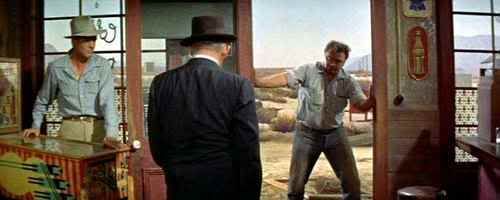
Kevin analyzes the Cinemascope flick Bad Day at Black Rock:

Back when I was writing up the posts on Shot Flow (here and here) in Who Framed Roger Rabbit, I watched Bad Day at Black Rock on Turner Classic Movies. I was in the mode of analyzing how shots hooked up, and I noticed something kind of amazing. Director John Sturges and cinematographer William Mellor (and an uncredited storyboard artist?) used screen direction to define character polarity. That is, if a character moved from screen left to right, he was good. If he was bad, the orientation was right to left (and I say ‘he’ because there’s but a single token female in the entire movie) ...

We know this ‘polarity’ information is frequently conveyed via musical cues, color, camera angles, and so on. A touch of ominous music or a subtly repeated musical phrase subliminally tells us who’s good and who’s bad. Or ‘cold’ colors predominate in scenes with the heavy, and ‘warm’ colors predominate scenes with the protagonist. Bruce Block lectures about how virtually any film-making element, if used consistently, can have storytelling properties like this. But I’ve never seen it done with screen direction. It just strikes me as counter intuitive, to say nothing of how difficult it is to stage virtually every scene to be consistent with such a self-imposed rule.

I broke down Bad Day at Black Rock scene by scene right after I watched it, and made some photo-montages to illustrate what I’m talking about. I’ve held off posting until the film came back on the TCM schedule, and they’re playing it tomorrow (June 17 at 6:45 pm PST, and again August 31). Take a look, it’s a pretty good movie (and if there’s interest, I might also discuss why I think it’s only good, and not great). After the TCM showing of the film I’ll post up the montages illustrating the use of screen direction.

Click here to read entire post

Work Begins on TAG's New Building

Front of building

It doesn't look like much now, but we're into the third week of reconstituting the Animation Guild's new building. One of the first jobs was to remove the old, ugly fake mansard roof from the front of the property. The structure is now gutted, inside and out, not even fit for a homeless person to sleep in.

Parking lot wall under construction

Workers rebuild the rear wall of the parking lot, moving it two feet further back to the property line. (Fascinating, no?)

Click here to read entire post

Correcting Deadline Hollywood's Misrepresentations

There's been some lively back and forth in comments below, but I wanted to address in more detail the post that got the ball rolling in the first place because some folks still don't get it.

But to scroll back to the opening act, Nikki Finke wrote on her website:

Sony is taking away [the writer's] right to be repped by the WGA's new contract. This is exactly what WGA leadership was afraid would happen to toon writers as more Big Media companies turn animation over to IATSE's jurisdiction because of the weaker terms of that union's contract.

To be transparent about this, I have no problem with Ms. Finke's reporting ... when she actually reports. But at the point she starts slinging charges and accusations with minimal factual underpinning, I take exception. To wit:

... By all accounts, the studio played fast and loose with the facts from the start. "Bill, Josh and Hurwitz all took Sony's statements in good faith that the show would be guild-covered," one of the writers told me tonight. "Because Sony was saying up and down the line that they were waiting for the pickup before signing with the WGA." Nor did the writers/producers have any reason to disbelieve the studio since a previous Sony animated TV show, Dilbert, had been under the WGA's jurisdiction.

And then IATSE's Local 839 -- the so-called Animation Guild Local (formerly Motion Picture Screen Cartoonists) -- arrived to everyone's shock and dismay ...

Shock and dismay. Satan's drooling spawn shows up and ruins the party, and heartache is rampant.

Let me explain in boring detail why Ms. Finke is full of it. Ten years ago, the writers on Dilbert were not part of Sony Adelaide. Sony had the scribes in a separate, non-signator company, and the WGA had every legal right to go in and organize them, and did. Cheers for the W.G.A.

But that isn't the case with the current situation. This time around (unless I'm misinformed) the writers are under Sony Adelaide, Sony's longtime t.v. animation division. And there's a horrid, unfair Federal law that prevents the W.G.A. from riding in and "organizing" writers who are, from a legal standpoint, already organized because they're working under a pre-existing union contract.

Now let me tell you about Adelaide and that pre-existing contract.

The division was set up in 1995, headed by Mark Taylor (currently at Nickelodeon) and Sander Schwartz (more recently at Warner Bros. Animation). TAG began an organizing drive with Sony Adelaide in the late summer of 1996. We set up lunches for employees with President Tom Sito, I went down to the front of the studio, stood on the sidewalk on passed out cards, the whole usual organizing routine that any grizzled labor person performs over and over and knows oh-so-well.

By Fall 1996, we had a majority of Representation cards, and filed a petition for recognition. All this took place before the WGA represented one animation writer anywhere.

Long story short: After lengthy jousting with Sony, after protracted negotiations, we signed a collective bargaining agreement in April, 1997. And from that day to this, we've represented Adelaide's writers, board artists, designers, background artists, all the people we've repped in animation since TAG's formation in 1952.

Meanwhile, the WGA represented nobody in animation. (It signed its Fox deal later that same year -- 1997).

But of course, in Ms. Finke's mind, we're the interlopers: "the so-called Animation Guild Local (formerly Motion Picture Screen Cartoonists) -- arrived to everyone's shock and dismay ..."

Right. We just crawled out from under our rock and snatched the chocolate cake from the writers' mouths. And it's pretty much our fault -- by implication -- that Sony strung these writers along. Problem is, had anybody picked up the phone and asked, we could have told them the reality: You can't throw a long-standing agreement out simply because somebody working under that agreement doesn't like it.

So here's a request to Nikki Finke: you want to be a reporter rather than a propagandist, pick up the phone and call the organization you're slandering for a comment prior to the smear. At least then you'll present the illusion of objectivity.

Click here to read entire post
Site Meter