Sunday, February 17, 2008

Sunday Papers

There was a lot of animation news in the Sunday papers, starting with:

Russia's animation industry looks set for a boost with TV station Channel One announcing it will be putting major funds into the sector -- starting with distinctive arthouse fare ...

"One of the targets of Channel One's cinema producing policy will be support of full-length feature 3-D animation blockbusters oriented at a wide family audience ..."

Channel One plans to deepen its relationship with Petrov and other gifted Russian animators, knowing that that even though their works aren't likely to be blockbusters, the Russian animation biz will stagnate without them.

"Nothing happens in this business without talented artists-animators, and we'll be doing our best to support them, too." ...

More players in the game. Is the field getting too crowded, or am I paranoid?

If anyone looks like "Mr. Inevitability" for the Best Animated Feature Oscar, it's the often-interviewed Brad Bird:

"[He] is singularly one of the finest and rarest filmmakers working today," [Disney Studios Chairman Dick] Cook says. "This guy writes, he directs, he does everything. He's incredibly smart and it shows up in all of his work."

Oh sure. Disney execs slobber all over Brad now. I can remember when Disney execs were firing his butt.

However. Is the Big Mouse laying it on too thick? Because there are a couple of dark horses in the Oscar race, one of them being a surfing epic:

Oscar prognosticators expressed surprise, even shock, when "Surf's Up" received a nomination alongside Sony Pictures Classics' "Persepolis" and Pixar Animation's "Ratatouille," the favorite to win. It trumped two Golden Globe nominees, "The Simpsons Movie" and "Bee Movie" with Jerry Seinfeld. But the arched eyebrows had less to do with the movie's merits than with its apparent invisibility among industry insiders.

"I don't know anyone who's seen it," says one Academy Award consultant for a rival studio.

But I do. A veteran director -- a very talented guy -- came up to me a month ago and raved about the picture. "It was really good. Funny, and I liked the characters. I took way too long to go watch it."

Click here to read entire post

Saturday, February 16, 2008

Production Maw Compression

Last week I got to talking with a long-time teevee animation vet about how the production pipeline tends to compress everything toward "the middle."

I noticed this years ago when I worked in game. I notice it now.

Like, if you have a script that's way worse than the normal half-hour in the 39 episode order, by the time the script is boarded, designed, sent overseas and returned in color to post, the finished product is closer to the average.

That's because everybody along the way (assuming they're hard-working professionals who care, and for our purposes we do) is striving to the utmost to create a silk purse no matter what the condition of the piggy's ear.

Board artists work hard to make the incoherent have a beginning, middle and end. To punch up gags. To restructure where necessary (and where they're allowed to).

Designers do their usual professional jobs. As will b.g. artists, checkers, everybody else.

And film editors will struggle to the max pulling the whole enterprise together. Like always.

In the other direction, a script that's better than the usual specimen will get the board artist saying: "Heey. This one works! I don't have to spend an extra twenty hours beating my head against a wall!"

And (s)he will spend less time and effort reworking and polishing because there will be less need to. So the resulting board will be as good ... but likely no better ... than the original script.

And the designers, b.g. artist, checkers and editors will do their usual sterling work. The animation crew overseas will put the characters through their paces in the regular way. (Another day, another Yuan.)

So the final result will be that the "good" script gets closer to the average because nobody is forced to work extra hard to make it shine, and the "bad" script will rise to the mean because it will be improved by each set of hands through which it passes.

Am I neglecting anything?

Click here to read entire post

Valentine Box Office

"Doing anything later tonight?"

The three new arrivals to your neighborhood AMC have bumped Kate and Matt down three notches.

Fool's Gold took a 50% hit Friday as Jumper, Step Up 2 the Streets and The Spiderwick Chronicles shoved past it to 1st, 2nd and 3rd on YMHP*

Meanwhile, the almost-gone Alvin and the Cees reached $210,460,191 on its 64th day of release ...

Update: The weekend finals were hardly surprising. Jumper, despite near-universal pans, ended with $27,225,000. Step Up 2 the Street and Spiderwick Chronicles came in 2 and 3, and both at the $19 mill opening weekend level.

Among animation in the marketplace, Alvin is at #19 and dragging $211.3 million in bullion behind him; Persepolis stands at #24 with a $2.9 million total, and the hapless Pirates Who Don't do Anything resides at the 28th domicile with a cume of $12.1 million.

* Your Movie Hit Parade

Click here to read entire post

Animations?

TAG Prez Kevin Koch discusses some of the terms ... and intricacies ... of the art of animation:

There are some terms that I find students struggle with, some of which come from traditional animation but tend to get mangled on the CG side of the fence. First, let’s start with one that isn’t a word: animations. I can’t tell you how much this grates on the ears of anyone who comes from traditional animation, be it hand-drawn or stop motion ...

What amuses me about terms that came into wide usage in the 1930s was how the spelling shortened and changed: roughs = ruffs, effects = effx. One of my favorites is how the storied feature animation director Wilfred Jackson's name morphed into Jaxson on memos and model sheets.

Click here to read entire post

Friday, February 15, 2008

If They Want To Get Rid of You ...

... it's sometimes tough to stop them.

I bring this up because a while ago ... and also at various times over the years ... I've seen artists railroaded out of a job not because their work was sub-par but because:

1) The boss was out for them. (There'd been some argument, and despite apologies, the head guy still held a grudge.)

2) The boss had a pet or pets he wanted to bring in to the artist's job-slot, and the artist was in the way ("Nothing personal, but my buddy takes precedence over you.")

3) The boss is told by a higher up that (s)he must make room for somebody else on her or his crew ... so the employee is handed a layoff slip, or written up.

You can probably think of variations to the above, but you catch my drift.

The shoals and eddies of the workplace are often treacherous. As an employee, new or old, you deal with over-sized egos, overactive paranoia, territoriality. These realities are always there to a greater or lesser degree, and an employee always has to be aware of them ... or suffer the consequences.

Many times, despite being endlessly pleasant and hard-working, artists suffer bad consequences anyway, because many things are simply outside their control.

How does a labor union enter into all this? Over the years I've found that the most effective way to counter these kinds of problems is to strategize remedies:

That could mean making "nice" to a supervisor who, frankly, doesn't deserve to be made nice to, but that's the best political move to make. It could mean recruiting allies who will vouch for the quality of the employee's work. And in certain situations it means filing -- or threatening to file -- a grievance.

The grievance route -- a step-by-step process between union and company that starts with a letter from the union laying out the problem and ends with a binding judgment by an outside arbitrator -- can be either effective or counter-productive.

I always tell a potential grievant the prospects I see for winning and losing a grievance. And I go over the ramifications a grievance will have. It seldom makes the company happy (it's a pain in the backside, it takes up time, etc.) And it can often (though not always) get the grievant pegged as a "trouble maker," which hurts the grievant's future employment with the company. But I've had studios tell me after a grievance, "that person is never coming back here!" And twelve months later, the person is back.

And sometimes push-back is helpful; in fact the only logical thing to do. We've had a number of grievances through the years where individuals have walked away with cash settlements because studios messed up the contractually-required discharge procedure (one write-up warning of a problem, followed by a second write-up). Occasionally the company backs off because it doesn't want to hassle the time and expense of full arbitration, and so compromises.

One point I emphasize to employees who are hot to file a grievance: You can be the finest artist this side of Michelangelo or Leonardo Da Vinci, and no arbitrator will go near the question of whether your storyboards or design work are "good" or "not good." The only thing an arbitrator will consider is, Were the contract provisions followed or not?

This is sometimes tough for aggrieved artists to process. "I was screwed over! My work is great! Why can't I bring that fact into the arbitration?" Because arbitrators aren't experts in line quality and artistic ability, and they always flat-out refuse to become one for the purposes of a job dispute with a conglom.

The cold reality: If Fat Cat Productions wants you gone badly enough, you'll be gone. Often the best solution is to walk away and get on with your career and life. But there are sometimes ways to soften the blow of an abrupt departure.

Click here to read entire post

Behind the Scenes of the WGA Strike

I've already credited the WGA with pulling off a credible strike and new agreement. The Artful Writer has good information about what was going on back channel over the recent 101 days of the Writers Guild job action:

One of the stranger moments to occur in the waning days of the strike was a reference by John Bowman to the “Dirty Thirty.” The urban myth says that a meeting took place, awful things were threatened, but the Guild stood firm!

It sounded fishy to me when I first heard about it, because, well, it sounded fishy.

Howard Michael Gould, a member of [the WGA's] Negotiating Committee, sets the record straight, and does so importantly ....

Reading Gould's insider report, it confirms a lot of things I thought might be going on at the time.

What's interesting (amazing?) to me is how many studio and union people I bumped into over the last few months who were wrong about how events were unfolding ... and how the strike and negotiations would ultimately play out.

Click here to read entire post

Another Linkfest

Star Wars? There's never enough (just ask my teenager) ...

The saga is set to continue with the release of Star Wars: The Clone Wars – a 3-D animated film hitting theaters in August before making its way to television in the fall.

This film won’t be distributed by Fox, but will feature a new partnership with Lucasfilm, Warner Bros. Pictures and Turner Broadcasting.

Variety reports the August 15th release of the film will premiere the new animated series which will make its way to Cartoon Network and airings on TNT. The release dates for international theaters and television series are still being set.

The Animation Archives puts up some excellent artwork by Gustaf Tenggren, one of the top-drawer artists who found a home Disney's Hyperion studio in the thirties:

While at Disney, Tenggren chaffed under the bit of anonymity. It's said that Walt instructed his artists, "If you're going to sign a name to your artwork, spell it 'Walt Disney'." But Tenggren defiantly maintained his individuality, signing many of his key paintings for Pinocchio. He left the studio under unhappy circumstances, and was bitter about the whole episode. But he had learned one thing from Walt... the power of branding one's self.

UPA's icon Mr. Magoo is returning to the big and small screen ... via Mexico:

Toon factory Anima Studios will produce "Kung Fu Magoo" for Classic Media, in a major deal for the budding Mexican shingle ... "Magoo" will go straight to video worldwide, but it's being produced in 35mm and Anima will likely engineer a theatrical release in Mexico via Videocine ...

N.Y. Daily News film reviewer Jack Mathews lists his "Five greatest animated films of all time."

“Aladdin” (1992). Maybe it should be titled “Robin Williams’ Aladdin.” His voice work as the Genie inspired the greatest animated movie of the hand-drawn era.

Personally I think it's silly to have "Best" lists. They just set off arguments and debates (which maybe is the point ...)

DreamWorks Animation got a downgrade from BMO Capital Markets and lost a little ground in the stock derby:

[BMO Capital Markets Analyst] Jeffrey Logsdon cut his rating to "Market Perform," or "Neutral," from "Outperform," or "Buy." He said the company's results vary with the success or failure of its movies, which is hard to predict, rather than showing dependable growth.

I think Jeffrey K. and Co. have done a helluva job at DWA, but it's definitely a high-wire act when your business model is "Make every feature release a hit." (This was also Pixar's model, but Pixar is now a division of a conglomerate with a well-loved name.)

And New Line Cinema (owned by Warner Bros.) is now in the animated feature business ... and they got the voices cast!

...[T]he CG-animated sci-fi film "Planet 51" ... revolves around a group of residents on the eponymous planet who fear an alien invasion. Johnson will play astronaut Capt. Charles "Chuck" Baker, who arrives from Earth and confirms their worst fears. He's forced to avoid capture so he can find his spaceship and return home ...

Dwayne "The Rock" Johnson, Jessica Biel, Seann William Scott and Justin Long will voice lead characters in the [film] ... It marks the studio's first animated feature in its 40-year history.

The sad part is, it's gonna be produced in Spain.

To wrap up, The New York Times reviews the animated shorts up for an Acadamy Award and discovers there isn't a lot of domestic content:

... Academy Award Short Nominees: Among the animated films nothing resembles a traditional Disney cartoon. Sophisticated illustration, puppetry, stop-motion animation and digital wizardry are the order of the day. And what does it mean for American cinema that among the nominated shorts, not one was made in Hollywood or even in the United States?

Especially in the animated category, advancing technology has sparked an astonishing creative revolution ...

Have a fine and lively weekend ...

Click here to read entire post

Thursday, February 14, 2008

Hi Def Wars Over? Or Not Over?

USA Today says that the battle over HD continues (so what do I know?):

During the last six weeks, Hollywood studios, consumer electronics companies and retailers have given Sony's (SNE) Blu-ray format a seemingly insurmountable edge over its rival high-definition DVD format: Toshiba's HD DVD...

"Warner's jump was the last straw to break the camel's back," says Walt Disney Studios Home Entertainment President Bob Chapek. "The format war's over."

Well, maybe. The HD DVD camp — which includes Universal, Paramount, DreamWorks Animation and Microsoft (MSFT)— hasn't raised a white flag yet.

But it also isn't predicting victory ...

Well. That's clear enough. HD has lost out to Blu Ray. Unless it hasn't. Got it.

"There are a lot of other product areas where different formats coexist," says Jodi Sally, vice president of marketing for Toshiba's digital AV group. "Look at gaming (where Nintendo and Microsoft compete with Sony). There are discs that won't play in each other's machines. Apparently that is the current scenario" for high-def DVDs.

Don't think so. How long did Betamax co-exist with VHS? A couple of years? Then it was over.

I think there's minimal chance that two semi-identical but incompatible formats will be flourishing side by side. Just doesn't make sense. Sooner rather than later, the marketplace will sort out a winner, and this time, Sony will probably win.

If two formats are going to be duking it out over a long period of time, it will probably be high-def downloads vs. a single disk format. Not Blu-Ray vs. HD.

Update: Okay, we can say with certainty that USA Today has its head up the old large intestine. Because now this has happened:

HD DVD, the beloved format of Toshiba and three Hollywood studios, died Friday after a brief illness. The cause of death was determined to be the decision by Wal-Mart to stock only high-definition DVDs and players using the Blu-ray format.

The format war confounded and frustrated consumers in Tokyo, above, and elsewhere. There are no funeral plans, but retailers and industry analysts are already writing the obituary for HD DVD.

So it's downloads (out there in the future, maybe) and Blu-ray. Roger on that.

Click here to read entire post

The Disney Background Department! During Jungle Book!

Here are three pillars of the Disney background department, circa the middle sixties, admiring their collective handiwork on some feature or other.

Kneeling on the left is Al Dempster, head of the department and a crackerjack artist. Standing is Bill Layne. Kneeling on the right is background veteran Art Riley ...

The Disney background department had a rep for professionalsm and hard work. And longevity. Art Riley and Al Dempster both started in the department before World War II, working on the early features. Bill came aboard in 1942, around the same time my father worked his way into the department (he'd been in effects before that.)

The background department was up on the second floor of the original animation building, Wing 2-F as I remember. All the artists' rooms had deep sinks and lots of windows with plenty of light. They had a quota of backgrounds to do each week and they all hit their marks.

Al and Bill departed the studio in the mid-seventies for retirement and more time to paint on their own. Art left in the mid-sixties to care for his aging and ailing mother.

Art Riley would probably have been considered the most eccentric of the group. Lived frugally. Invested some of each paycheck in blue-chip stocks. Lived with his mother. Also didn't get out much.

Story artist Vance Gerry told me the story of how Art drove a Disney artist home one day because the guy had car trouble. And the artist asked Art to stop "at the store" so he could pick up a couple of groceries.

Art got out of the car with the guy and accompanied him into the market. When they got through the double doors, Art looked up at the fluorescent lights and the long rows of shelves with baked goods and breakfast cereal, all the bins of fresh vegetables and said:

"This place is amazing. What do they call this place?"

The artist looked at him and said, "It's a supermarket, Art."

Apparently Riley didn't do much food shopping. He'd never been in one.

Bill Layne at work on the second floor ...

And thanks to Ann Guenther for the use of the pictures.

Click here to read entire post

Wednesday, February 13, 2008

Studios ... Round and About

Nick nick nick-o-lodeon ...

Wandering through Starz Media/Film Roman a few days back, the place was two thirds deserted.

This was just before the writers of the WGA gathered at the Shrine Auditorium and declared victory ... and an end to the strike. But the few Simpsons artists who were still in the building were upbeat about full production coming back soon. (Some artists have been off since November and early December, and if the e-mail I received this morning is indicative, anxiety has increased:

"I need to get back to work soon!"

Over at Nickelodeon, I fell into a conversation with a studio higher up about whether they would be doing more scripted shows now that Brown Johnson was the new Nick top-kick. She told me:

"We're already doing a lot of scripted shows. I don't think there'll be big changes."

And that let to a question from me about more collaboration between writers and board artists, maybe gag crews to punch up stories and scripts. The exec said she'd tried to get that kind of stuff going, get more interaction, but there was some, ahm, resistance.

"Egos. Territoriality," I said.

"Ah. You know about that."

"I used to work in animation story departments. I'm old, but I remember."

Click here to read entire post
Marc Davis at Disneyland

A month before Marc Davis's passing on January 12, 2000, he and Ann Guenther were guest speakers at the Fantasy Fun Club at the Disneyland Hotel. Their mission: To talk about "the old days" at the Disney Studio.

For Marc, that meant the 1930s and Hyperion:

... [T]he first job I had at the studio was "Snow White". I don’t like the term particularly, but I got stuck with the human characters ... One of the things Milt Kahl and I suffered from was that we could both draw so much better than some of the others. We both had a better understanding of the human figure, and there simply weren’t that many people who could handle them. After a while these things just became automatic: “OK, Milt does the Godmother and Marc does the Princess.” We both really wanted the opportunity to do some of the things we would have loved to have done and were quite capable of doing ...

For Annie, that was the Burbank Studios in the 1950s, when she rolled into California, a fresh-faced teenager from Pennsylvania, and broke into animation ...

She discovered there was some, ah, regimentation:

In the fifties, men wore white shirts and ties. The women wore dresses. One woman, Renee Henning in the ink and paint department, decided to wear a stylish pantsuit to work. She was called in by Supervisor Grace Turner and told if she wore it again she would be fired. Well, she wore it again and was fired.

The photo above was taken by Alice Davis, Marc's wife. Ann Guenther believes it was one of the last photographs of Marc taken.

Click here to read entire post

Tuesday, February 12, 2008

Chinese Animation

Kevin Geiger, a longtime TAG shop steward at Disney and now captain of his own ship, sent me this article a few days back. Slug that I am, I'm just getting to it now. Kevin gives us a short primer (via o-meon) in Chinese animation, past and present:

The history of Chinese animation dates all the way back to 180 A.D., when inventor Ting Huan created the first zoetrope. Ting Huan's automated contraption hung over a lamp: rising hot air turned vanes that spun sheets of paper on which sequential images magically “came alive” ... With ambitious animated films such as the Wan brothers' Princess Iron Fan (released within two years of Disney's Snow White, during the Second Sino-Japanese War no less), China's fledgling animation industry was technically and artistically on par with the rest of the world. At the Shanghai Animation Film Studio, remarkable animated features, such as the vividly colored “Havoc In Heaven”, were created with the active support of the central government ...

China has done sub-contracting work for American animation for decades. (A Shanghai studio inked bubbles for Disney's The Little Mermaid back in the late eighties.) As Kevin points out, China is now in the process of building its own domestic animation industry.

The question comes up again and again: "Is U.S. animation going to be sub-contracted away?" My answer is the same now as it was a half-dozen years ago. The world gets more inter-connected by trade and high-speed internet minute by minute. Work will be "going away" at the same time work grows by a factor of three.

Labor costs are only one part of the equation. There's also the concern of quality control and cultural differences, also this: American producers have discovered over the years that some types of out-sourcing work better than others.

American animated features outsourced to the Pacific rim have never made it big at the box office. Doesn't mean that it won't someday happen, but it hasn't happened yet. And that plays into production calculations by American Animation Studios. Ice Age: The Meldown was created in White Plains New, York, not Beijing ... or Dubai ... or Monaco. There's a reason for that. Hoodwinked -- out of Manila -- made money, but it wasn't a $700 million worldwide blockbuster.

Which isn't to say that the majors won't produce a big-budget feature in China or India at some point in the future. World economics are ever-changing. But global animation has grown steadily for years, and I have a tough time envisioning the United State and Southern California not being major players in it far into the future.

Click here to read entire post

Son of Linkorama

Still early in the week, but let's redirect some traffic to subjects we've been dealing with around here.

Walt Disney Productions from a while ago: Disney veteran Floyd Norman talks about when The Rescuers was going to be a nice, simple, inexpensive movie. This wasn't in the seventies, but the early sixties ...

The first "B" [animated feature] was underway. Writer/artist Bill Berg began developing "The Rescuers" as a feature film ... Bill quickly had his boards completed, and ready to show to Walt Disney ...

I was close enough to hear the pitch through the closed story room door. Over an hour had passed and all appeared to be going well until the door opened, and the old guys walked out into the hallway. I moved toward the story room just in time to see the Old Maestro himself walk past me and down the hallway. The look on Walt's face, and his overall attitude told me all I needed to know ...

When I got to Disney's in 1976, a different version of The Rescuers was being completed. Artists who were working on it told me this second version had also been considered a "B" movie (originally boarded by story artist Fred Lucky) but then turned into an "A" production ...

The Writers Guild Strike: Patrick Goldstein at the L.A. Times has a nice compendium of Winners and Losers:

Winners

* The WGA leadership: Whenever I spoke to studio chiefs, they heaped abuse on Patric Verrone and David Young, dismissing them as naive, hapless militants with no clue about how to negotiate a showbiz contract. All wrong. Despite some missteps along the way, the WGA leaders kept their fractious membership together, courted the powerful TV show runners, thrashed the studios in the PR wars and stayed cool under fire. For all the concessions they had to make, they got the guild perhaps the best deal it's had in decades. If that's not saying much, that's more a reflection on the perilous state of unions and Hollywood than on the WGA ...

* Nikki Finke: As much as I hate complimenting someone who has consistently belittled my newspaper's coverage of the strike, not to mention trashed my own work, it's impossible to ignore the fact that Finke turned her Deadline Hollywood Daily blog into a must-read for timely strike coverage. While many of my writer pals scoffed at the accuracy of some of her "scoops," she racked up an eye-popping amount of traffic, proving again that the Web is a great leveler, allowing one dogged reporter to successfully compete with far bigger news organizations ....

Lastly. Toon Zone interviews Nickelodeon Veep Teri Weiss about Nick's debuting cartoon series Ni Hao Kai-Lan:

[NHKL] began as a series of shorts that we did ... [O]nce those shorts were complete and we saw this little girl come to life, we just thought there was something there that we wanted to explore in a much deeper way. We just felt like the designs were so beautiful and unique, we thought that the spirit of the character was infectious, and we wanted to see what else we could do with it ...

And so on and so forth.

Click here to read entire post

Monday, February 11, 2008

WGA Organizing Writers in Animation

An interesting comment down below regarding the WGA's organizing ... and negotiating for ... writers working in animation:

... WGA members waved the flag that "everything has to be written first." For animation, such a statement directly devalues the art created in the animation process.

If Verrone were serious about organizing animation, he would have included artists in his dialogue - would have really reached out to TAG for public dialogue. Even leading up to the negotiations ...

So that everyone knows, there have been occasions when the WGA has attempted to organize animation board artists. (Not many, but it's been tried. Without success.) ...

This afternoon I was talking to an animation writer at one of the congloms who asked me: "What does it take to get animation writers into the WGA?" Here's more or less how I answered him:

A lot.

The pie got divvied up around 1940. Animation writers and board artists went into the Screen Cartoonists Guild, live-action writers into the Screenwriters Guild. It's been pretty much the same since.

The Writers Guild has made runs at animation writers over the decades. The Guild's first notable success was with The Simpsons in 1997 when it negotiated an agreement with Fox for prime-time animation. A few agents told me at the time that the other studios hated this deal, but Fox does what it consider to be best for Fox (just like every other big company in Hollywood. And everywhere else.)

Outside of prime-time, the WGA has negotiated some other concessionary agreements with animation producers that exclude residual payments. WGA Prez Patric Verrone worked under one of these agreements on Class of 3000.

But what would it take to get animation writers out of The Animation Guild and into the WGA?

1) The IA President would have to agree that the IATSE would no longer represent writers in its traditional jurisdiction (animation.) The animation representative (me) doesn't have the authority.

2) It would then take the various companies who have collective bargaining agreements with the IATSE/Animation Guild to agree that animation writers would be excluded from those contracts.

3) After those things happened, the WGA would have to organize the non-represented writers and successfully negotiate collective bargaining agreements with those companies that included animation writers.

Since the WGA just failed to get jurisdiction of animation scribes via the AMPTP, I would say the odds against most writers in animation migrating to the WGA anytime soon are high. I'll be honest here. I'm the IA/TAG rep, so I have a dog in the hunt, but the canine is small.

There are many animation writers that don't think it's fair that they don't receive residuals. I believe that everyone should make as much money as possible, but I don't have much of an opinion on the fairness thing, because I don't believe in "fair" or "unfair." I'm a union guy. I know from long, hard experience that you only get what you have the leverage to get.

Anyone who's followed the WGA-AMPTP negotiations know this too. The scales of justice have little to do with it.

Click here to read entire post

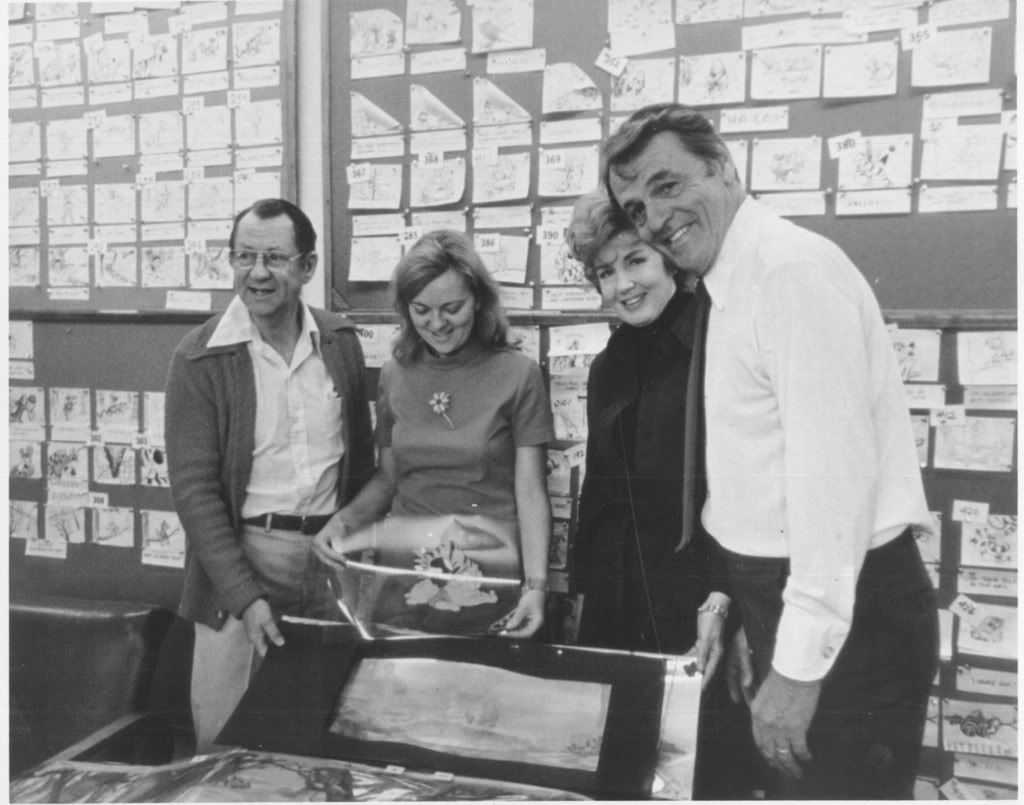
Woolfgang and Co.

A quick ride on the wayback machine ...

A workday at Walt Disney Productions, circa the early 1970s.

Here we have background artists Bill Layne and Annie Guenther, layout artist Sylvia Roemer and producer-director Woolie Reitherman going over a color set-up for "Winnie the Pooh and Tigger Too"

...

But it's clearly a publicity photo-shoot, since there are storyboards behind them, and color set-ups were done down in the ink-and-paint building, under bright lights.

Thanks to Ann Guenther for dropping this pic off at the office so we could put it up ...

Click here to read entire post

Pixar Triumphs Again

The bay area is on a roll. While Industrial Light and Magic picked up a load of Awards at the Visual Effects Society's clambake at the Kodak Theatere Sunday night, there was also another northern California studio that did okay:

... in a surprising turn, Pixar's RATATOUILLE was right behind with three awards for outstanding supporting visual effects, outstanding animated character (Colette) and outstanding effects in an animated feature for its innovative food, marking the first-time distinction between vfx for live action and animation.

So that's like what? 427 awards in three days?

I'm going way out on a limb here. I'm betting that Ratatouille does really well at the Academy Awards, and the heavily favored other pictures less so.

Click here to read entire post

Sunday, February 10, 2008

In Praise of Patric Verrone

From comments at United Hollywood:

Don't think for a second that AMPTP entering "informal" talks was not conditional on reality and animation being dropped. AMPTP has been allowing Verrone et al to save face, because membership goodwill toward Verrone is helpful when he champions this crappy contract.

Make no mistake. Verrone is owned by AMPTP now. He may not like it, but AMPTP has more control over his opinion than he does now. Because when it's about face-saving, the one who allows you to save face controls everything. The NegCom is essentially AMPTP at this point.

Not hardly ...

Mr. Verrone is like most other union officers in the United States today: He leads an organization that is badly overmatched against corporations that have the deepest of pockets and the basest of motives.

At every turn, in every circumstane, they quite simply want it all. And today in Hollywood, the only groups that keep them from devouring the entire enchilada happens to be labor unions, yet unions operate on a playing field that's about as level as the upper elevations of Everest, and almost as treacherous.

I'll be crystalline here. I don't agree with the WGA's grabs for other unions' and guilds' jurisdictions. I couldn't agree and remain an employee of the IATSE. But Patric Verrone played his hand -- given what it was -- about as well as it could be played.

* He orchestrated a job action when the companies didn't expect it.

* He held his unit together for thirteen weeks.

* He initiated events that provided the Directors Guild of America maximum leverage at the bargaining table ... and the directors' result contributed greatly to WGA's ultimate success (just as John Wells said).

To be sure, there was pain and collateral damage with this strike, but there could have been more. And the pattern of agreements that has now been stitched by the WGA and DGA will (probably, hopefully) preclude an actors' walkout in July, for by then other unions will have hammered out new contracts with the AMPTP based on the writers' and directors' precedents.

What some union and guild members don't understand is that the power entertainment unions enjoyed when movie studios teetered on bankruptcy in the early sixties was far greater than it is in 2008. A long strike then meant death for a Warner Bros. or Twentieth Century-Fox; today all it means is a mild head cold.

So. Is Patric Verrone a tool of the AMPTP? Only if you dwell in some alternate universe that is now sixty years behind us.

Click here to read entire post

Saturday, February 09, 2008

The Box Office List

Friday's numbers roll in about where expected.

Fool's Gold, despite wretched reviews, sails to the top with $7,650,000 ..

Hanna Montana falls to #3 -- displaced by Matt, Kate and Martin Lawrence -- but the little lady has by far the tallest per-screen average: $4,148.

On the animation front, Alvin has fallen to #19 on the Hit Parade, but look at its domestic cume! $208.4 million! Not at all shabby!

Update: As the weekend wraps, the new releases end about where the parent studios expect:

The lacklustre Fool's Gold breaks through the $20 million barrier with $22 million (until the optimism is revised downward on Monday); Roscoe Jenkins is #2 with $17,127,000 ... and a higher per-screen average.

Among the other top ten, There Will Be Blood, Juno and The Bucket List drop the least, the vivacious Hannah Montana the most.

Click here to read entire post

WGA East/West Has a Deal

Looks to me like the Writers Guilds of America, East and West, have themselves a deal.

Looks to me like it's a kissing cousin of the DGA deal (time will tell) and that the WGA Neg Comm is advocating its ratification:

... we believe that continuing to strike now will not bring sufficient gains to outweigh the potential risks and that the time has come to accept this contract and settle the strike.

Much has been achieved, and while this agreement is neither perfect nor perhaps all that we deserve for the countless hours of hard work and sacrifice, our strike has been a success ...

None of this should surprise anybody. The way this went down was, the "difficult" WGA (difficult for the AMPTP) negotiated to a stand-still back in December. The Alliance walked out to work a deal with the DGA (more "reasonable" but still tough).

The DGA had a brisk wind at its back thanks to the Writers Guild strike. The congloms were motivated to make a deal because the strike hurt. (They weren't going to give away everything on the dry goods shelves and back in the store room, but the corporations bent farther than they would have liked to.)

Once the deal was done, the end-game was pretty predictable. The corporations weren't going to do a hugely different agreement for the WGA, because they had a precedent. They did some tweaking. And they took mean old Nick Counter out of the negotiating equation, replacing him with the non-demonized CEOs Iger and Chernin.

And they negotiated, pretty much, the agreement the Directors Guild walked away with.

So what happens now? The road map seems pretty clear: the WGA membership will ratify, although various people will be complaining. AFTRA will negotiate a deal. The IATSE will negotiate a deal.

And SAG will be unhappy. They will state that the other unions' agreements can't be the template for them, because their needs are different, that they'll have to get more and better, etc.

But they will, when the dust particles float back to earth, negotiate a similar agreement to DGA, WGA, AFTRA, and IATSE.

It's pattern bargaining, and the way of the world. Like it or not, we must deal with it.

Update 1: And WGA East has had their meeting, and it appears that the majority are okay with the agreement:

New York -- More than 500 WGA East members poured in to a ballroom at the Crowne Plaza hotel in Manhattan on Saturday afternoon to debate the draft agreement reached by producers and writers early Saturday morning, in what was the writers guilds first test of the proposed labor agreement.

The session, which lasted nearly three hours, didn't result in any concrete resolution. But leadership said they were encouraged by what they called a very positive response to the proposed agreement, a development which increases the likelihood that leadership on Sunday would recommend that the board approve the deal.

"I think the meeting went very well," said WGA East president Michael Winship, who noted that he thought there were more members at this meeting than at the one authorizing a strike three months ago. "There was a frank discussion of ideas, and everyone who wanted to ask a question got to ask a question."

I'm betting that a) the good east coast meeting will be atopic at the Shrine meeting here in L.A., and b) the thrust will also be positive on the Left Coast.

Update 2: Screenwriter/blogger John August weighs in on the deal, and finds it acceptable:

So is this deal, today, good enough to accept?

It’s a yes for me. And I suspect it’s a yes for most writers. Some would shout yes emphatically, with a victory dance around a giant picket bonfire. Others would mutter yes with a forlorn shrug of their shoulders, deeply dissatisfied yet not able to rationalize a no vote. I’m somewhere in-between. I don’t think it’s great — hell, it’s not even “good” — but it’s honestly better than I thought we’d get.

And WGA member Mark Evanier live blogs from the festivites at the Shrine Auditorium:

Hello from inside the Writers Guild meeting where some of us are getting a bit weary of leaping to our feet for standing ovations. That's about the extent of the negatives so far...and while no vote has been taken (I'm not sure any votes will be taken this evening) the sense of the room is quite celebratory ...

So. Unless I'm missing something, it appears that the WGA Strike Circa 2007-2008 is pretty close to being history.

Click here to read entire post

Friday, February 08, 2008

Linkorama

Another end-of-week frolic through 'toon news you probably can't use (but might be interested in anyway...)

I've never thought of Argentina as a hotbed of animation. I guess my ignorance demonstrates what a sheltered life I lead.

Argentina is becoming a Latin American hot spot for animation, with producers entering the field with projects that fuse local flair with international standards.

Illusion Studios, behind blockbuster "Patoruzito" with Disney-backed Patagonik Film Group, has refashioned its pencil-based production operation into a digital studio with 2-D Toon Boom and Maya 8.5 3-D software.

Lately there's been a lot of shifting of cartoon execs from one studio to another. Brown Johnson, longtime Nickelodeon exec, has been promoted to the position of President of Animation, for Nick, MTVN Kids and Family Group.

In 2008, animation on Nickelodeon will include more than 225 new episodes of Nicktoons series. Supervising successful titles to the tune of SpongeBob SquarePants, Avatar: the Last Airbender and Back at the Barnyard, as well as overseeing the development of new titles, such as The Mighty B and The Penguins of Madagascar; Brown Johnson will be plenty busy. She will supervise creative executive teams on both the East and West Coasts, managing the creative direction and coordination efforts between series production, on-air promotions and marketing and consumer products.

TAG President Kevin Koch has a piece at Synchrolux on the perils of too much "constructive crticism" lousing up creative juices:

... people can be creatively shut down by those trying the aid them with ‘helpful’ suggestions. ... As a mentor and as someone who believes in actively collaborative environments, I worry that I’m sometimes on the other side of this equation, that I’m the one shutting people down ...

Where I’ve felt this phenomenon most obviously, however, is when I’ve been kicking around an idea for a film or some personal animation, and someone does this number to me:

"If we are honest with ourselves, when we start excessively pontificating and trying to add value, we are often not really focused on the quality of the idea at all. We are just trying to prove to the world how smart we really are.

Ideas are really fragile that way, and sharing them with a pontificating know-it-all is sure death to those ideas. Or at least death to your drive to go forward and develop the ideas ...

The Annie Awards happen tonight at UCLA. It outgrew Glendale and the Alex Theatre and so ... hello Westwood!

For the fourth straight year in a row, everyone's favorite animation host and voice of SpongeBob SquarePants Tom Kenny will host this year's Annie Awards ...

In the feature categories, Pixar Animation Studios' "Ratatouille" leads the field this year with 13 nominations including Best Animated Feature as well as individual nominations for directing, writing, character animation, animated effects (two nominations), production design, storyboarding, character design, character animation, music and voice acting (three nominations). Sony Pictures Animation’s “Surf’s Up” follows with 10 feature nominations for feature, animated effects, animation production artists, character animation (two nominations), character design, and directing.

Rounding out the Best Animated Feature category are DreamWorks Animation’s “Bee Movie,” Sony Pictures Classics’ “Persepolis,” and Twentieth Century Fox’s “The Simpsons Movie.” ...

(Update: The boys and girls at Pixar almost sweep the feature animation category. Who would have guessed it?)

The Motley Fools weigh in that, despite the current financial troubles of the greater market, Disney had itself a fine quarter:

Fiscal first-quarter revenue climbed 9% to nearly $10.5 billion. Earnings -- before asset-sale gains and one-time items from a year ago -- soared 29% to $0.63 a share. Analysts expected a profit of just $0.52 a share on $10 billion in revenue ...

[Disney CEO Robert] Iger referred to what the company is calling "The Disney Difference" during yesterday's conference call. Disney feels that it is in a more recession-resistant position than its competitors. No leisure company may be completely insulated from an economic slowdown, but Disney's various moving parts prove that its unique promotional ecosystem is enough to keep it afloat during lean periods ...

Lastly, Mike Judge will be rolling out new animated projects:

Media Rights Capital is now mounting a strong smallscreen push, starting with a 13-episode order from ABC for a new animated series from Mike Judge.

"The Goode Family," which is also from "King of the Hill" exec producers John Altschuler and Dave Krinsky, reps the first animated project for Judge since "Hill" launched in 1997.

Headlines from the deal also include a 10-episode order for an animated series at HBO ...

Have yourself a safe and sane weekend.

Click here to read entire post

Beginning

Detail how to work in the industry fresh out of school without getting screwed...

Easier said than done. When I started, I was fortunate to get into a trainee program at Walt Disney Productions, where salaries and job classifications were pretty cut and dried. They paid you scale, and you worked your way up.

You didn't make a lot of money, but you didn't get shafted, either.

It's my experience after doing this job awhile that many companies play fast and loose with state and federal labor regulations. Some do it willfully (they know better but figure they can get away with some cheating), and some do it out of ignorance. Either way, it adds up to the same thing.

But to the question: "How does a newbie avoid getting screwed?" ...

The short answer is, you have to know what your rights are. You don't know the basic rules, you're going to just blunder along relying on the benevolence of your employer. Sometimes (not always) that's a dangerous thing to do.

So. What are these rules? There's a ton of them, so I'll only touch on a handful of important ones.

You work as an employee or an independent contractor. (I discuss the differences here.)

Generally, an independent contractor works with his own equipment and tools in his own workspace, has minimal to no supervision, gets paid by flat check, etc. (The Internal Revenue Service has a list of guidelines.)

If you're an employee, you're either exempt from overtime rules because you're "creative," or "managerial" or "professional," or you're non-exempt (non-exempt from overtime -- usually "time and a half" after forty hours in a week; double time during the seventh day worked.)

Under Federal regs, "animator" (in quotes) is a non-exempt category. Surprised? Well, the Fed's reasoning is that animators are working with pre-existing figures/characters (true for both traditional and cgi), therefore they are non-exempt from overtime rules.

This reg is pretty much ignored. (Game and cgi studios argue that digital ain't the same as traditional, but I don't believe the issue has been litigated to a final conclusion. I don't pore over law journals, so I could be wrong.)

Most assistant work is non-exempt. Most assistant type work on the production side ("p.a.") is also non-exempt.

In California, employees have the right to share wage information, something many companies strive mightily to discourage. (I've had employees complain about intimidation by production execs on this score numerous times. When the employee points out California law protects sharing salary info, the exec quiets right down).

In our corporatist society, there is huge pressure to keep employees ignorant of labor law. (I served on a federal workforce board for years, and pushed teaching workplace rights to high school students. I wasn't met with ... uh ... overwhelming support by companies on the board.)

The long and short of it is, the internet makes it easy to find out what your rights are, but most people don't make a lot of effort to learn, because it's sort of boring. In the time I've been doing this, the folks who know what the rules are and how they can protect themselves (state labor commissioners, unions and guilds, etc.) end up better off than those who don't. It boils down to:

Knowledge = Power

Click here to read entire post

Thursday, February 07, 2008

Trials of an Artistic Career -- Part I

These are the kinds of things that drive me crazy:

I get a call today from an artist doing assistant work -- old-fashioned cleanup for hand-drawn animation -- at a small, non-union company sub-contracting work from one of the four giant, entertainment conglomerates which brighten our drab lives. (No point in me telling you which one; it's non-covered work and isn't relevant anyway.)

The company has him working as an "independent contractor," which in and of itself is a large stretch, because the company is 1) giving this guy directions on how to do the job (a no-no), 2) supplying him with the pencils, paper and animation desk necessary for that job (another no-no), and 3) insisting that he drive to the company's premises and be at the animation desk working by nine o'clock (a major, big-time no-no if he's an actual independent contractor).

In case you don't know, everything above -- and I mean everything -- is okay if the artist is working as an employee. But since our cleanup artist is being 1099ed (the numerical term for "i.c."), numbers one through three are out-of-bounds. (The Internal Revenue Service has regulations governing these things. A shame it seldom enforces them.)

Of course I tell the artist all this.

And the artist says to me: "Welll ... I thought what was being done might be wrong ... but I needed the work."

There's one other small wrinkle: I'm getting this call today because the artist has been waiting over a month to get paid, and he's getting ticked off.

Sound familiar at all?

So I go through the various remedies: The artist can go to small claims court. The artist can go to the California Labor Commissioner and file complaints for a) unpaid overtime, and b) non-payment of wages (the good part here is there are extra penalties that can be collected for late payment.)

The artist asks me to call the employer/contractor and try to get him to spit out a check. I have zero leverage, but I say I'll give it a try. So I punch up the employer's number ... and by great good luck the guy picks up, and acts kind of rattled that I actually know the applicable IRS regulations and that he's (most likely) violating them.

He makes the usual alibis ("The client hasn't paid me yet, but as soon as he does I'll pay Billy ...") and I make the usual snarky, biz rep come-back ("It's not Billy's problem that the conglom hasn't paid you. He needs to get his MONEY!")

We hang up. And an hour later I start to think maybe the conversation has done some good when I talk to Billy the artist and find out the employer has just phoned Billy up -- after three-weeks of avoiding his calls -- and said "Okay already! I'll get you your money by tomorrow! Monday at the latest!"

Apparently the gent is worried that something bad will soon happen if he doesn't placate the cleanup artist he's been stiffing and give him a live check. (This remains to be seen, but I'm hopeful).

Moral: When you've busted your hump for an employer and the job is over (or you're still doing the job and he's not paying you), there's no need to be nice.

Click here to read entire post

Trials of an Artistic Career -- Part II

And this drives me even more crazy.

I got another call last Tuesday from an Animation Guild retiree. He anted me to come over to his house Thursday morning, so I did. And he told me his tale of woe:

He's been collecting a pension for eight years, and three years ago -- when he was 68 -- he did some work for a signator company who reported to the plan that he worked forty hours in a month, even though the work really took thirty-eight. As a result, three years later when the Motion Picture Industry Pension Plan audited his account, they reduced his pension by 25%.

Why?

Because he was under 70 years and six months of age at the time, and worked 40 hours in one month. And you do that, they take away a chunk of your monthly pension.

This is known as minutia. And it sucks when it bites you in the fanny. But here's the sad truth about any pension plan: the Plan has its book of rules, and it sends you that book (with updates) every few years. And if you don't read with an attentive eye, and know how the rules apply to you, tough noogies. One morning you wake up and discover that your pension has gone down a whole bunch and suddenly you don't have the money to pay the rent.

The good news is, by the time I drove to his house this morning, he'd heard from the Pension Plan that it was going to revoke its 25% pension cut because his three-years-back employer had notified them that it had made an error about the forty hours, and his angst had abated. (And I could have saved myself a trip if I had found out in time, but it was good to see him.)

Since I was there, we had a long talk. I told him that it's really, really important to know the dangerous triggers in Medicare ... or pension accounts ... or whatever. That it's really, really important to read the literature sent out. He said:

"But we're artists, Steve! We don't read!"

To which I replied "Bullshit. You're smart. And there's artists who do know what's in their 401(k) Plans, how the different parts of the Industry Plan fit together, what their investments are doing. You owe it to yourself to do a little homework."

He didn't disagree. On the drive back to the office, I thought about the artists I've met who paid no attention to the boring details of their retirement and lived to regret it. The sad part is, for people who wait until they're sixty-plus to take care of business, it's almost too late.

Moral: Don't wait until it's too late! Pay attention!

Click here to read entire post

Pre Anime

This is worth your notice:

Japan Society’s Dawn of Japanese Animation series offers an illuminating look at the innovative early days of animation from the land of Astro Boy. These are not the direct antecedents of anime or prototypes of Speed Racer. The series features films from the late ’20s through the ’40s that are more parallel to the early cartoons of the west.

What's interesting to me is how American live-action films, and later American animation, ended up dominating the global marketplace.

I can't help thinking this had to do with a couple of world wars where the United States ended up on the winning sides, and the fact that in the mid twentieth century, the U.S. of A. became the strongest military and industrial power on the planet.

When you dominate, you dominate.

Click here to read entire post

Wednesday, February 06, 2008

A Wrap for the WGA Strike?

This weekend is looming large for those looking for signs of when the three-month writers strike will wind to a close.

The WGA West has set a membership meeting for 7:00 p.m. PST Saturday at the Shrine Auditorium in Los Angeles. The WGA East will gather its troops at 2 p.m. EST Saturday at the Crowne Plaza Hotel in Manhattan for an update on contract negotiations.

WGA negotiating committee chair John Bowman on Tuesday gave members of the WGA West and East a heads-up that "informational meetings" are being planned for this weekend.

"While we have made important progress since the companies re-engaged us in serious talks, negotiations continue," Bowman said. "Regardless of what you hear or read, there are many significant points that have yet to be worked out.

Last night after the TAG executive board meeting, one of the board members and I stood around in the parking lot sorting out what we know and what we estimate will happen with the Writers Guild strike:

* The WGA Neg Comm is most or all the way to a deal. (Duh.)

* Strike fatigue for many has set in.

* The DGA agreement is the template, but the WGA's streaming/new media clause won't have the DGA caps (like 2% instead of $1200/yr.)

* The Neg Comm will sell the deal over the weekend, some won't like it, but the WGA membership will ratify it.

* AFTRA and the IATSE will make deals soon after the WGA contract is tied up with a bow.

Obviously we could be wrong.

Late this morning I stood on Alameda and talked to WGA picketers at the north Disney gate. I asked them about the meeting this weekend at the Shrine, they said "We hope the hors d'oeuvres are good and the bar is hosted."

They seemed more relaxed and upbeat than the last time I swung by. They also said they were ready to get back to work.

I hope they do. There's been plenty of damage to go around.

Click here to read entire post

Voice Work

One fine voice actor ...

Most homo sapiens, when they're between the ages of eight and sixteen, think it's wonderful and witty to do funny voices into recording devices. Back when I was a kid (and Ulysses Grant was wrapping up his second Presidential term), my friends and I would spend hours doing warped little comedy bits into tinny microphones attached to reel-to-reel tape recorders. Each minute of humor seemed hysterical.

At the moment of creation. But a year or two later, when we had the misfortune of putting the neglected reel back on a tape machine and listening again, we were always amazed at how absolutely lame our efforts were, how amateurish we actually sounded.

I was reminded of all this when I read Kevin's post yesterday:

I’ve never thought what voice actors did was easy. And I’ve known, at least since I was in a church play during the 7th grade, that I not only can’t act, but that I tend towards performance anxiety in those situations.

So it took a couple of beers to loosen me up enough to get into the sound booth. I didn’t have visions of being the next animator to do a memorable voice (Brad Bird doing E in The Incredibles comes to mind). I’m glad I didn’t notice until after I took my turn at the mic that there was a video camera projecting an image of me to the rest of the crew in another room with the sound engineer. The tiny sound booth was across the room, and through the two separate panes of glass and the distance I imagined no one could really see me. I managed to get over the horror of hearing, with great fidelity, the sound of my own voice in the headphones as I tried to perform, but I was rattled by the way the mic picked up every gurgle in my nervous throat.

It’s a funny experience trying to match vocal performances to new variations of shots you’ve already animated, having listened again and again to a professional actor reading the original lines. Now, with some shots having changed slightly, I got to try to match the performances of Luke Wilson or Danny Trejo or David Cross. I wasn’t nearly drunk enough to think I generated any usable lines, except maybe one of Wilson’s character, semiconscious, whispering “Why did you save me . . .?” as he lapses into unconsciousness. I kept thinking of what a field day my friend Ken Kim, now at Pixar, would have had in this situation. Some people just have a knack for doing voices, and I know I’m not one of them ...

I found out years ago how few people have the knack. I was part of a crew auditioning voices on a Disney sound stage, trying to find a voice to match the drawn image of an animated character. Actors came in and emoted, gave their absolute all, and we would thank them for their efforts and show them out. And after each one I would think:

Cripes. Not even close.

This went on for days. A few candidates weren't bad, but nobody jazzed us. And then one afternoon an actor nobody had heard of came through the door and nailed it. I mean, everybody on the stage knew the moment he was done that this was the guy.

Naturally he was hired. And in all the recording sessions we did with him over the next couple of years, he was never anything but professional, creative, willing to do another take after already doing fifty.

I've spent some time in the intervening years musing why there doesn't seem to be the same depth of voice talent as there seemed to be in the heyday of old, hand-drawn cartoons. I think one of the big reasons is this: dramatic and comedic radio shows don't exist anymore, and actors aren't forced to use their voices in the same way they had to when they were hired for a radio soap opera on Friday and then did Bing Crosby's or Jack Benny's nighttime shows the following Wednesday or Thursday.

There are few Paul Freeses or Hans Conreids around today who can narrate, act, double voices and you name it. Today it's (mostly) the name actor who's a presence on-screen but a lesser light behind the microphone. More's the pity.

Click here to read entire post

Tuesday, February 05, 2008

The Studio Roundabout

At Universal Cartoon Studios (high up in General Electric's black tower), the Curious George crew is busily at work on Season Three of George with -- apparently -- more seasons to follow ...

Most series today don't go out beyond 39 episodes, it's not like the big days of syndication, when there were orders of sixty-plus half-hours. But we could end up doing something like that with George. We seem to have a good-size preschool audience. PBS seems to hold on to its little-kid base year after year ...

Across the Valley, Disney TVA has good news with a new series:

Disney Channel scored with "Phineas and Ferb."

The new show became cable's most-watched animated series premiere among tweens 9-14 (1.6 million) and Disney Channel's second-most-watched animated series premiere in total viewers (4 million) and across key boy and girl demos.

Phineas is a non-scripted "premise" show that's been in the prccess of becoming since the last half of '06; it's nice to see all the work paying off. Back near P and F's beginnings, story artist Chris Headrick had these observations about premise shows and Phineas:

"Nightmare Ned", which was the first show I worked on in the industry, was a Disney premise show back in 96-97.

Unfortunately, "Ned" might have turned DTV off premise shows for a long time: it ran quite a bit over budget ...

Now there's a concerted effort at DTV to make cartoons like CN and Nick have, hence taking the risk on premise shows again.

[T]he "premises" are still eight pages or so long on Phineas and Ferb! It's tough to wean people from scripts when they are used to them. Nevertheless, it is starting to be evident to the powers-that-be at Disney that 8 pages of script = 8 minutes of screen time, but 8 pages of premise = 20-30 minutes of screen time...

...the exec comments I've witnessed on P&F have been like I've never seen before at Disney...for the most part light, easily-accomplished and even helpful at times. There's a good vibe ...

Hopefully the good vibes and ratings will carry on.

Click here to read entire post

Globalization Tango

A couple of weeks back, an animator standing in the hallway of a Big Name Animation studio said to me:

We had a meeting with [the Top Dog] last Wednesday. And of course somebody asked him: "Are you sending the work to India?" And he said "No, it's six years too late for that. Wages have come up, the dollar is down, and it isn't cost-effective anymore."

Which doesn't mean outsourcing of product isn't going to happen, as this article from New Delhi attests:

... With global players like Walt Disney, Imax, Warner Bros signing contracts with Indian animation companies for outsourcing and co-production, it is expected that the animation industry in India can touch $950 million by 2009 ...

The problem for India, according to Jaiddep Ghosh (Director of KPMG Advisory Services) is infrastructure and staying up to speed with the large players. “Animation needs a much larger investment and longer production circles ... Although India is the largest media consuming market in the world, [it's] only 1 per cent of the US market size which is estimated at $10 billion" ...

Another wrinkle, which I see from the immigration visas that come across my desk, is that the top foreign talent that American studios want doesn't hang around the lower-paying global neighborhoods for very long. When a European, Israeli or Indian animator begins to acquire a reputation (and many do), he or she migrates to where the pay is higher. Most times, that means coming to Southern California, although the Bay Area and east coast are also occasional destinations.

Globalization is a dance where the participants, large and small, pirouette in multiple directions.

Click here to read entire post

Monday, February 04, 2008

Surviving the Strike(s)

The hopeful signs of an end to the WGA strike are in the air, but it hasn't ended yet:

... Patric Verrone, Dave Young and John Bowman -- the WGA leadership involved in Friday's breakthrough session of the writer-mogul talks with Peter Chernin and Bob Iger -- are recommending the deal hashed out Friday and briefed the guild's negotiating committee today. There is also a regularly scheduled WGA board meeting today, and the leadership may brief the board about the deal but that's not certain. I hear no one at the top of the guild will be asked to vote on the deal today. That can't happen until the deal is drafted, and there's the rub. I'm told that if something, or someone, gets tricky with the language or terms, then writing down what was agreed to becomes a major haggle. "Everything needs to be in writing. So there's still a possibility that this thing could get f*cked" ...

Literally tens of thousands of "below-the-line" film workers have been affected by the writers' strike. Even in a best-case scenario of a quick settlement with the WGA, we still have to worry about the Screen Actors Guild contract which expires this summer.

If you're a member of the Animation Guild or any other IATSE union, and if you have been laid off (or are facing layoff) because of the WGA strike, the IATSE, the Animation Guild and other agencies have coordinated a number of assistance resources.

This Friday, February 8, starting at 9:30 am, there will be a Strike Survival Seminar at IATSE Local 80, 2520 W. Olive Ave. (corner Buena Vista) in Burbank. This seminar will be held regardless of whether the strike is settled this week.

Representatives from the Motion Picture and Television Fund Social Services, the Actors Fund and the LA County Federation of Labor Utility Assistance Program will be available to answer questions.

Registration is at 9:30 am and the seminar starts at 10 am. Space is limited and is on a first-come, first-served basis. Parking is also limited; follow the attendants’ instructions to access validated parking.

For further information, visit TAG’s strike assistance page.

Click here to read entire post

Iger the Negotiator and Disney Financials

Navigating the internets this morning, I came across this item from Motley Fool that points to why Disney CEO Robert Iger has maybe been involved in the "informal" negotiations with the WGA the last few weeks:

If you think that a U.S. downturn brings bad news for this company, you should read a book and try again. It's a global brand that draws in more and more big-spending tourists as the dollar weakens, making up for the loss of reticent, penny-pinching American customers.

A bigger storm cloud on Disney's horizon is shaped like a drawn-out writers' strike. Without a steady stream of fresh feature movies, Disney's long-term prospects dry up. Take away Desperate Housewives and Lost, and there goes a good chunk of the near-term income ...

Disney, although only slightly smaller than News Corp., has been weaker in its stock price to earnings ratio.(13.7 p/e for Disney. 18.5 p/e for Fox News Corp.). Disney's stock price has lagged of late, even as its profit margins have increased. And the Fools speculate about what will trigger a Diz stock price rise:

* "The stock has to bottom out soon, trading at only 12 times trailing earnings" (at the time).

* "When the writers' strike ends, so does Disney's discount."

* "Solid company with diverse operations"

* "A weak dollar benefits this international superstar."

* And my personal favorite: "Steve Jobs is near it."

I think the company is seen as a little more nimble and flexible during the new Iger era. Whether that perception holds up, time will certainly let us know.

Click here to read entire post

Sunday, February 03, 2008

Kings of Worldwide Animation

Darryl Z.

It long ago stopped being about box office in the U.S. with foreign markets a minor afterthought. And it ain't about just one or two California studios anymore.

The reason pictures get made today is because of European, Asian, and South American ticket sales. Happily, that's the case with American animated entries now generating big cash flow:

Disney's "Enchanted" drew an estimated $2.8 million from 3,150 spots in 39 territories, lifting its overseas cume to $172.1 million. The title is expected to cross the $300 million mark globally this week ... Twentieth Century Fox International's Alvin and the Chipmunks lifted its overseas cume to $113.3 million ... DreamWorks Animation/PPI's "Bee Movie," [has cumed] $155.1 million ...

The point to all these numbers, as always, is that domestic animation is doing robust business in far-flung corners of the globe.

Take Alvin and the Chipmunks. To date it's collected more than $314 million ($207 million in the U.S.) on a budget of $60 million. Which means there's the same probability of Alvin II getting made toute de suite as there is of the sun coming up tomorrow morning.

Then there's Bee Movie. You read various financial pages, this DreamWorks Animation feature has been dubbed "a disappointment," and so it probably is. But thus far the disappointment has made $280 million around the world and the flow of cash hasn't stopped yet. (The budget is almost triple the chipmunk saga, but still ...)

Finally there is last summer's The Simpsons Movie, which collected $526,548,036 around the world. Not too shabby on a $75 million budget. Or even a 175 million budget.

And the producers of animation gold are no longer restricted to Disney and Disney alums. Everybody dwells on the big animated franchises of DreamWorks and Disney/Pixar, but take a moment to consider our friends at Twentieth Century Fox. In the past two years, the house that Zanuck built has generated close to $1.5 billion from its animated product (Simpsons, Alvin, Ice Age Deux).

Impressive, no? Even Walt would find it pretty awe-inspiring.

Click here to read entire post

Saturday, February 02, 2008

Hannah Lives!

In glorious 3-D at an Imax near you!

Miley Cyrus's little concert movie opens well for Disney, collecting $8,550,000 on a Friday evening...

The rest of the field? Amazingly unmemorable, but Alvin and the Chipmonkeys stands at $205,409,000 after fifty days of release (at #16) while the other middle-aged flick -- also fifty days old -- has collected $252.5 million.

That one is I Am Legend. Interestingly, it's made $47 million more than Alvin, but ranks #21 on Your Hit Parade.

Update: So little Hannah, she rakes in the chips:

Walt Disney's 3-D movie "Hannah Montana & Miley Cyrus: Best of Both Worlds Concert" topped movie box offices, raking in $29 million for the biggest opening over a normally slow Super Bowl weekend, according to studio estimates on Sunday.

Jessica Alba and The Eye finish second, with $13 million.

On the animation front, Alvin, ever resilient, has tucked $207.6 million into the hollow of the big tree.

Click here to read entire post

Ninety Days and Counting

So unless my math is off, today the Writers Guild strike hits the ninety-day mark.

And how are things going? Mostly I have no super-informed idea, since the WGA leadership and CEOs Iger/Chernin are holding "informal discussions" that have gone on now for two weeks. And nobody is talking to the General Public.

But since I get asked about progress toward a settlement a lot, and since I'm a union type who's "supposed to know," I'll give you my Very Useful Speculation.

This summary from Rupert's Business Organ capsulizes current issues nicely:

Noise from restless factions of the Writers Guild of America, a desire to save the looming Academy Awards and a downward drift in television ratings in the absence of much new programming could combine to precipitate action ...

[T]he WGA continues to make interim deals with TV production companies and independent movie studios, cracks have begun to appear within the ranks and fallout continues in the film and television industry ...

Pressure from TV "showrunners" -- writers who also produce their own shows -- may be growing. Some outspoken showrunners, such as "ER" executive producer John Wells, have been agitating for resolution since the directors' guild hashed out its own deal ... Several [showrunners] have said they think the directors' template is the best that the writers are likely to get ...

Here are the problems for each side:

For the Producers: They can't be perceived as giving away the store after making a different (lesser?) deal with the DGA. This would be "rewarding bad behavior" ("bad behavior" = strike). Plus, it'd be tough to get the various congloms to sign off on the agreement.

For the WGA negotiating committee: It could have a rough time with members -- particularly the "United Hollywood" faction -- if it's seen as knuckling under to the producers and not getting something better than the malleable DGA. (Former WGA President John Wells's happy e-mail didn't sit well with some folks.)

At the same time, a lot of the Guild's highly compensated writers (the "moderates") are rumored to be getting antsy about watching contracts and paychecks evaporate into the polluted air.

Despite the problems, there's a lot of pressure to get to a workable compromise ... and if today's press reports are within hailing distance of reality, movement toward a solution may be going on.

Informal talks between representatives of Hollywood’s striking writers and production companies have eliminated the major roadblocks to a new contract, which could lead to a tentative agreement as early as next week, according to people who were briefed on the situation but requested anonymity because they were not authorized to speak...

I've been running around telling artists I thought there'd be a deal in 2-4 weeks. One thing that's often overlooked by people who haven't been through a strike is, long ones are nerve-wracking and debilitating. It's well and good for somebody sitting off to the side to pump a fist in the air and yell "stay strong!" But when it's your bank account that's disappearing and your house that's being foreclosed ... well, it gives the job action a darker and deeper meaning.

I can only hope that the reports from today are accurate, and that there's an agreement in days not weeks. The whole industry has suffered.

Click here to read entire post

Friday, February 01, 2008

The Double Ds

DreamWorks and Disney.

I spent part of the morning at DW, where I come late to the party in getting word that the place is bursting at the seams (that part I knew) and is going to be expanding on-lot parking and office space to accomodate all the newer bodies (that part I didn't know)...

And over at DisneyToons, the Tink III script is in hand and ready to launch onto boards. Tink II is in work; Tink Uno is slated for completion over the summer for a Fall release.

Elsewhere in the Disney empire, Mr. Iger has been reupped as CEO:

The Walt Disney Co. has signed Chief Executive Robert A. Iger to a new five-year contract ...

The new contract, which ends Jan. 31, 2013, raises the CEO's minimum bonus to $10 million from $7.25 million and grants him an option on 3 million shares, according to a filing Friday with the Securities and Exchange Commission. The value of Mr. Iger's long-term incentive award target was raised to $9 million from $8 million, according to the filing.

This is good news indeed. Now Mr. Iger won't have to take out the second on the house to make ends meet ...

Click here to read entire post

Linkomatic

The cartoon links of our lives ... and don't forget there's an ELECTION Tuesday (although not the one above).

The Washington Post touts Jerry Beck's new history of Nickelodeon and the 'toons therein:

... This hefty collection -- five pounds and nearly 300 oversize pages -- is a treasure trove of Nickelodeon's original cartoon series. The history lesson begins on Aug. 11, 1991, with the premiere of the first three Nicktoons: gross-out cat-and-dog pair "Ren & Stimpy"; sensitive and caring "Doug"; and the wise, large-headed baby "Rugrats."

And Disney Television Animation has rustled up some executive talent from a rival:

Disney Channel has poached veteran Nickelodeon animation executive Eric Coleman to lead the channel's aggressive push in the area as senior vp development at Walt Disney Television Animation.

Coleman, who has worked at Nickelodeon for 15 years, overseeing the development and production of such hit shows as "SpongeBob SquarePants" and "Avatar," will start at Disney on Feb. 4. He will report to Disney Channels Worldwide entertainment president Gary Marsh.

"Bringing Eric to Disney is an absolute coup," Marsh said. "There is no executive in the entire television animation space who has the creative vision, the credibility and the track record that Eric does."

Coleman's mandate is to spearhead development of animated short-form and long-form series targeting kids 6-11 for Disney Channel, Toon Disney and Jetix platforms, which reach more than 219 million homes worldwide. He also will oversee Walt Disney TV Animation's casting and music departments.

So there's some changes going on in TV Animation land. We'll see where this leads...

Brad Bird makes a confession:

[Bird] does regret not being part of The Simpsons Movie. “Of course I loved it; they’re my old home team. I wanted to help, but at the time, I had my nostrils just barely out of the water working on Ratatouille ...”

Daily Variety gives Disney TVA's Phineas and Ferb a big thumbs up:

Infused with a refreshing sense of wit and irreverence, "Phineas and Ferb" is that rare modern animated series for kids that even adults without a frontal lobotomy can sit through. The title stepbrothers engage in spectacular adventures in their quest to get the most out of their 104-day summer vacation, thwarting an older sister's attempts to fink on them every step of the way ...

(The show has just rolled out, and the staffers I talked to this afternoon at Disney TVA are hopeful it's a winner ... so they get a pickup. We'll know in a few weeks, I guess.)

Globalization is always with us. In '72, the front page of the April Peg-Board had a story on Hanna-Barbera setting up an Australian 'toon studio. And in 2008, TIME Magazine has a story on Lucasfilms setting up a studio in Asia:

Eighteen months ago, the digital-art powerhouse [Lucasfilm] launched its first overseas studio in Singapore. The 170 employees come from 33 nations, and together they make sure that Luke Skywalker's animated cloak swings naturally in the TV series Clone Wars and that Jackie Chan slides effortlessly down the Eiffel Tower in Rush Hour 3. Like their colleagues back at Lucasfilm's San Francisco headquarters, the Singapore crew members work in jeans and decorate their cubicles with their favorite Star Wars action figures ...

And as we've posted items from our 1972 newsletter, so ASIFA's archive has put up an animation union newsletter from 1946 (with the first page on view up above). And this paragraph caught my eye:

Labor unions are in the headlines!

Unfortunately, due to the anti-labor press monopoly, the headlines have not been very friendly. For this reason, people in general do not know the real facts behind these headlines. They go on thinking that the unions are the villains in the labor-management dilmna of the present day ...

It's sure great that things are way different now. Have a fabulous weekend.

Click here to read entire post

Run Run Run Runaway ...

A think-piece from the April 1972 Peg-Board referencing Hanna-Barbera setting up an Australian studio in February of that year:

Hanna-Barbera registered as an Australian company in Sydney... [T]he Aussies aren't taking this one in a prone or horizontal position ... [T]hey have gone to the highest echelon of their Government to get action... The infusion of the nationalistic angle into the fracas in an election year should promise some interesting developments. The Australians are known as gents who hae a high sense of national pride and a low flash point when their well-being in any sphere is endangered by foreign incursions ...

The hazard to us is that this establishes a most dangerous precedent. If Hanna-Barbera can thus establish an entire studio of its own in a foreign (and low wage scale) country, capable of producing entire series at greatly reduced budgets and consequent losses to American workers, the peril is obvious indeed ...

Thirty-five years on, runaway battles still rage, but the war is pretty much over.

Globalization (see "linkomatic" above) is a hard and ever-changing reality we all live with. Case in point: That H-B Sydney studio existed for decades before being sold to Disney ... where it produced higher cost dvd features before being shuttered when the parade moved on.

TAG fought the runaway wars through the seventies and early eighties. At the end, we lost. Ultimately, a union doesn't (and can't) control trade and industrial policy. Only a national government does that, and only an active and informed electorate can build the kind of government that will serve its interests and not the whims of various global conglomerates.

In the end, countries need semi-coherent trade/foreign/industrial policies to remain viable and robust. Sadly, the United States doesn't -- at present -- have those.

Click here to read entire post
Site Meter