Saturday, August 21, 2010

Harry Browne's Lessons

Back to investment advice.

When I was a swabbie in the U.S. Navy, I came across an author named Harry Browne. He had just published a book entitled "How I Found Freedom In An Unfree World" and I was entranced. I read it cover-to-cover in a San Diego bookstore and have remembered large chunks of it ever since.

Harry, an investment guru, candidate for President (Libertarian Party) and best-selling author, has now moved on to his reward, but the Browne educational plan lingers on. I give you truncated versions of sixteen of his pearls of wisdom below:

Rule #1: Your career provides your wealth.

You most likely will make far more money from your business or profession than from your investments. Only very rarely does someone make a large fortune from investments ...

Rule #2: Don't assume you can replace your wealth.

The fact that you earned what you have doesn't mean that you could earn it again if you lost it. Markets and opportunities change, technology changes, laws change. ... So treat what you have as though you could never earn it again. ...

Rule #3: Recognize the difference between investing and speculating.

When you invest, you accept the return the markets are paying investors in general. When you speculate, you attempt to beat that return. ... There's nothing wrong with speculating — provided you do it with money you can afford to lose ...

Rule #4: No one can predict the future.

Events in the investment markets result from the decisions of millions of different people. Investor advisors have no more ability to predict the future actions of human beings than psychics and fortune-tellers do ...

Rule #5: No one can move you in and out of investments consistently with precise and profitable timing.

You'll hear about many Wall Street wizards, but the investment advisor with the perfect record up to now most likely will lose his touch the moment you start acting on his advice. ...

Rule #6: No trading system will work as well in the future as it did in the past.

You'll come across many trading systems or indicators that seem always to have signaled correctly where your money should have been, but somehow the systems never come through when your money is on the line. ...

Rule #7: Don't use leverage.

When someone goes completely broke, it's almost always because he used borrowed money ...

Rule #8: Don't let anyone make your decisions.

Many people lost their fortunes because they gave someone (a financial advisor or attorney) the authority to make their decisions and handle their money.

Rule #9: Don't ever do anything you don't understand.

Don't undertake any investment, speculation, or investment program that you don't understand. If you do, you may later discover risks you weren't aware of. ...

Rule #10: Don't depend on any one investment, institution, or person for your safety.

Every investment has its time in the sun — and its moment of shame. ... We live in an uncertain world, and surprises are the norm. You shouldn't risk the chance that a single surprise will wipe out a large part of your holdings. ...

Rule #11: Create a bulletproof portfolio for protection.

For the money you need to take care of you for the rest of your life, set up a simple, balanced, diversified portfolio. ...

Rule #12: Speculate only with money you can afford to lose.

If you want to try to beat the market, set up a second — separate — portfolio with which you can speculate to your heart's content. But make sure this portfolio contains no more of your wealth than you can afford to lose. ...

Rule #13: Keep some assets outside the country in which you live.

Don't allow everything you own to be where your government can touch it. By having something outside the reach of your government, you'll be less vulnerable ...

Rule #14: Beware of tax-avoidance schemes.

Tax rates are still low enough in the U.S. that you might gain very little from the risk and effort of constructing elaborate tax shelters. And a great deal of money has been lost by people who hoped to beat the tax system. ...

Rule #15: Enjoy yourself with a budget for pleasure.

Your wealth is of no value if you can't enjoy it. But it's easy to spend too much while the money's flowing in. To enjoy your wealth, establish a budget of money that you can spend yearly without concern ....

Rule #16: Whenever you're in doubt about a course of action, it is always better to err on the side of safety.

If you pass up an opportunity to increase your fortune, another one will be along soon enough. But if you lose your life savings just once, you might never get a chance to replace it ....

Most of Mr. Browne's points of light seem self-evident, so it amazes me how many people (myself included) stray s far from them so much of the time.

Click here to read entire post

Friday, August 20, 2010

Always the Competition

Pixar and DreamWorks Animation duke it out again:

DreamWorks Animation and rival Pixar animation both have two scientific and technical achievements that are currently being considered for awards by the Academy of Motion Picture Arts and Sciences.

The Academy's Sci-Tech Awards Committee said Friday that 15 methods and devices have been selected for further awards consideration. ...

After all the entries are investigated, the committee will meet in early December to vote on recommendations to the Academy's board of governors, which will make the final awards decisions. ...

And now it's time for the trolls and pixies to come out and dump on their least favorite animation studio. So forest sprites and affiliated hangers-on, over to you!

Click here to read entire post

Another Day, Another Hybrid (Maybe)

DreamWorks Animation never lacks for development, as The Wrap and Reporter tell us:

The idea for the tentatively-titled project originated at an internal DWA retreat several years ago and "Shrek Forever After" director Mike Mitchell is developing it with the writers, although he isn't attached to direct at this point.

It's possible that the project could become a live-action/animation hybrid ... but nothing has been decided at the moment, as it's still very early in the development process.

Coincidentally, DreamWorks co-founder Steven Spielberg previously explored developing an imaginary friend project, and he also flirted with the idea of remaking the imaginary-rabbit movie "Harvey" with Tom Hanks for 20th Century Fox earlier this year ...

The question here: Will DWA expand into live-action in the foreseeable future? And if so, will you have DreamWorks releasing live action through the Diz Co., and DreamWorks Animation (same founders, different company) releasing live-action/animation through the Viacom subsidiary Paramount?

Inquiring minds yearn to know.

Click here to read entire post

The (not-so) Perfect Storm

I attended a meeting of IA business agents this morning on this topic. The following article is adapted from the April 2010 issue of the IATSE Organizer newsletter.

No single issue dominates headlines these days more than how best to provide health care for American families. And the reform bills passed by the House and Senate (H.R. 3962 and H.R. 3950 respectively) have only fueled the national debate.

But on one point everyone agrees: rapidly rising health care costs have threatened health insurance plans throughout America, even in the film and television industry’s employer contribution-based system, one of the most benefit-laden of any in the country.

Did you know that the average COBRA cost for a family under our MPIHP* health plan is $16,741 per year? And with costs rising at 9-10 percent year, projections put that figure close to $24,000 in the next five years!

* Motion Picture Industry Health Plan

Statistics from The Centers for Medicare and Medicaid Services provide a clear sense of the economic challenges facing your MPIHP Health Plans:

  • In the last decade annual health insurance premiums for families rose 131 percent
  • Between 1970 and 2009, the share of the U.S. economy (GDP) going to health care rose from 7.2 percent to an estimated 17.6 percent, with total health spending in the United States last year surpassing $2.5 trillion
  • By 2018, health care spending will be over $4.3 trillion ($13,100 per resident) and account for 20.3 percent of GDP

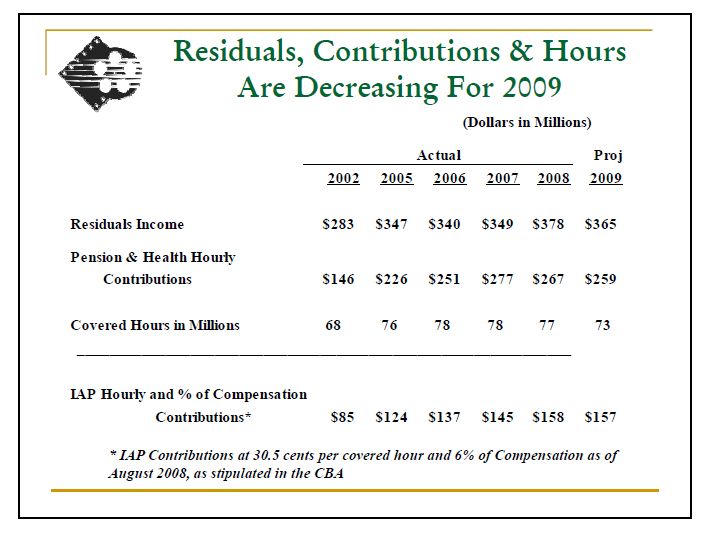
Skyrocketing health care costs are just one part of the problem; residuals from supplemental markets and Post 60’s, which have helped to strengthen MPIHP reserves over the last decade, dropped 12 percent industry-wide in 2009, representing a loss of income to the Health Plan of more than $17 million.

Add in the worst national recession in more than 25 years, which helped to lower employee hours into the Health Plan by more than 8 percent in 2009 due to the rapid drop in film and television production, and you have unprecedented economic attacks on your Health Plan. As Mercer health care consultant Chuck Hartwig observes, “Funding sources for multi-employer plans are defined in collective bargaining agreements. So when we see inflation at higher rates, it’s a big challenge to find ways for funding to keep pace.”

Storm Preparations

Health care experts describe the events above as “the perfect storm,” precipitated by declining DVD revenues, rising health care costs, declining hours into the Plan, and an unstable investment climate. Fortunately, the IATSE has been preparing for this better than any other Union in the entertainment industry.

  • Allocation of excess Health Plan reserve amounts over the last five years have helped to stave off Plan changes, even as other industry Plans have been forced to reduce benefits and charge co-payments. The 2009 IATSE Basic Agreement reveals the in-depth levels of preparations (over the course of the last three Contract cycles) made to counteract this “perfect storm.”
  • Banking an additional $187 million toward your Health Plan by spending down Health Plan reserve levels to the recommended minimums (according to health care consultant professionals) of 6 months in the Actives Plan and 8 months in the Retirees Plan)
  • Increasing employer contributions to the Plan by 35 cents per hour (roughly 1 percent of average wage earnings) per year in each year of the Agreement, resulting in an additional $164 million directed into the Health Plan over the life of the Agreement.
  • Additional 15 cents per hour in the second and third years of the Agreement if reserves fall below 10 months
  • Re-allocation of up to 1 percent of wages or IAP into the Actives Health Plan levels should reserve levels fall below recommended minimums
  • Bargained for Health Plan design changes saving $233 million over the term of the Agreement

On the last point it should be noted that MPIHP Plans remain alone in the film and television industry for having no participant premium co-pays, a remarkable statistic given that your MPIHP Health Plans cover more than 115,000 lives.

For so many of us, the rise in eligibility hours from 300 to 400 (which does not commence until August 2011) remains a large and threatening number; but even after such changes, MPIHP eligibility requirements will still remain the lowest in the industry. MPIHP Actives working a little more than 5 days per month will retain coverage; and the increase in eligibility hours in the 2009 Basic Agreement will impact less than 10 percent of Plan Participants.

Funding the Plans

To truly understand the scope of the health care crisis as it affects your Health and Pension Plans, it’s helpful to diagram the Plans’ funding structure. Plan insiders describe it as a water fountain with “buckets and buckets” piled on top of each other.

In this “dripping bucket” scenario, the top of the fountain (the largest pipe of water) are revenues from supplemental markets and Post 60’s, which account for roughly 60 percent of the overall income coming into the Health and Pension Plans. The first bucket to fill up is the Pension, and the second to fill up is the Retirees health plan bucket. What trickles over after those other buckets are full goes into the Actives health plan.

Under Federal regulations, the minimum levels of the Pension Plan must always be funded first, so in a declining investment environment, when more residual revenues are required to go into the Pension that much less will trickle down to the active health plans.

In the “dripping bucket” diagram, it’s also key to note that the Pension Protection Act of 2006 placed strict limits on single and multi-employer pension plans across the nation, with private sector employers having to meet federally mandated pension funding levels of 94 percent in 2009. That means that already decreasing residuals income must be redirected from the Health Plan to meet strict levels required by the Pension Protection Act.

By 2012, the combination of rising healthcare costs and the need to fund the pension will produce a deficit in your MPIHP Health Plan of more than $580 million. In fact, the economics that the IATSE has had to reckon in making preparations to protect your Health Plan for just a single Contract cycle (new employer contributions of roughly $164 million, and an additional $35 million when additional 15 cents ($.15) per hour is triggered, spending down reserves in excess of $187 million, and negotiated Health Plan design changes of more than $233 million) reveal a staggering figure of nearly $600 million just to keep pace with the “perfect storm” described above.

Perception vs. Reality

One question many Plan members have voiced is: How can our MPIHP Health Plans be under such intense economic duress when Hollywood-made films like Avatar are breaking global records and 2009’s overall domestic box office gross was $10.594 billion? How could a banner year for Hollywood studios result in lowered employer contributions into both the Health and Pensions Plans of 73 million total hours, six million hours less than in 2007?

To understand this, you need to look at the whole picture. The primary source of income flowing into our MPIHP Health Plans comes from supplemental markets, i.e.. DVD sales, foreign markets and sales into network television, etc., not from box office revenues.

A New York Times article from January about the proposed sale of MGM highlighted a report by Barclays Capital, which noted that, “even studios much healthier than MGM, bitten by falling DVD revenue and a 30 percent decline in operating income from 2007 to 2009, had experienced a sharp reduction in their relative importance to the media companies that own them.” The article went on to note: “Looking at Warner Bros, (a unit of Time Warner), Paramount (Viacom), Disney Studios (the Walt Disney Company) and 20th Century Fox (the News Corporation), the Barclays report reckoned that such studios, on average, accounted for only about 10 percent of the “enterprise value” of their parents.” “While we enjoy thinking about the film business, the reality is that film doesn’t matter nearly as much to the stocks of media conglomerates as it previously had,” the Barclays report stated.

While the IATSE has gone the extra mile in protecting our MPIHP Health Plan (through preparations noted above like spending down reserves, and increasing employer contributions at the bargaining table) the storm is just too intense to weather by such methods alone. Mercer’s Chuck Hartwig says multi-employer plans like MPIHP are working extra hard to ensure Plan dollars are spent as efficiently as possible. That includes joining forces with the other entertainment industry plans to find the lowest cost/highest quality prescription drug program in the market, and offering disease management programs to help participants with high-cost conditions.

So what can you, as a Plan member, do to help weather this inflationary storm?

  • Cooperate with our Guild’s organizers to help them help us find the extra days of work to get us all qualified for eligibility, by getting contracts with non-Guild employers. Contact Steve Kaplan at (818) 845-7500 ext. 112 or skaplan@animationguild.org.
  • Stay within network when choosing services and utilize the MEDCO prescription drug plan whenever possible. Previously contracted rates reduce the overall costs of the Plan and ultimately reduce any out-of-pocket costs for Plan Members.
  • If available, take advantage of the medical services provided by the Motion Picture & Television Fund clinics and physicians who typically cover 100 percent of costs, to better help reduce overall Plan rates.
  • The passage of the Health Care Reform legislation has not ended the national health care debate. Get involved and urge your representatives not to compromise when it comes to important issues impacting your family’s future. These include not taxing so-called “Cadillac” insurance plans and mandating that all employers pay their fair share.
Click here to read entire post

Thursday, August 19, 2010

Working for Free. Again.

David Cohen -- behind a subscription wall at variety.com -- tells of another visual effects house that doesn't pay its employees.

The latest bad news from the vfx biz comes from Montreal's Fake Studio, part of the Camera e-Motion Group. A handful of artists who worked for Fake on the 3D vfx for Dimension's "Piranha 3D" have yet to receive payments due in April. Their plight has inspired a great deal of anger in vfx circles, where hearing "unpaid artists" and "Montreal" opens the old wound of Meteor Studios and the problems artists had getting paid for New Line's "Journey to the Center of the Earth."

One of the unpaid artists, Manny Wong, told Variety that with the Meteor incident in mind, he negotiated a payment-in-advance deal, but upon arrival in Montreal, he liked the atmosphere at Fake enough to forego advance payment. He says the producer was "very upfront" with him about the pic's financial difficulties through two crises that threatened to shut down the picture. Then Fake management said it hadn't been paid by the client and couldn't pay the 3D team anymore from its own pockets. Months later, payment is still due.

Last week Dave Rand, a veteran of Meteor who has become something of a watchdog for abuse of vfx artists, posted about the Fake and its unpaid artists on his Facebook page. Marc Cote, an owner of Fake, responded with a note admitting the company is in arrears and saying it is "making arrangements with all of the creditors … to reimburse them as quickly as operations permit." He continued: "Short of shutting down the company we cannot reimburse everybody's debt in one shot. … We are 100% committed to reimbursing this debt." ...

I've encountered tales like this for decades, and I always say the same thing: Professionals should deal with employers professionally. If there are no wages, there should be no work.

It's a simple concept, but often a hard one to execute in real life. Management exerts pressure to be "a team player," fellow workers fall in line, and pretty soon most or all of the non-paid staff find itself "pitching in" to save the project. The difficulty is, people need cash flows to survive, and if the non-payment routine goes on for long, individuals find themselves gnawing shoe leather.

Once again I will point to TAG member Glenn Vilppu. You might remember Mr. Vilppu from a previous post or three. He's the Warner Bros. layout artist who refused to work for free.

On top of being a talented studio artist, Glenn is also a gifted art teacher, and a few years back found himself getting stiffed by an art school for which he worked. The owner, a lad with a silver tongue, had talked most of the artistic staff into working for free, giving them one sob story after another about why he "just couldn't pay them that week."

Most everybody went along, but not Glenn. He told the owner of the school that he was sorry about the problems the guy was having, but if he, Glenn Vilppu wasn't paid by cashiers check the moment he walked into his classroom, he wasn't coming back to teach.

The owner moaned, begged, pleaded. Glenn didn't budge. And since Mr. Vilppu was the star teacher in the school's glossy brochure, he got a check placed in his hand each time he entered the premises.

The other teachers? They went on getting no money. Sometimes it pays to be a hard-nosed professional.

Click here to read entire post

Aspiring Artists

The L.A. Times gifts us with this upbeat saga:

For the last two years, [Aya Yokura] has spent up to 100 hours a week at her workstation — a low-paying, labor-intensive job that helps bring Japan's famous style of animated cartoons to life. Although the 26-year-old earns only about $10,000 a year and lives with her mom to make ends meet, she and a few thousand Japanese artists like her fill a crucial role in the technical process of creating this visual entertainment form, known as anime.

But even as anime's popularity grows worldwide, the Japanese artists who do much of the work are finding their jobs at risk.

"I left a Tokyo Disneyland job, which had benefits and a higher pay, to pursue this dream" of being an anime artist, said Yokura, who works on the popular series "Naruto" and "Bleach" for the animation production studio Pierrot Co.

The problems plaguing the industry are numerous. Seeking lower costs, production companies for decades have been outsourcing the work to animation companies in South Korea, India, Vietnam and elsewhere, where scores of trade schools have cropped up and artists can be hired more readily. ...

Sound familiar?

But dreams die hard. Yesterday a woman called me from Atlanta. She wanted to know about getting into the hand-drawn animation business in Los Angeles. She had her heart set on it. I told her:

"It's tight out here, there's lots of competition for just a few jobs and those we've got are taken by veterans with lots of production experience. You'd be really smart to stay where you are and not come."

But she's probably coming.

It's hard to dissuade people from their ambitions and aspirations. If you want to be a cartoonist, or writer, or tightrope walker, who am I to say the field is too full and the competition too stiff? There's that one in a thousand chance that you're the genius with the natural gift and work ethic that will knock everybody's socks off and you will be wonderfully successful.

Jaded as I am, I know there are times when following your passion is the best road to travel. Added to which, job opportunities rise and fall, and it's tough to predict whether a segment of any particular market will be roaring or foundering when you're ready to jump into it. (Could anybody have predicted the 'toon boom of the nineties in, say, 1985? That in 2010, animation would be a major driver in full-length movies? Could my predecessor in this job have forecast that the 700-member Motiin Picture Screen Cartoonists over which he presided would morph into the 2900-member Animation Guild? Doubt it.)

The future is always unknowable. Even though it's a reasonably safe bet that hand-drawn animation will not be regaining the high-ground it held in 1994, and that a chunk of lower-tier animation work will be outsourced to low-cost providers, the market is ever-changing, and it's not insane for a twenty-something to chase after her dream job. (At that age she has the time and the opportunity, so why the hell not? My only advice would be to pursue your heart's desire in an area of art that is robust rather than fading.)

If you don't grab at that brass ring when it floats by, the chance to yank it free might never come again. No matter how long the chances.

Click here to read entire post

Wednesday, August 18, 2010

Boo U

Another day, another feature.

[Seth Rogen] has been cast to voice a lead character in the studio's "Boo U." The comic story centers on a ghost who must return to ghost school to learn how to be a better spook.

"Igor" director Tony Leondis is directing the 3D project, which Gil Netter and Courtney Pledger are executive producing. ...

I see a lot of development going on at DWA's Glendale campus, but Boo U hasn't been on my radar, either because I've been in a trance or because development is going on at PDI in Northern California.

(Or maybe if I lower the dosage of some of my meds, more projects will swim into focus ....)

Click here to read entire post

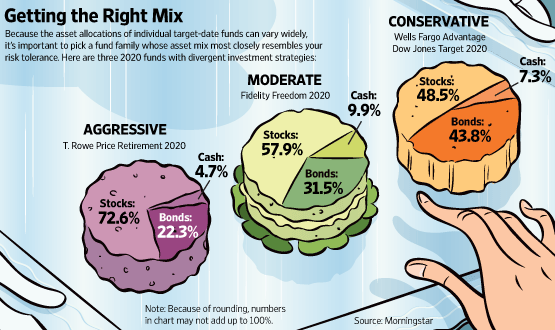
Target Date Funds

A few weeks back, The Wall Street Journal examined different Target Date Funds:

... Fees are the single biggest factor in predicting the performance of target-date funds, and portfolios stuffed with funds that passively track indexes tend to outperform those holding funds run by money managers. ...

Target-date funds are designed for investors who hope to retire around a certain date—say, 2025—and don't want to fuss with changing their allocations of stocks, bonds and cash by themselves. Instead, the fund becomes more conservative as the retirement date nears ...

Only seven of the 31 fund families Morningstar included in its analysis managed to beat the benchmark over the three years ended June 30. ... Five of the six top performers—including Vanguard, Wells Fargo and JPMorgan's SmartRetirement funds—were helped by below-average fees ...

I bring the above up in a blog post because I am doing 401(k) Enrollment Meetings this week and next, plus I think it's really, really important to focus on building a nest egg.

The trouble is, many participants in 401(k) Plans don't know much about investing and don't want to know. (Studying asset allocation charts and reading about investment strategies is almost as exciting as watching paint dry.) That being the case, Target Date Funds are the solution that a lot of professionals choose, since who the hell knows what the best selection of stand-alone mutual funds are, and who has the time to read thirty research papers to find out anyway?

For some years, the Animation Guild 401(k) Plan suffered along with sub-par target date retirement funds. Happily, a couple of years back we were able to secure Vanguard Target Retirement Funds for the Plan's investment lineup. These babies are a combination of different Vanguard Index Funds and generally out-perform managed funds over time. They have the added advantage of being inexpensive (less than one fifth of one percent in fees) while providing "one stop shopping."

(The Journal's article misstates the costs of the Vanguard funds. It's .18%, not .70%.)

I will be holding 401(k) Enrollment Meetings next week, so if you work at one of the fine studios listed below and would like to join TAG's investment club, fall on by the conference room where I'm holding forth and we'll get you started on squirreling money away for your sunset years.

TAG 401(k) Enrollment Meetings

Starz/ Film Roman -- Tuesday, Aug. 24, 10 a.m. "Glass" conf. rm.

Sony Pictures Animation -- Wed. Aug 25, 10 a.m., rm 2000

Disney Toons Sonora -- Fri., Aug 27, 10 a.m., rm 2025

Click here to read entire post

Tuesday, August 17, 2010

Fox Domination

This seems to happen on a weekly basis:

Last night FOX aired encores of THE SIMPSONS (1.8/6 among Adults 18-49), THE CLEVELAND SHOW (1.8/6) and FAMILY GUY at 9p (2.3/6) and 9:30p (2.3/6), and won the night among Adults 18-34 and Teens ...

What I want to know is, why can't any other teevee animation producers replicate the kind of successes Fox Animation and Gracie Films achieve year in and year out?

Click here to read entire post

A Wage Story

Thinking about the wage piece below and reading about wages at VFX Soldier triggers a story about a TAG member's salary that occurred at Turner Feature Animation back when we all were very young ....

So one bright Spring day, an animator calls me from TFA in Glendale, wanting to know what other animators in his department are making.

It so happens that I have a fat printout of all the wages of TAG members, generously donated to the Guild by the Motion Picture Industry Health and Pension Plan. Quick as a wink, I pull it out and rattle off the salaries of the various animators working at Turner Feature on "Cats Don't Dance.".

And whattaya know? The animator I'm talking to on the phone turns out to be the lowest paid. After a long pause, the guy says: "They told me that nobody was making more than I was."

"Hmmm," I rejoin. "Turns out they're lying."

Another pause. "I think I'm going back and talk to them again."

So he does. And the next day, the animator calls back and says: "I told them I found out I was the lowest paid person in the department. They got mad and asked where I'd heard that. I told them from you."

My heart sings. (Or maybe I'm just getting a sudden case of indigestion.} "Great," I mutter. "Thanks for bringing me in to this."

"No problem. Then they got even madder, yelling that you shouldn't have told me."

"No good deed goes unpunished. But tell me something. Were they embarrassed at all? That you'd caught them lying?"

"No," the animator answers.

And therein lies the tale. The job of studio management is to keep costs down, so they don't consider it lying when they say things like, "Nobody's getting laid off" ... "We're not changing the schedule and there's no budget for overtime" ... or ... "You're making as much as anybody else." even though all those statements are demonstrably false.

Because in Studioland, they aren't lies. They are simply good business practices.

Click here to read entire post

Wages in the VFX Industry

Lately, much ado has been made of the wage structure of the visual effects world. I've been quite active on a forum thread that was brought to my attention at CG Talk and the discussion lately as been focused on the Guild's wage minimums that are written into our contract. A few loud voices posted about how the wage minimums were "crushing meritocracy" and that the Guild, through its contract, "gives more through bullying tactics".

The venerable and ever-eloquent VFX Soldier crafted a post in his blog that spoke to the current truths to wages in the vfx industry, as well as providing a link to a Google spreadsheet listing over 2,500 job titles and salaries from "vfx, animation and game facilities".

What really was a shock was the vehement argument that was posed against wage minimums that we have written into the contract. Minimum wage rules have been in existence since this Labor Organizer has. Its been my understanding that wage minimums are set to protect the worker against management abuse and help provide a bare minimum compensation for work rendered. Our minimums are floors, intended to ensure that

Hulett: Wage floors and decent pay have been what Hollywood labor unions have been about since the 1930s.

For those who don't know Tinsel Town's history, until the advent of sound there were minimal protections for moviedom's labor. No overtime rules, no wage minimums, no meal breaks. As one Hollywood ancient remembered to the L.A. Times some years ago:

"You came in at 8 and worked until you fell down."

In the Spring of 1933, the studios cut salaries 50% across the board. Unsurprisingly, a slew of entertainment unions and guilds sprang up soon thereafter. Also unsurprisingly, wage minimums were part of their agenda.

Seventy-seven years later, not a hell of a lot has changed. A month back, the Hollywood Teamsters union came close to going on strike over a wage boost of 2%. (They wanted 3%, but ultimately settled for a percent less.) Studios have reined in oversacle deals, cut staff, instituted layoffs. Today at the animation studio of a large entertainment conglomerate, a lead pulled me into his room and said: "People have been uncompensated overtime around here for the last four months." I've told them to stop doing it, but it goes on ..."

Here's the dirty little secret of the movie workplace: It always goes on. Managers pressure employees not to share wage information (a protected right). Production supervisors lean on staffers to "help them out" and work for free. Producers tell artists "there's no money in the budget for overtime."

So is it any wonder that wage minimums are a big part of what Hollywood labor unions? And is it a surprise that wages and overtime pay are issues in the visual effects industry?

Click here to read entire post

Monday, August 16, 2010

August Studio Roundabout

Monday was a two-studio day: Disney Television Animation on the Disney lot in the morning, and DreamWorks Animation in sun-kissed Glendale through the middle of the afternoon ....

The Phineas and Ferb crew in Disney's Frank Wells building is busy with the new season of the Mouse's biggest hit show. As one of the staffers said:

"The execs let Marsh and Povenmire [show creators] do a lot more than producers are usually allowed to do on Disney TVA shows. It's not too often the lead guys are allowed to write songs and do character voices around here, but when you make a successful series, you get leeway. Hopefully management won't top out the number of shows anytime soon, and we'll go on the way SpongeBob Square Pants has gone. Be great to do years of half-hour episodes."

Elsewhere on the floor, Fish Hooks continues in work as it nears its Fall premiere*. I was told that Disney TVA moves lock,stock and barrel to Glendale when the building next door to the fabled Sonora Building becomes available sometime next year, but everybody is vague about the month and the day that will occur.

Over at DreamWorks Animation, Katzenberg was roaming the studio having meetings, and one of the development artists in the Lakeside Building told me:

"They had a screening of Megamind at an outside theater last week, and everybody was happy with audience reactions and results. There were notes and the crew will keep tweaking things, but the screening went well."

A couple of sequences of The Croods are now in layout, and some of the story people informed me the picture is shaping up nicely.

I had a discussion with a storyboard veteran about how boarding has changed through the years, how story reels now require more poses than in earlier times (a result of digital boarding and the demands for faster pacing.) Some story crews at DWA are now putting up just the main story points of their sequences first, then showing them to the directors to make sure everybody is on board with the overall flow of story, and then putting in more detail.

I'm told this approach helps speed things along and reduces heartburn.

* There are a few other items being developed at DTVA/ Frank Wells, but since they haven't seen the light of studio press releases, I will maintain a discreet silence.

Click here to read entire post

China and Animation

The Middle Kingdom lusts after Japan's slot in the animation universe.

When it comes to animation, China wants to be the next Japan.

Long envious of its Asian neighbor’s success with anime, China is nurturing homegrown cartoonists and animators and encouraging them to produce films of their own. With the blessing of the country’s Ministry of Culture, provinces and municipalities are staging contests, festivals and conferences, all aimed at getting homegrown talent more exposure -- and some badly needed attention on the international stage.

The holy grail is theatrical, TV and especially home entertainment distribution contracts in the United States that played a key role in helping anime break out of its native Japan and become a true international phenomenon in the early 2000s. ...

Of course, to become a worldwide phee-nom, one needs infrastructure (not a problem), a flexible, high-energy talent pool (also probably not a major deal), and product that will sell like gangbusters around the world. (We'll see how that works out.)

There's no question that China has a monster internal market to consume its own animated output, but how well it does as A) an international animation sub-contractor, and B) an international player producing home-grown theatrical and television cartoons that sell like hotcakes in Dubai, Denver, Denmark and St. Petersberg remains to be seen.

American features and television shows have been globally dominant since the 1920s. Much of the world has less than warm and fuzzy feelings about the United States, but most of it buys into American culture, otherwise Sly Stallone -- now at retirement age -- wouldn't be topping the international box office. For China to become a dominant player, it will need to sell its national sensiblity as well or better than the United States (with its cultural salad bowl) has done over the past century.

And that's a tall order. Even Japanese anime, as successful as it's been, is still pretty much a niche product in the world marketplace.

Click here to read entire post

Sunday, August 15, 2010

Jeff Varab

Mr. Varab, a tad older than when I knew him at Disney ...

Cruising the highways and biways of the worldwide web, I plowed across this small journalistic piece.

Jeffrey Varab is an animator and director who started at Disney, did years with Don Bluth, used to work for Disney Feature Animation Florida, left there and worked on films such as “Eight Crazy Nights.” ... He set up an outfit, with backers, called Genesis, which animated a movie about a WWII vintage Willys Jeep named “Tugger,” “The Jeep 4 x 4 Who Wanted to Fly.” ....

Varab was arrested this week, charged wtih fraud in Osceola County. ...

Jeff came to Disney in the seventies, a young guy with stylish long hair, tight jeans, and a well-trimmed beard. (Mouse House artists of that time could tell you stories, lots of stories.)

After a few years, Jeff left the studio abruptly, moving on, leaving his Porsche in the Disney parking lot. I ran into him a few times after that. He told me how he was directing a feature about Vikings in northern Europe, then working for Disney again. He was always colorful and a little mysterious, a young man in a hurry.

But not so young anymore. And (apparently) no longer quite so footloose and fancy free. At least now I know his location, and what he's about these days.

Good luck to you, Jeff. You've had an amazing and interesting run up until now. We'll see where it goes from here.

Click here to read entire post

The Foreign Horse Races of August

Animation continues to figure prominently in the moving picture palaces beyond the seas.

The weekend's No. 2 title, "Toy Story 3," wound up two months on the foreign theatrical circuit with a cume of $539.3 million, making the Pixar/Disney 3D title the distributor's biggest-grossing animation release of all time overseas, surpassing 2003's "Finding Nemo" by $11.1 million.

A muscular Thailand debut propelled "Toy Story 3" to a $22.7 million overall from 7,773 venues in 50 markets. Top market is Japan where the threequel captured the No. 1 spot for the sixth consecutive round ...

A No. 1 opening in Venezuela (an estimated $550,000 at 65 spots) plus first-place holdovers in Brazil and Mexico propelled "Despicable Me" to a $7.5 million weekend at 1,725 venues in a total of 25 territories. Foreign cume for Universal's family-oriented 3D animation voiced principally by Steve Carell stands at $56.2 million. A Poland bow is up for this week ....

DreamWorks Animation's "Shrek Forever After" in 3D is still playing internationally via Paramount, grossing $6 million on the weekend from 4,460 venues in 57 territories, and pushing its foreign gross total to $440.5 million. A China opening this week should boost the animation franchise's fourth installment's cume nicely. ...

For the number crunchers among us, the ogre has now collected $677,730,000 with 65% of the take coming from foreign box office; Toy Story 3 is just shy of a billion with $940,067,000. ($57.4% of the number comes from abroad.)

Despicable Me meanwhile, has cvollected a mere 20% of its worldwide total of $278.2 million from countries outside the U.S. and Canada.

Still in all, the three animated features have chalked up almost $1,9 billion over the past few months. Their collective production costs? $434 million*.

* Listed budgets: "TS3" -- $200 million; "Shrek 4" -- $165 million. "Despicable Me" -- $69 million.

Click here to read entire post

Saturday, August 14, 2010

What the Biz Rep has Learned -- #6

You've got to take responsibility and ownership of the things that happen in your life, because if you don't, you end up playing the victim.

Years ago I heard Richard Pryor admit on "The Tonight Show":

"I've been married six times. And every time I got divorced, I told my friends, "That bitch stabbed me in the back and broke up the marriage." Around about divorce #5, some of my friends started saying: "You know, Richard? Maybe it ain't the women ..."

In young adulthood, I glided through my working life. College, the navy, grad school and Disney, I moved seamlessly from one thing to another and assumed that was the way my professional existence was supposed to be, and the way it would always be.

But I was disabused of that notion when I got let go from the Mouse House and spent the next four years scrambling from one short-lived, badly paying job to another. And one night, when I was on the brink of washing out of a college credentialing program, cursing my fate and blaming everybody except me for the spot I was in, my wife said:

You're the one who got into the mess. You're the one who has to get out. And you can't quit."

Which of course is what I wanted to do.

Long story short: I stopped my whining and finished the program, taught high school and middle school for a few years, got back into the animation business, and ended up here as an Animation Guild employee. Like all jobs, union business repping has its ups and downs, but it's given me a ringside seat for observing the wide array of artists and technicians that work in Cartoonland, And this is what I've observed:

There are employees who work hard and master their skills sets, take ownership of their career arcs, suffer the occasional setback but pick themselves up and move on, adapting to the industry as it changes.

There are employees who work tenaciously and are talented, but who complain a lot and don't work as steadily.

And there are employees who work, have some chops, but have never taken responsibility for terminations and layoffs, can't get it through their heads that they've got to play well with co-workers, and (mostly) throw themselves pity parties and assume the role of victims.

Fate is sometimes capricious. No sane human believes that they command every wrinkle and happenstance of their life. But if they don't take responsibility for the results that occur inside it, they end up handing the power of their existence to outside forces.

In the end, that makes for way less effective living.

Click here to read entire post

The Augustian Derby

Now with candy-coated Add On.

The Nikkster gives us the sad news. No animation in this weekend's Top Five:

1. The Expendables (Lionsgate) NEW [3,270 Theaters] -- Friday $13M, Estimated Weekend $33.7M

2. Eat Pray Love (Sony) NEW [3,082 Theaters] -- Friday $9.8m, Estimated Weekend $28.3M

3. The Other Guys (Sony) Week 2 [3,651 Theaters] -- Friday $5.5M (-58%), Estimated Weekend $17M

4. Scott Pilgrim v The World (Universal) NEW [2,818 Theaters] --[Friday $5.2M, Estimated Weekend $13.3M)

5. Inception (Warner Bros) Week 5 [3,120 Theaters] --Friday $3.4M (-38%), Estimated Weekend $11.3M

Remarkably enough, the most well-reviewed movie -- Scott Pilgrim Vs. the World -- turns out to have the weakest opening. Go figure.

Add On: The Mojo of Turnstiles gives us finer-tuned numbers for the Friday box office list:

1) The Expendables -- $13,250,000.

7) Despicable Me -- $2,060,000 (total: $217.3 million)

12) Toy Story 3 -- $605,000 (total: $399,207,000)

Add On Too: B.O. Mojo provides Sunday numbers that are not dissimilar to earlier projections.

The animated offerings at the top of the list, Despicable Me and Toy Story 3 have the smallest percentage drops of any movies in the Top Eleven. (Woody and Co. declined 30.6%; DM dropped 27.1%).

Click here to read entire post

Friday, August 13, 2010

Your Tail of the Week Linkages

Now with churlish Add On.

She's been with us for a decade. How time flies.

With Saturday and Sunday upon us, more news you can use.

... Hannover House and Red Bear Entertainment are teaming to develop "Terminator 3000", a $70 million 3D animated feature based on the characters and storyline of the franchise ...

The toonage just gets wider and deeper all the time.

But wait! According to the Nikkster, it seems that Pacifico, owner of Terminator rights, is not necessarily on board with this:

Pacificor ... has sent a cease and desist letter in response to a press release issued by Hannover House detailing plans to develop Terminator 3000 ...

There is happy animated news for the Diz Co.

...Earlier this week, Toy Story 3 surpassed Finding Nemo to become the highest grossing film in Pixar history. Today Lee Unkrich’s sequel has passed another major milestone, becoming the highest grossing animated film of all time. The film has grossed more than $920 million worldwide, surpassing DreamWorks Animation’s Shrek 2 ($919.8 million worldwide) for the title. ...

The New York Times is less than fully enthralled by a freshly released animated feature from Japan:

Stolid and humorless, larded with windy speeches about keeping Earth’s balance and other virtuous platitudes, “Tales From Earthsea,” a Japanese animated adaptation of Ursula K. Le Guin’s “Earthsea” fantasy novels, feels a little like a science-fiction Sunday school pageant. ...

And there are new animated features percolating on the Emerald Isle:

16 years ago Cathal Gaffney and Darragh O’Connell founded Brown Bag Films. In a pre-digital era the pair set up the studios as a means of making their own films. The group was founded at a time when Ireland has the biggest animation industry in Europe with the ironic fact that none of the studios here were Irish-owned. ...

Brown Bag Films are now two months into a 24 month plan now to pull in a pure animated feature and bring it to Dublin for production. “The office has been running since the start of July and we have a number of projects that are under review,” Cathal explains, “but it’s going to be family and children’s films - that’s what we do. We’re looking for hybrid movies as well - which would be live action and animation - but primarily animated films, and for the US market. We are looking for the Global market ...

Time Magazine rhapsodizes about Clone Wars -- the Series:

... [A]s bad as the animated Clone Wars movie was, I've really come to like the series—on its own action-adventure terms—as it has developed and found its voice. But the persistence of the series raises a question about the balance of the Star Wars franchise. Namely, the prequels now dwarf everything else like the Death Star dwarfs the Millennium Falcon. Just in terms of sheer canonical story, there is now far, far more "prequel" material (i.e., anything taking place before episode IV) than there is material of the post-episode III, Darth Vader era. That is, the stuff that the parents of Clone Wars watchers really like. ...

And we'll end with Happy Birthday news for Nickelodeon and Viacom!

"Dora the Explorer" has been on Nickelodeon for 10 years this month, which the network is celebrating in prime time Sunday evening with the hour-long "Dora's Big Birthday Adventure." That's followed by a 12-minute tribute documentary in which toddlers, child psychology experts and bubble-eyed celebrities (Shakira, Salma Hayek, Elisabeth Hasselbeck) pay fitting homage.

... Here's the thing about Dora. She is still and forever 7 (pay no attention to that tween makeover she got last year) ...

Add On: Forbes Magazine points out that Snow is still the fairest of them all in constant box office dollars:

... The No. 1 animated spot belongs to Disney’s Snow White and the Seven Dwarfs (released in 1937) which earned an inflation-adjusted $866 million at the domestic box office compared to $400 million for Toy Story 3. ...

Add On Too: Since I just learned from comments that Scott Pilgrim has its share of animation (I get around so little), here's the Cartoon Network version of S.P.:

Have yourself a grand weekend.

Click here to read entire post

Thursday, August 12, 2010

Bugs Rebooted

... Yet again.

The Nikkster's site breaks this story:

Warner Bros has hired Elf scribe David Berenbaum to write Bugs Bunny, a live action/CG feature film designed to revive one of the studio’s most iconic intellectual properties. I’m told that Berenbaum, who also adapted The Spiderwick Chronicles and is writing an animated project with George Lucas--just closed his deal. No producer has yet been assigned. ...

No offense to Mr. Berenbaum, but me, I'd put some top-flight animation story artists on the project and create some beat boards, maybe flesh out a couple of sequences. Then I'd bring in the live-action writer to collaborate.

You would end up with something more cartoony and visual, and the writer would be there to plus the dialogue, plot, and characters.

Sadly, it's seldom done this way anymore. Most film execs are more comfortable starting with a script. And they wouldn't have a clue who the high-powered story artists even are. ...

Click here to read entire post

The Mouse House

Where the lighting department is in its final 6-8 weeks of work for Tangled ...

and morale is lower than a dachshund's belly, since most of the artists and technicians were given their notices in July, and layoffs now loom.

As one Disney employee mentioned: "People who've been here five, ten and twenty years are getting let go. It's not a happy time."

Indeed not. But sadly, it's a recurrent theme. Disney Feature Animation's atmosphere, in fact, is a lot like it was in 2001, when hand-drawn animation was imploding and everybody working on Home on the Range knew they had four months before they got to go stand in the unemployment line: Grim.

The problem, of course, is that story development on new features has been scanty and now there is nothing to drop into the production pipeline to keep tech directors and animators going. So, tech directors and animators get laid off. Sitting in one long-time Disneyite's office, I allowed as how the studio seemed indifferent to hanging onto talented staff. I got a thin smile.

"Incompetently indifferent."

Click here to read entire post

Currently at Gallery 839 ...

Gallery 839 features an all-new show (new to the Gallery, that is) with reproductions of caricatures by John Sparey, Christmas card art by Ralph Hulett, and polo sketches by Virgil "Vip" Partch (above).

Above: Paliwoda In Hi-Fi, by John Sparey; below, Home For Christmas, by Ralph Hulett.

This show will be open Monday through Friday from 8:30 am to 5 pm.


The next Gallery 839 show, opening September 10, will be the work of the A. Muse Salon, consisting of artists RITA JOYCE, STEPHANIE PYREN, BARBARA SCHRADE and GWEN WETZLER. More details as the opening draws nearer.

Click here to read entire post

Wednesday, August 11, 2010

Conglomerates That Maximize the Internet

The World Wide Web is a very tricky tool for our fine, entertainment conglomerates. On the one hand, it's a highway by which pirates can steal entertainment product and speed off with it. (Movie poaching, anyone?) But it's also a fine funnel by which corporations can suck money out of the pockets of youngsters eager for that online, gaming experience.

For instance:

This week, Walt Disney Co. formally unveiled its latest online community: World of Cars, inspired by Pixar Animation Studios' 2006 hit movie "Cars."

The Burbank entertainment giant plans to begin revving its marketing engine for the virtual world this month, with promotions appearing on Disney Channel and elsewhere. World of Cars is Disney's fifth online community — one that's designed to keep children interacting with Lightning McQueen, Mater and other characters from the movie until "Cars 2" is released in 2011 ...

Synergy, interactivity and cash flow. Magical concepts when you're working to maximize profits and reinforce brands and product lines. Disney has been making money from interactive on-line games for over a decade now. If anybody can make everything fire on all cylinders, the Mouse can.

Click here to read entire post

At Fox On Wilshire

Today I trotted through the Family Guy and American Dad units, where new seasons are rolling along (and artwork of various FG/AD characters decked out as comic book Super Heroes. hangs in the central hallway.)

At FG, the newest order of shows is just now ramping up, and a lot of board artists are still on hiatus. Over at Dad, they've already cranked into a half-dozen episodes, and as one artist said: "Things are starting to stack up with the workload, and the pressure's on, but we're getting through it" ...

Yeah, the pressure's on, like it always is in television. Tight schedules. More complicated shows. But I talked to a few artists on both Fox half-hours who informed me:

"We come in and find ways to get work done without doing overtime. We're here for eight hours, then go home. We've been at the studio for more than a couple of seasons, and we're back again for this one, so what we're doing must work okay."

An artist who's been with Family Guy since almost the beginning worried aloud about Seth MacFarlane "getting tired and bored" with doing the show; I answered that the money Seth is getting probably helps keep his interest up.

Happily, Fox and its audience haven't lost interest.

... FOX aired encores of THE SIMPSONS (1.8/6 among Adults 18-49), THE CLEVELAND SHOW (1.8/5) and a one-hour FAMILY GUY at 9p (2.1/6). An encore AMERICAN DAD aired at 7p (0.8/3), followed by a THE SIMPSONS encore at 7:30p (1.2/4) ....

With a full block of Animation Domination encores, FOX ranked No. 2 for the night among Adults 18-49 (tie) and Adults 18-34 and No. 1 in Teens.

The Resident Teenager can attest to Animation Domination's high scores. (And Rupert's happy too.)

Add On: The Nikkster tells how some FG staffers are climbing onward and upward:

... Veteran Family Guy writers-producers Alec Sulkin and Wellesley Wild have signed overall deals with the animated series' producer 20th Century Fox TV. ... Their first project for the studio is expected to be a live-action comedy. Writing partners Sulkin and Wild, repped by WME, have been on Family Guy since the show's return to originals in 2005. ...

Click here to read entire post

Tuesday, August 10, 2010

Mr. Lasseter Earns His Keep

What a difference a year makes. No churlish phone calls from the Disney CEO about the company's movies being no help with Diz Co.'s earnings.

... Iger highlighted the film studio's summer performance, noting that it released three of the top five films worldwide in "Toy Story 3," Disney's "Alice in Wonderland" and Marvel Entertainment's "Iron Man 2." ...

You will note that one movie was a cartoon, one was a semi-cartoon made by a former cartoonist, and one was based on a comic strip.

Small wonder that live action filmmakers have disdain for animation and its creators. All that the cartoon crowd does is make lots of money. No point in actually respecting it.

Click here to read entire post

Weak Math

(Chart from the Motion Picture Industry Pension and Health Plan via VFX Soldier.)

The MPIPHP is, besides being a pension and health plan covering 110,000 participants and their dependents, is a large trust fund. As I write, it's got $4.2 billion in it ....

Over twenty years, the trust funds have returned over 8% per year, even with an investment mix of 62% bonds, 38% stocks and real estate. (Having thirty investment advisors looking after the money stash has apparently helped.) It's been fairly consistent over a long period of time.

Lately, however, the sailing has been choppy. So far this year (2010), investment returns have been 2%. Given the times in which we live, this isn't awful, but it's waay below the returns that Plan actuaries expect. It's also below the 8% projections the accountants and negotiators use when figuring out where the Plan will be in 2011, 2014, or 2024. Either the 8% number gets hit ... or calculations have to be changed.

And what that ultimately means is, either the employers and/or unions have to kick in more money, or parts of the MPIPHP have to be changed. (Usually it's a combination of both.) But there are rules. Under federal regulations, the Industry Pension Plans have to be funded first, then the Medical Plans for active and retired participants get whatever remains of the cash flow. So what happens is, the pension plans are relatively stable, and the health plans -- being the last in line for money -- have to be "adjusted" every three years when contracts are renegotiated.

So, if you're a health plan participant who's wondered why medical costs go up and coverage goes down every thirty-six months, now you've got your answer. Over the past decade, Plan outgo has exceeded Plan income each and every year, and to close the gap contract negotiators have hammered out changes to lower health coverage costs: medical co-pays have grown larger, out-of-pocket costs for pharmaceutical drugs have gone up, hospital deductibles have risen. Etcetera.

Weak math, unfortunately, but with medical inflation running 9.5% per year and Plan income flat or negative, the only math there is.

Click here to read entire post

Monday, August 09, 2010

Transit Links

Now with Deadly Add On!

Sitting in hotels and airports on a travel day -- what fun. Therefore, a few links for a Monday.

Director/animator Will Finn provides kudos to the little-seen but well-regarded A Town Called Panic.

Without a doubt, one of the most original films I have ever seen, animated or otherwise. Recklessly and relentlessly funny and oddly touching at the same time; it's a triumph of pure and simple film technique and outrageous narrative originality ...

Floyd Norman remembers Ward Kimball's space unit at Walt Disney Productions:

... The entire second floor space of D-wing was occupied by Ward Kimball's unit, and they seemed to exist in a world all their own. I do not exaggerate when I say they were probably Disney's most creative and innovative animation department. They did things other animation units would never dare, and they got away with most of it even though their boss, Walt Disney was known to be a micro manager. How did this happen, you might wonder? There were two things, really. Disney knew his Directing animator, now turned producer could deliver the goods. Second, the Old Maestro was preoccupied with his theme park and other matters that left him distracted. This meant Ward Kimball could run things his way because a lot of it was being done "under the radar." ...

The Wall Street Journal thinks Disney's movie division will be fueling corporate earnings.

... When Walt Disney Co. reports quarterly financial results on Tuesday, all eyes will be on its movie studio.

The April to June period included a sizable chunk of monster box-office take for "Alice in Wonderland" and, thanks to an early home-video release, the first month of DVD and Blu-ray sales. On top of that, "Toy Story 3" took in $258 million domestically in June and went on to become the Pixar unit's second biggest-grossing title ever, behind "Finding Nemo." ...

Discovery/Hasbro's Hub is, per the L.A. Times, close to its start date.

The Hub, a new kids' cable channel being launched by Discovery Communications and Hasbro Inc., will spend roughly $20 million to hype its Oct. 10 launch and is setting its sights on younger viewers as other kids' channels aim for teens.

Although the Hub, which will launch in about 60 million homes, is still keeping its schedule close to its vest, the network's Chief Executive Margaret Loesch, a veteran kids' television programmer, thinks there is an opening for the channel to woo kids and the advertisers trying to reach them.

"Our competition is starting to age up," Loesch said at the Television Critics Assn.'s summer press tour in Los Angeles. The Hub will focus primarily on viewers in the 6-to-12 age range ...

According to this article, Tarzan could be getting a 3D facelift.

Germany's Constantin Film is swinging into "Tarzan," launching development of a 3D animated feature.

The English-language pic will be produced inhouse by Robert Kulzer and Reinhard Klooss. Constantin acquired animation rights to the "Tarzan" novels from the estate of author Edgar Rice Burroughs.

Add On: During flight yesterday, the Nikkster published this:

... Yikes, another crazy busy day. Bkft with Cyma Zarghami (pres of Nick) to discuss out series. Penguins continues to be very strong (3rd highest rated show 2-11yr). We have already been given a second season pickup for KFP series and it won't even go on the air until fall 2011 after our feature film has been released. Big promotional/advt pushes lined up for our launch of Megamind and KFP2. Back at studio I spent 2 hrs with Croods and saw fantastic and very imaginative presentations of characters, creatures, and world. REALLY exciting and unique. ...

Lastly: Forbes, always quick on the uptake, points out that animated features rule the summertime box office.

Toy Story 3 ... is the summer's top earner at the box office, taking in $895 million worldwide as of Monday. Sure, it's in 3-D, which often means as much as $5 more per ticket. But the movie also got rave reviews... It has now earned more than the first two movies in the series combined. ...

In second place is Shrek Forever After from DreamWorks Animation ( DWA - news - people ). With $663 million in earnings globally, the final Shrek film is $232 million behind Toy Story 3. It's the worst performing of the four Shrek films in the U.S., but it gets a boost from the overseas box office, which represents 64% of the film's earnings.

Have a glorious Wednesday.

Click here to read entire post

Sunday, August 08, 2010

Yogi! ... Feel the Media's Gag Reflex

Execs might be saying "the trailer tests great!" but I donno. The media doesn't seem overly thrilled with the early publicity rollout for Yogi and Boo Boo's new movie:

... . I just hope [audiences] don’t notice that the guard rail Yogi repeatedly smacks his butt against when Boo Boo’s trying to pull him into a moving train didn’t exist when Yogi was running. ...

Along with:

And then there's the trailer for "Yogi Bear," coming to theaters in 3-D this Christmas just in time to make a lump of coal seem like a thoroughly delightful yuletide treat ...

Or:

Ten Things We Already Hate About 'Yogi Bear': The Movie

10. The new, winking double-entendre tagline (above) from veteran "That '70s Show" writers who have made millions out of crafting winking double-entendre "one-liners."

9. The continued crass and shameless plunder of the favorite cartoon shows from our childhood so a studio can turn a quick holiday-season buck.

8. The shameless plunder of a favorite cartoon show IN POINTLESS 3-D, so a studio can make 20-percent more quick holiday-season bucks ... (etc.)

And:

“Someone is having a good time making this [poster], no doubt,” ... “But they’re a long way away from hitting the gold standard for ridiculously, gratuitously entendre-laden children’s programming.” But what is the gold standard? The title “Cats & Dogs: The Revenge of Kitty Galore,” maybe?

Finally:

Dan Akyroyd, for some, has license to do whatever sort of half-baked project he wants, because after SNL, the Blues Brothers, and Ghostbusters, he has bought our eternal love. We don’t care if he makes videos about UFOs or sells overpriced vodka in crystal skulls. Or does this.

Somehow, I have to believe Warner Bros. was hoping for a little more love and slightly less nausea.

(And the live-action was shot in Auckland, New Zealand, not Australia, as stated earlier.)

Click here to read entire post

The Derby Beyond Our Shores

Animation keeps on gobbling up currency in foreign venues.

... According to studio figures, the big six Hollywood majors -- 20 Century Fox, Disney, Warner Bros., Paramount, Universal and Sony -- have collected combined foreign boxoffice of $7.926 billion, 32% ahead of last year's January through July figure of $5.978 billion. ...

"Shrek Forever After" in 3D is Paramount's top-grossing title through July, and is still playing. Latest stanza overseas generated $10 million from 5,472 venues in 57 markets, shoving the DreamWorks Animation title's foreign cume to $426.7 million.

Meanwhile, the weekend's No. 2 title, Pixar/Disney's "Toy Story 3" in 3D, drew $29.4 million in its latest round overseas at 7,928 screens in 49 markets, pushing its total foreign gross to close to the half-billion dollar mark ($498.7 million). It is now the third largest-grossing animation title ever released on the foreign circuit. ...

Opening in four markets, including a No. 1 bow in Brazil ($3.2 million from 278 locations, distributor Universal's biggest market debut ever), "Despicable Me" took in an estimated $9.8 million overall from 2,170 venues in 24 territories. With 40 markets yet to play, including key openings in Australia and Europe, Universal's family-oriented, 3D animation title featuring the voice of Steve Carell has collected a foreign gross so far of $43.5 million. The film opens in Venezuela this week. ...

So, for those of you scoring at home:

The always disappointing Shrek Forever After has chalked up $663,250,000 in worldwide grosses ...

Toy Story 3 has collected $895 million (and counting) ...

And Despicable Me has tallied $252.9 million, with a poop-load of foreign venues yet to come.

The way this is unfolding, I see a a number of virgin companies jumping into the feature animation business, including effects houses looking to expand their profit margins. That big, shiny brass ring is just too tempting, and the one thing that Hollywood execs do real well is jump into "hot markets."

Click here to read entire post

Saturday, August 07, 2010

Oncoming "Adult" Animation

It always used to set my teeth on edge when a Disney muckymuck would tell us: "Guys, we're doing movies for kids. We're babysitters."

I don't think animated features started out being "for kids." That's just the way it ended up. But I don't ascribe to the notion that the current crop of animated pics are tools for baby-sitting, so I have mixed emotions regarding the Independent's details about new animated features for parents:

Sex and surrealism: The next wave of adult animation

'Howl': Opening Sundance earlier this year, Rob Epstein and Jeffrey Friedman's film about the obscenity trial surrounding Allen Ginsberg's infamous 1956 poem "Howl" blends live action with remarkable animation.

'The Rabbi's Cat': First published in 2003, Joann Sfar's whimsical 1930s Algeria-set comic book series about a rabbi and his talking cat (which eats a parrot and insists on studying the Kabbalah) has sold 700,000 copies in France alone ... Sfar is now leading a 100-strong animation team adapting his script for the big screen.

'Heavy Metal': ...[T]he cult sci-fi/fantasy magazine defined by its dark blend of violence and erotica has already spawned two animated portmanteau films – the much-lauded 1981 original and the widely trashed 2000 sequel. ... David Fincher is trying to get a third off the ground – with such heavyweights as Avatar 's James Cameron and Watchmen 's Zack Synder all set to direct segments, in 3-D ...

'The Goon': Another Fincher project ... set to be animated at Blur Studios, The Goon is based on the paranormal Dark Horse comic-book series by Eric Powell.

'Mary and Max': ... [A]n eight-year-old girl with an alcoholic mother and an obese 44-year-old prone to anxiety attacks become pen pals ...

Frankly, I think "Adult Animated Features" is a phony construct. Up a kids movie? How To Train Your Dragon or Toy Story 3 features for the elementary school set? 2010's mainstream animation is designed for the audiences that live-action releases from the major film studios were once made for: Everybody.

Animated features that fall into the "baby-sitting device" category are the Disney Toons product. There's no need for the Independent to smear the rest.

Click here to read entire post

The August Weekend Derby

The first full weekend of August, and we have ourselves some new leaders.

1) The Other Guys -- $13 million Friday -- $35.5 million cume.

2) Step Up 3-D -- $6 million Friday -- $15.5 million cume.

3) Inception -- $5.6 million -- $228 million cume.

4) Despicable Me -- $3.4 million weekend -- $210.7 million cume.

5) Dinner for Schmucks -- $3.4 million weekend -- $46.5 million cume.

Regarding Despicable Me: A commenter makes the point that Despicable Me isn't the first animated feature to sub-contract out its various moving parts. True enough. But it's the first animated feature to be resoundingly successful at it. (Hoodwinked would have to be counted a minor animated hit ...)

Add On: Box Office Mojo gives us the race at the wire:

At the back of the pack, 17th place Shrek Forever After has collected $234.5 million ... Toy Story 3 (#9) has earned $396.3 ... and Despicable Me is $10 million over the double century mark.

Click here to read entire post

Friday, August 06, 2010

What the Biz Rep Has Learned -- #5

Tonight's lesson:

New management always rolls into town and reinvents all the wheels ... Whether the wheels need reinventing or not ...

I've seen this happen time and again.

An animation division has some failures, and the conglomerate's Top Dog (whoever that Dog happens to be) replaces the executive(s) deemed to be causing the under-performance. A "fresh, innovative team" is brought in to repair the division.

So far, so wonderful. But what then happens is: as bad elements get tossed out and re-engineered, so do the parts that run like a well-oiled machine. The result? Sometimes the division runs better, and occasionally the division runs worse. And here and there the end results are a wash. Performance and end-products remain crappy, just in new and different ways.

What it boils down to is, better outcomes depend on how smart incoming managers are. If they sit down and ask the right questions of the right people, finding out what the processes are, they can usually bore in and make genuine improvements. But when new management marches in, barks out orders, and fails to address the actual underlying problems, the only thing that happens is one set of debacles replace the older set. (I can think of one animation studio that has stumbled along for years and is now on its fourth set of managers. In the last few months, the crew's morale is somewhat better, but prior to that I was resigned to the consistently dour faces -- and accompanying complaints -- that I found every time I walked through the place.)

Smart managers make smart course corrections; bad managers are like bulls in Florentine glass shops, stomping around and smashing vases that shouldn't be smashed (along with some of the glasswhare that should). Years ago when I was a swabbie in the U.S. Navy, a wise old CPO (Chief Petty Officer) told me:

"We get new Ensigns and Lieutenant j.g.s on board every few months. They all get assigned command of a ship's department, and the smart ones talk to the senior enlisted man to find out what's going on and then take his suggestions about what to do until they figure things out.

"The dumb ones? They mostly don't listen and usually fuck things up. They might have gone through Annapolis or Officer Candidate School, but it don't mean they know a hell of a lot about what goes on aboard ship. Especially when they've only been there a week."

The moral of the story: Just because you've been hired to "make changes" doesn't necessarily mean you have the best idea of what changes need to be made. Acquiring quality information first is always useful.

Click here to read entire post

$200 Million

Despicable Me hits the double century mark ....

... and I gotta wonder what this does for feature animation's business model.

The Pixar and DreamWorks Animation approaches certainly work, but now Illumination Entertainment has shown that a smaller crew and quality contractor can make some magic.

Feature animation artists from various Big Animation Studios sub-contracted story work from IE, then Mac Guff did production in Paris. All this could be replicated top to bottom in Burbank or Culver City. In fact, the oncoming Winnie the Pooh feature with its $35 million price tag could, in many ways, be considered a hand-drawn cousin of DM.

The question looming in my mind is, how many more companies and start-ups will now jump into the feature animation game and pursue Cartoonland's holy grail using Illumination's blue-print?

Click here to read entire post

Mouse Development

Earlier today, while I was out goggling at the historic landmarks of old Philadelphia, the intertubes coughed up the identities of the directors of Disney's next hand-drawn animation.

... [T]wo more projects have been given the development go-ahead: one CGI, and one hand-drawn. The hand-drawn one is based on a pitch by Ron Clements and Jon Musker (directors of The Little Mermaid, Aladdin, Hercules, Treasure Planet and The Princess and the Frog). Honor has this to say about it:

And while details are slim, this project is being described as unlike any project that these two directors have done before and takes Disney into territory it hasn’t really explored. This will be no princess movie.

We'll see how long it takes Blue Sky Disney, Filmonic or some other fanboy sites to come up with the subject and title ....

Click here to read entire post

Thursday, August 05, 2010

They Can Be Taught!

Who says movie execs don't learn from their mistakes?

When Summit Entertainment announced that the final installment of the Twilight franchise would be coming to theaters on November 16th, 2012, Disney/Pixar was quick to move the release date of the much-anticipated “Monsters, Inc 2” sequel movie.

No battle of the sequels here, folks. Disney got its backside handed to it when the company scheduled Bolt against Twilight Uno back in '08, probably losing $20 to $30 million on White Doggie's opening weekend.

Happily, Diz Co. doesn't plan to make the same mistake twice. Good for the Mouse.

Click here to read entire post

Dini Leaps From One Super Hero Universe to Another

... and at a single bound.

Paul Dini has joined the writing team behind Marvel and Disney's Ultimate Spider-Man animation, MTV reports.

The Batman scribe will work alongside Brian Michael Bendis and Man Of Action creators Duncan Rouleau, Joe Casey, Joe Kelly and Steven T. Seagle on the project ....

Mr. Dini has been a mainstay at Warners for years, working on the D.C. catalogue. But I guess now he's heard the seductive call of Marvel and the Mouse, and so journeys from one part of Burbank to another.

Congratulations on the new assignment.

Click here to read entire post

Our Meeting with Alex Alvarez of Gnomon

Back in early July, we found a thread on the CG Society forums where the announcement of Gnomon Studios was highlighted. There was quite a racket over the matter of students being used as an unpaid labor force to work on

... feature project[s] ... as was the case with the facility’s recent contributions to the 2011 film “Green Lantern” and the popular TV series, “Fringe.”

Enough questions were raised that Alex Alvarez, founder and CEO of Gnomon weighed in to share his feelings and set the record straight on what happened. Steve Hulett posted his thoughts on the matter here and in regards to Alex's response here. VFX Soldier posted about it here on his blog and here regarding Alex's response. Alex reached out to us and I went over to Gnomon to sit with him and discuss what happened.

I met Alex in the late afternoon; he started out by giving me a tour of the facility. I was shown the classrooms, labs and hangouts of Gnomon School, the recording rooms and store of Gnomon Workshop and the workspace of Gnomon Studios. We then sat in Alex's office and had our discussion.

It is my belief that Alex never intended to break the law or use his students to form a production studio. As many of the supporters in the blog threads have pointed out, the opportunities that Gnomon present to the artists who attend the classes there are intangible in value. Gnomon's contributions to the skill set of the student artists either in the classrooms or through their DVDs have been the difference in employment for many of the successful vfx artists in the industry today. Simply looking at the placement rate and placement location of Gnomon graduates speaks volumes to what Alex has achieved through Gnomon.

However, the fact that it happened is a matter of record and history. According to what was told in the blogs and to me directly, both projects were presented to Alex directly who brought them to students. His intentions were that of the director of Gnomon School and an instructor looking to give further examples of real-world work and expectations. Students worked on the projects for about six weeks in totality. The work for the Fringe episode aired in the season two finale toward the end of May of 2010. Green Lantern is scheduled to be released in June of 2011. I was never told who got paid for the efforts, but assuming that Alex was the one who did would seem logical.

In the public forums and in person, Alex pointed out that running a full vfx facility was outside the intent and scope of what Gnomon strives to achieve. Gnomon Studios is set up as an example of what production schedules and stresses students will encounter when they graduate from the school. Its easy to believe that Alex, an accomplished artist in his own right, brought work to the students he's worked so hard to enrich that was presented to him. It makes it easier to understand how it happened right after Gnomon Studios was formed since it is supposed to imitate real world schedules and pressures.

It's also easy to understand why we were so quick to jump in defense of the students who are working so hard to become the artists in the field making the art we all love to experience. Our organization will always stand against labor law infractions or any abuse of the artists we strive to represent. It's kept us busy for the last 58 years.

I look forward to working with Gnomon in the future to bring awareness of the guild and labor organization as well as the benefits of Guild membership to their students. I also look forward to seeing the work that comes from the students who are empowered by the high caliber of training that Gnomon gives the artists who attends their classes.

Click here to read entire post

Wednesday, August 04, 2010

Philadelphia Linkorama

Midweek linkage from the city of brotherly love.

Toy Story 3 continues to do gangbuster business here and around the world.

Through Tuesday, August 3, the 3-D animated juggernaut has earned $391.5 million in domestic revenue. ... [I]t will most certainly reach $400 million during the week of August 9.

It's not hard to see why the big box office keeps rolling. Disney marketing has really been knocking itself out with ground-breaking trailers to, you know, keep interest up.

Wade Sampson looks at a Disney film that almost nobody remembers:

It was the film that directly inspired the creation of ... Disneyland. There were plans for it to be the first all-live-action Disney film. A part of the film ended up in the backyard of animator Ward Kimball ... A significant part of Walt Disney’s personal childhood in Marceline is physically represented in the film, including a classic structure that provided Walt with countless hours of private pleasure at his own home until his death. The film featured an Academy Award-nominated song sung by “America’s favorite balladeer” and gave him his first hit single ...

I'm not really buoyant about how this will turn out:

Twilight Saga producers Temple Hill have latched onto another branded property, one that moves them from scary vampires and werewolves to a beloved elephant. Temple Hill partners Marty Bowen and Wyck Godfrey have made a with rights holders Nelvana and The Clifford Ross Company to generate family films around Babar ...

(Will we soon see a CG Babar? I can't wait ...)

BusinessWeek Bloomberg talk about Tinsel Town's recent money-making in Cartoonland:

July 16: General Electric Co. says NBC Universal's ... third quarter is off to a good start with the release of the animated film "Despicable Me" on July 9.

July 27: DreamWorks Animation SKG Inc. says net income slipped 6 percent as rising costs and charges offset increased revenue. "Shrek Forever After," the latest in the animated series, generated $51.8 million in revenue during the second quarter, and "How to Train Your Dragon" contributed $33.4 million. DreamWorks says growth should pick up in the second half of the year as DVDs of both movies hit stores ...

Story artist Mark Kennedy reflects on the question:

... [H]ow do you pick which moments to illustrate? ...

Patrick Goldstein at the L.A. Times believes that Hollywood is busy strangling the 3-D baby in its crib.

... Whenever Hollywood finds a new cash cow, it dives in and loots its riches faster than any pickpocket on the planet. That's what the movie industry has been doing with its much-ballyhooed 3-D technology, which has spawned one legitimate masterwork ("Avatar") but otherwise has been little more than a cushy new revenue source for exhibitors and studios. Both have been raking in loads of moola from the extra $4 to $5 theater owners charge at the box office for admission to 3-D movies.

... The paltry numbers for 3-D tickets sold for "Despicable Me" come as no surprise if you have kids, since I've heard dozens of parents with children usually age 10 and under say their little ones can't stand wearing 3-D glasses, complaining of either discomfort or headaches. So far, studio execs are putting on a brave face. ...

(Please don't tell me Three Dee is a gimmick! I couldn't bear it!)

Two days until the weekend, friends and neighbors. Press on.

Click here to read entire post

No B and B 3-D for YOU!

I find this disappointing ....

Disney’s bumping “Beauty and the Beast 3D” from its 2011 theatrical lineup. ...

A shame, actually, because the 3-D conversion is good. Having watched the first act dimensionally -- and seen Disney employees working hard on it -- I think it should be released sooner rather than later. Of course, I don't have my eye on the Big Picture.

... [T]he campaign is really all about the eventual release of “Toy Story 3D,” “Beauty and the Beast 3D” and other converted animated features on Blu-ray disc.

It is, after all, about maximizing bucks, not getting the handiwork of dedicated artists before the viewing public. (I say this as someone who's not even particularly jazzed by dimensional cinema. I still think it deserves an audience prior to 2012.)

Click here to read entire post

Tuesday, August 03, 2010

Philly Meetings

It's not the sunniest of times for labor unions in general, but the IA is working to hold its ground ....

I've been in IATSE Executive Board Meetings here in Philedelpha the past two days (and will until the end of the week) and these are some of the things I've learned:

* The IA has increased its account balancess and defense funds over the last year. (A good thing, considering the times in which we live.)

* The IA has forged a new, peaceful alliance with the Teamsters (which is useful, because in the past the IA was at war with the Teamsters.)

* The Cinematographer's Guild (one of the IA's national unions) has had solid success with training seminars it's set up in various production cities. (Training in digital cinematography, training in 3-D cinematography, etc.)

At the same time, wage increases in different Collective Bargaining Agreements across the U.S. and Canada have been in the 1%, 2%, and 2 1/2% range. (The days of 3% annual boosts are, for the moment, o-ver.) And IA Reps are going to different parts of the country helping out smaller locals who have been put under pressure because of the Big Recession.

And none of the Hollywood union reps to whom I've talked between exec board meetings say that their members are over-employed just now. As one said last night:

"It's been tough. We've had 40% of our membership unemployed over the past year."

Bad times have a way of biting in painful ways.

Click here to read entire post

Robert F. Boyle, RIP

Mr. Boyle worked in live-action production design for almost sixty years.

Robert F. Boyle, a four-time Oscar-nominated production designer best known for his work on Alfred Hitchcock's "North by Northwest" and "The Birds" and Norman Jewison's "Fiddler on the Roof," has died. He was 100.

He started in the business in his early twenties at Paramount, and went on until close to eighty. A long and storied artistic career.

Click here to read entire post
Site Meter