Toy Story will be getting the 3-D treatment in the next couple of years. (Nobody can ignore those big grosses that stereo viewing pulls down...)
[Dick ] Cook, [ chairman of the Walt Disney Studios], said, "We are committed to bringing moviegoers the best and most exciting 3-D movie experience ...
And equally committed to seeing the big box office grosses roll in.
And then of course, there's this year's Oscar nominations (and hopefully the ceremony will be held):
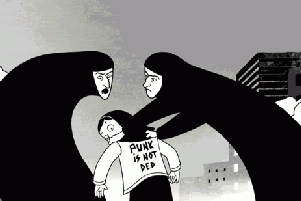
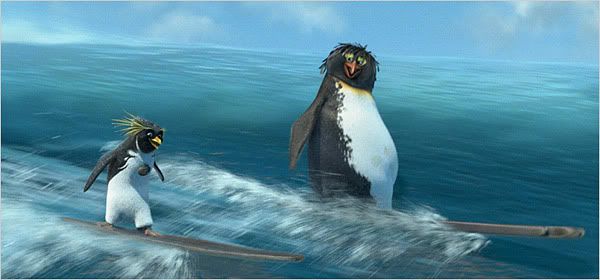
Penguins that surf, a rat that cooks and an Iranian girl growing up in the midst of a revolution will compete for the Academy Award for best animated feature film of 2007.
Nominations for 25 awards, also called Oscars, were announced yesterday. PG-rated "Surf's Up," G-rated "Ratatouille" and PG-13-rated "Persepolis" were nominated for best animated feature.
"Ratatouille" ... compared well with the live-action best film nominees. Only four other films this year had more nominations. "I'm just thrilled," Bird said. "It's particularly gratifying to get five. That was really wonderful. We felt we had a pretty good chance of a nomination in the feature animation category, but to get nominated for screenplay and sound and score, I was thrilled about that ..."
DreamWorks Animation rolls out details regarding its Bee Movie video release (I'm ... ah ... guessing it won't be in the non-Blu-Ray high def format for very long, now that Sony's system has pounded its rival into the ground):
Exclusive to the HD DVD will be several additional features, including "The Animators' Corner" a picture-in-picture storyboard reel that runs the length of the film, "Barry's Trivia Track" pop-up fun facts and "My Menus" which allow users to customize the disc's navigation based on their favorite character.
I'm still sniffing Blu-ray in Bee's not-distant future.
I thought about giving this its own post, but since others have noted the death of animation vet Brice Mack, I put it up here. There are fewer and fewer artists still around who remember what it was like to work on Snow White, Pinocchio and other early features. Now Mr. Mack has departed and reduced that small population even further:
Brice Mack, who painted animation backgrounds for Walt Disney and later produced and directed commercials and films, died Jan. 2 in Hollywood. He was 90.
Mack painted backgrounds for "Fantasia," "Pinocchio" and other Disney films including "Snow White and the Seven Dwarfs," "Cinderella," "Alice in Wonderland," "Peter Pan," "Song of the South" and "Lady and the Tramp."
He also painted backgrounds for short subjects including the 1942 Academy Award winning "Lend a Paw." ...
Lastly. As newspapers get strangled by the internet, Newsday (in New York) has battled back by increasing its online presence, doing this with animation. (Crude animation, but hey. The content is pretty funny.)
The huge jump [on Newsday's site] was in large part attributed to the popularity of an animated cartoon by Walt Handelsman, an editorial cartoonist at Newsday who has won the Pulitzer Prize twice.
One cartoon that recently attracted viewers featured a baby boomer couple coping with aging problems like knee replacements, using the song lyrics “Bored, tubby and mild” sung to the tune of “Born to Be Wild.”
Have a non-soggy weekend.












 Posts
Posts

