Saturday, July 21, 2007

Making Your Breaks

Most of us (and I'm here excluding royal families and the inheritors of limitless wealth) have to break our own pathways through the forest.

We start out with a certain amount of intelligence and environmental advantage (like we were't born in a small mud shack in, say, Darfur.) And we take those things and use them to fuel our journey through life.

Some of us end up rich and famous. Or merely rich.

Some of us end up middle class with a comfortable pension, a circle of friends, a pleasant but unexceptionable family.

And some of us finish in a small room at a YMCA in an inner city ghetto, a bottle of Jack Daniels under one withered hand, and a small Social Security check.

But whatever our final destination, we get there via the things described above and the amount of talent, energy and luck that we possess. As I've said before, if you've got more of one of those things (t, e or l), you probably need less of the other two.

I bring this up here because of the observations that came up in comments on Career Arcs down below:

...if there hadn't been a non-artist advocating for Tim [Burton] to Wilhite, what was the likelihood that he would have been able to actually produce Vincent and Frankenweenie at Disney? Slim to none.

I understand what the commenter is saying, but tend to disagree.

If Tim hadn't broken through the way he did, he very well might have climbed the ladder via another route. He had, obviously, plenty of talent. (And just as obviously, we'll never know the answer for sure. There's only what happened, not what might have happened if...)

Everyone, to a greater or lesser degree, makes their opportunities. And sometimes getting a strategic boost helps, and sometimes it hurts or is irrelevant. Here's what I mean:

The first Katzenberg/Eisner group pitch meeting at Disney happened in 1985. Fifteen artists sat around a conference table in the Disney commissary and pitched animated feature ideas. I pitched "The Man Who Would be King," got to first base, then flamed out at the treatment stage a month later.

Here's what my "flaming out" was: I wrote a treatment, Jeffrey read it, didn't like it much, and said "no, I don't want to do this."

And I gave up.

There was another person at the table that day who Jeffrey and Michael said "no" to:

Ron Clements.

You might have heard of him. He's written and directed a mess of animated features with another guy named John Musker.

Ron pitched a Hans C. Anderson story titled "The Little Mermaid." Jeffrey and Michael thought a moment, then shook their heads.

"Unh unh. Too much like Splash. Next."

Think about that a minute. Right there on the spot, Ron Clements got N-O from the two new kingpins at Disney. No helping hand, no back rub, just a negative response.

So what did Ron do?

He went off and wrote a treatment of "The Little Mermaid" detailing what he wanted to make, and sent it off to Eisner and Katzenberg without anyone asking. They read it. And Jeffrey and Michael then said:

"Hmm. Well, maybe. Show us more."

And so on and so forth.

But note what happened to Mr. Clements. Rejection.

So let's speculate. What would have happened if the two new bosses had said, "Heeey now. You're onto something. Write us a treatment."

Maybe, filled with hope and confidence, Ron would have written the treatment, and because he thought he was halfway home, he would have rushed it a little, put a little less effort into it. And then Jeffrey and Michael Eisner might have read it, been less than enchanted, and said "Forget it."

The whole history of animation might have changed, yes?

Sorry. All we've got is what actually happened.

Tim Burton received a leg up from a Disney executive when he needed a leg up, and became a success. And Ron Clements got slapped down, wouldn't take no for an answer, and became a success. (And yeah, they've both had failures in their careers, as everyone does. Steven Spielberg will not be remembered for 1941, trust me.)

My point is, they both carved pathways through the forest using the elements Fate or God (or whatever you care to call Her) gave them. And it's impossible to know if X had happened at a strategic moment rather than Y, where their life-paths would have taken them. Just as it's impossible to know where you and I would be if we'd been born someplace else.

Because there's only, in the end, what is.

Click here to read entire post
Friday, July 20, 2007

TAG's Newest Family Member

Imagi, as you may or may not know, is a tyro cgi studio in Hong Kong. Founded in 2000, about a year ago it set up a branch office in Sherman Oaks that focuses on story and visual development for the mother ship back on the other side of the Pacific.

Today, the Animation Guild finalized a deal with Imagi.

It's been a while in coming. I first found out they were doing business in the middle of the San Fernando Valley some months ago, when members started telling me they had arrived in town and were hiring. (I already knew that Imagi was the studio that had done DreamWorks Animation's production work for Father of the Pride.) We started collecting representation cards, and a while later, I had a brief meeting with one of their execs.

I've had sporadic contact with Imagi since. The company, I'm delighted to say, wasn't hostile about becoming part of our little animation family of signator studios.

And today I rolled over to Sherman Oaks to meet with the crew and corporate execs, answer questions, and sign documents. I had a long, question-and-answer with the staff where I gave my lecture about the Motion Picture Industry Pension and Health Plan, the Animation Guild 401(k) Plan, and the joys of becoming one of the United States' most noble minorities (a union worker.)

Most everyone seemed generally upbeat, and I departed in the early afternoon wishing a long and happy corporate life for Imagi.

Click here to read entire post

The Family Guy and American Dad Junket

Yesterday was my time to amble about the Fox Animation studio, located on Wilshire Boulevard in what used to be the heart of the slick and chic section of Los Angeles. (The tar pits and Museum are just a stone's throw away.)...

American Dad has been picked up for its fourth season, with designers, board artists and revisionists rolling onto it over the next month or so. One staffer said to me: "I think the writing on the shows is getting stronger. "American Dad" is finding its own identity, and the dvd sales are good. Fox is happy. And I'm happy we've been picked up."

The AD unit used to be way the hell and gone on the other side of the building from Family Guy. Now, however, it's right next door, so that probably is a useful thing.

The WGAw has a deal with Fox for the writing of its prime-time animation shows that includes AD and FG. So there's understandable concern among the artists at Fox Animation about how the WGA/AMPTP negotiations are going. If there's a strike, particularly a lengthy one, they know it's going to impact their jobs, and not in a a good way.

Click here to read entire post

Seaside Shanty

house on stilts

Here's an interesting painting from the 1960s: a ramshackle shanty at sunset, overlooking the calm Pacific...

Model of stilt house

The real life model for this painting was a metal sculpure, twelve or fifteen inches high, of a multi-level shack that sat on a coffee table at the casa for years and years. I've no idea where that sculpture is now.

Click here to read entire post

Thursday, July 19, 2007

In Praise of the Disney Sequels

Sharon Morrill should draw comfort from this.

Dan Kois rhapsodizes about the artistic quality and the lilting story notes of some recent sequels to older Disney classics:

[H]ave you ever actually watched one of Disney's DVD sequels? If you're expecting half-assed hack-work, you're in for a surprise. Lady and the Tramp II (2001), Bambi II (2006), and Cinderella III (2007), to take three recent examples, are certainly not perfect, but they're worthy successors to the originals, carrying the well-worn stories forward with care and charm. What's more, the movies tell their stories in the classic animation mode, using hand-drawn images, winning songs, and an energetic but not hyperactive style that has entertained children since Snow White and the Seven Dwarves.

I haven't seen any of the films listed above, but I've walked often enough through the studio where they were being crafted, and I can tell you that what Mr. Kois says about the care taken with layout, characters and the quality of drawings is true. Disney spent one hell of a lot of time and expense getting the films to look good, as the clips that I've seen certainly do.

I spent a couple of afternoons with background artist Bob Schaefer, who walked me through the backgrounds he was doing for Lady and the Tramp II, and though they were created with Photo Shop rather than paint, they were (are) gorgeous. And Bob went down to the Disney Australia studio (since shuttered) to make sure the crew down there got the backgrounds just right.

And I thought art director Carol Police did a great job on the art direction I saw on Bambi II.

How were the stories of these films? I don't really have much of a clue, since I haven't seen them, although a DisneyToons staffer who worked on Little Mermaid III told me: "The film is a prequel, and I thought they did a great job of tying things together from the original movie. It's a cute movie."

You want a review of Bambi III, Cinderella III, and Lady and the Tramp II, you'll have to delve into Dan Kois's article. The only Disney sequel I have a strong opinion about (because I've actually seen it) is Jungle Book II. The visuals on that feature I found to be top notch, the characters wonderfully drawn and the animation quite good, the backgrounds rich and colorful.

And the story of JB II? Sadly, it's a pale copy of the original and pretty thin gruel.

Click here to read entire post

Gamesmanship and Negotiations

In the last edition of the Big Contract Talks (WGA and AMPTP), the Alliance of Motion Picture and Television Producers had two offers on the table: one was for a total revamping of the residual system, the other was the "status quo" proposal, which would keep the current system of residuals in place, and institute a study to see what sorts of residuals should happen for all the new delivery systems (iphones, ipods, itelevisions, etc.).

That was Monday. On Wednesday, this happened:

Producers unexpectedly pulled their proposal for a three-year study off the table Wednesday -- meaning the companies' remaining take-it or leave-it proposal amounts to a revolutionary revamp of residuals with payments coming only when costs are recouped.

WGA leaders took an assertive tack of their own on Wednesday, insisting that a residuals revamp is out of the question since companies can't be trusted to tell the truth about production costs.

Two members of the Guild negotiating committee accused studios and networks of practicing fuzzy math on net profit participants on hit TV shows such as "The Simpsons" and successful features such as "Chicago."

Alliance of Motion Picture and Television Producers prexy Nick Counter blasted Guild leaders for passing up the study option, which would have retained the current residuals system during the three years.

"While we believe the WGA's rejection of a study is short-sighted and self-destructive, we did give them that option," he said. "The study would not only give us valuable insight into the new world and its impact on traditional media, but also would give us insight on how to deal with the challenges and opportunities, while continuing to compensate writers under the current provisions and side-letters to their 2004 contract."

So. What's going on here?

Nick Counter, the lead negotiator for the producers, has to build consensus in the crowd of studios and t.v. networks that he represents. If they're not all on board the Alliance's proposals, they don't have a package to present to whatever guild or union with which they're negotiating.

It's like herding cats. (And not much different for the union side, with getting factions to agree, satisfying hardline officers, and things like that.)

So lead negotiators -- for guilds and companies -- get the exciting challenge of threading needles that are constantly moving, shifting, changing. There are the various parties that have demands and bottom lines on your side of the table. And the parties that have demands and bottom lines on the other side of the table.

It's not generally the norm to offer multiple proposals right out of the box, but my guess (and it's only a guess) is that the two-track approach put forward on Monday by the AMPTP was meant to satisfy different constituencies. And pulling off one of the proposals was done for similar reasons.

The Alliance performed its version of the "we'll be conciliatory" dance, and now that the WGA has "rejected" the conciliation, it's snuggled up to the set of demands that are its starting blocks in the negotiations: roll back residuals.

This isn't about finding a "new way" and "new structure" that will, when the dust and entrails settle back onto the ground, make the studios pay more money. It's all about paying less.

Because this isn't about "fairness". It's got little to do with a new structure or fresh paradigm. It's about money.

Click here to read entire post

Wednesday, July 18, 2007

Career Arcs

The frustrated artist who drew Nightmare Before Christmas on the side while working on "Fox and the Hound."

In the very recent past, during my afternoon stumble through one of our fine animation studios, I plunked down and talked to an artist/director who's worked in the business for twenty years (and I've known almost that long), who told me a story I hadn't heard before.

Like a lot of people in the biz, he had his share of scrabbling around getting a toe-hold. Today he is a pillar at one of the larger animation studios, doing well, with a fine career rolling out ahead of him. But he related how when he was in art school and had done a student film, some Disney mucky-mucks viewed his reel and tartly informed him, "you'll have a hard time getting work in the business with that."

He related how he was pretty stung by their critique, but persevered...and today is thriving. More than thriving.

As he talked, I flashed on some animation artists -- starting out around the same time this dude did -- who also got doused with cold water.

Like young, mouthy Brad Bird, getting fired from Disney for complaining about product (even though the complaints had merit).

Like Tim Burton, working on Fox and the Hound but developing Nightmare Before Christmas on the side and getting nowhere with Disney animation management...until a live-action exec took him under his wing and helped him take the first small steps into live action.

And young John Lasseter getting bounced out of the Disney Animation department in early '84 when management became disenchanted with him.

Or even --further back -- war veteran David Swift who returned from World War II, realized he wasn't going to go much of anywhere at Disney, and struck out into television.

I guess my only point here is that having passion and perseverence often overcomes early brusque rejections by studios who don't recognize genius when it comes knocking.

Click here to read entire post

At Nick Nick Nickelodeon...

Today was Nickelodeon day, and I spent the afternoon wandering through the various nooks and crannies of the Olive Avenue facility...

Nick is one of the busier television animation studios these days. Just about every board artist and designer over there now works on Cintiques (those big, tilted lcd screens that artists draw on) and a lot of episodics are in production.

In addition to the shows detailed here and here, there are six episodes of Making Fiends, a total of twenty new interations of Fairly Odd Parents, and 26 episodes of El Tigre.

The main question I was asked is "how is the rest of the industry doing?" I replied that hiring is picking up in teevee land, and that there will probably be more hiring in the feature area at the end of the year.

Click here to read entire post

Tuesday, July 17, 2007

Off and Running -- First of Show Biz Union Talks Begin

The Writers Guild of America and the Alliance of Motion Picture and Television Producers sat down for their first round of talks on Monday. They'll meet again on Wednesday.

And here's a surprise. They're not real close to a deal:

...[T]he guild is pushing hard to expand residuals for TV and film content that is reused on the Internet and other digital media platforms, such as cell phones and iPods.

Industry executives insist that wireless and Web-based entertainment still consist largely of experimental ventures whose business models are unproven.

The producers also argue that the old system of calculating residuals of all types as a percentage of gross revenues is outdated in the fast-changing, fragmented world of the Internet and other new media.

They want a new system that withholds residual payments to writers and other creative talent until studios recoup costs for development, production, distribution and marketing....

"The producers argue that the old system of calculating residuals...as a percentage of gross revenues is outdated..."

You bet it's outdated. The producers are paying more money than they want to. And they want to pay less. That there current system sounds way outdated to me.

I mean, if there's anything I know for certain, it's that the top tier of money earners in the U.S. just isn't isn't getting enough dollars put into its threadbare pockets.

(More stories and position statements here, here and here.)

Click here to read entire post

Sony Adelaide in Culver City

Culver Studios in 1920. Mansion look familiar? It's in the front title of Gone With The Wind. Sony Adelaide used to be across the street from it, then four blocks south of it. The big house is still there, looking pretty much the same...

A few years ago, Sony Adelaide was the largest television animation studio in Los Angeles. It was housed in a large concrete building below the Culver Studios, a hundred yards from Ballona Creek -- a concrete-lined waterway that courses like an arrow to Marina Del Rey. A half-century ago, the property was part of the "Forty Acre" backlot (actually 28 acres) where King Kong, Gone With the Wind and The Andy Griffth Show was filmed.

SA was roaring at the time, producing Jackie Chan, Men in Black, Spider Man and a host of other half-hour episodics. Now Adelaide is quieter, headquartered on the second floor of a warehouse on Fairfax near Washington Boulevard. Just outside of the Culver City boundaries.

It's among the most interesting studios that I visit...

The upstairs space is a series of linoleumed hallways and low-ceilinged offices in which I usually get lost. Adelaide has, hands down, the most unique breakroom I've seen: a big room with an orange floor, white and red walls, two long black couches and copper lamps. The animation crews work in cubicles and offices arrayed oaround other large rooms.

Just now The Boondocks latest season is in post, the new incarnation of Spiderman is in full bore production, and several pilots (including a new iteration of American Dragon) are in development.

Always fun to wander around down there. What's not fun is driving to Culver City and back on the 405 freeway.

Addendum: Oops. I have a mistake here. It's Dragon Tales that might be put back into production (74 episodes so far). American Dragon is a Disney show. My bad.

Click here to read entire post

Monday, July 16, 2007

The Southern Mexico Hulett

This painting is pretty much what it looks like: Southern, tropical Mexico...

In 1952, Ralph, his wife and his mother-in-law loaded up the family's wood-panelled station wagon and drove from Los Angeles...all the way down the west coast of Mexico...to Guatemala. With Mr. Hulett, of course, painting all the way.

The trip ended in Guatamala, where a traffic mishap led to Mrs. Hulett and her mother being thrown in the clink for an afternoon. (Mr. Hulett was off on a painting assignment for Ford Times -- you think he ever did anything else? -- and so didn't get carted off to jail.)

The woody station wagon got impounded, never to be seen again. The three travelers boarded a plane back to L.A. (The car was never returned, ending up a business write-off.)

Click here to read entire post

The Monday Studio Rotation

Ordinarily I try to visit one signator studio per day in a normal week, walking around and chatting people up, scarfing up gossip and gripes.

Today was a twofer day; I got a call from artists who wanted to have a meeting about uncompensated overtime (They've been doing it, but they're tired of doing it. Especially since it's uncompensated.) The meeting lasted lunchtime, after which I went off to Cartoon Network Studio in sun-kissed Burbank, where the birds always sing and hearts are always light. And no artists wanted to meet with me...

At CN, I got into a conversation with one of the flash animators on Foster's Home For Imaginary Friends -- now finishing its fifth season and starting Season #6 -- who told me about the abundance of flash animation around town and how most of his friends were working and the business looked great. (Sad part for Yours Truly: a chunk of that work is at non-signator studios, but at least it's in town rather than on an island off the south coast of China.)

Cartoon Network has been doing a good bit of hiring lately, and TAG will hold a new member lunch for a bunch of the newbies this week. Among the projects now bubbling along at the studio:

* Class of 3000 is wrapping up its second season.

* CN has done several dozen 2-minute shorts slated for the internet, theatres near you, and various phone-type devices. And more shorts are in work.

* The Powerpuff Girls returns to the teevee with a new 1/2 hour special now in work.

* Two new pilots are being done by the creator of Billy and Mandy.

* Camp Lazlo is wrapping up its fourth season.

* Chowder is wrapping its first 13 episodes and commecning its second 13.

* Several pilots are in various stages of development.

Outside of the usual office work, that was pretty much Monday. (Aren't you glad you asked?)

Click here to read entire post

Sunday, July 15, 2007

Simpsons Movie Tub Thumping Grows Louder

The Shrek, Surf's Up and Ratatouille launches are behind us. The next big animation offering is The Simpsons Movie coming to a multiplex near you at the end of July.

Fox got a nice promotional bump from the Kwik E Mart rollout a few weeks back, and now interviews with the film's creators begin to roll out:

David Silverman, director of The Simpsons Movie, is confident that audiences will love the film... But he's not pretending it has been an easy project, what with the expectations of a fanatical fan base plus the job of corralling the 400-odd animators, writers, producers, actors and assistants who worked on the film.

"Yes, there was a lot of pressure," said the 50-year-old director the morning after the film finally wrapped up at the end of last month. "We were working right down to the wire — I think we even animated a small detail last Thursday and were making negatives over the weekend. But I actually feel very confident now that we're done. And I think it looks really beautiful."

I'd concur. The bits and pieces that I've seen on various computer monitors at the studio look terrific, and the wide-screen format is used to good effect.

"We were working at an incredibly fast pace," says Silverman. "Most animated features are not produced this quickly. We decided we didn't want to overdo the animation, because if you have too much of that Disney-like nuance, it doesn't feel like our characters."

Large parts of the film were animated by Rough Draft Animation in Korea, but there was a number of Disney-experienced animators working on the flick stateside. (Actually, a lot of old Disney hands worked on it.) The Simpsons Movie had at least three different animation crews in different geographic locations turning out footage.

The bulk of production on the film took about a year, which is fast but not unprecedented. Space Jam and it's sixty minutes of animation was done in ten or eleven months; the Fleischers got most of Gulliver's Travels cranked out in less than twelve months. And the grandmother of all animated features -- Snow White and the Seven Dwarfs -- completed the majority of the film in a little over a year (and yeah, they had SW in story way longer than that...).

I'm betting that The Simpsons Movie's opening weekend numbers are as good or better than Ratatouille's.. In two weeks we'll get to see if I'm a prophet or an ignorant moron.

Click here to read entire post

Saturday, July 14, 2007

B.O. Plenty

At the height of summer, the box office derby sizzles as the latest Harry Potter collects $26.2 million on his first Friday of release. The boy wiz has already taken in $88.8 million in the U.S. and Canada...

In second place, the big robots collect $10.9 million as Transformers closes in on a $200 million gross.

And Ratatouille -- in the show position -- spoons up $5,340,000 and a $130.3 million domestic total.

Update: The weekend stats are in, and there are few surprises.

* Harry Potter and the Whatever It Is harnesses $77.4 million and a total of $140 million after its first weekend...

* Transformers drops 49% but still collects $36 million for its second weekend (and a cume of $223 million).

* Ratatouille declines 38% for an $18 million weekend and a $143 million running total. (And here's a dandy chart showing how the latest Pixar feature has done compared to other Pixar features. Be sure to scroll down through the whole thing.)

* Surf's Up appears to have vanished from the rankings, but I know it's out there someplace.

* Shrek the Third has pretty much run its course, declining three slots -- number 13 to number 16 -- while collecting $615,000. Its domestic Grand Total stands at $318 million, making it the third highest animated film (U.S. and Canada).

* Out of eleven top-ranked features, seven have collected more than $100 million.

Click here to read entire post

Falsifying Documents

Between Links and Box Office, I post this short observation:

Over the past week, I've received a number of gripes regarding too-short schedules and artists working unpaid overtime to keep up. Most of the uncompensated o.t. is taken home. Most is on production boards, but not all...

Everybody knows the drill: they get three weeks for roughing, three weeks for cleaned up and revised final. And sometimes this 3/3 deal is 3/2 or 2/3. And yes, depending on the production and the budget, basic mileage can vary.

Some shows are more sane about scheduling than other shows. And some artists figure out how to get the work done without pulling all nighters or long weekends by simplifying, or doing their first pass as clean as possible and hoping the revision notes aren't killers.

But many just suck it up and keep nose to the grindstone until ten or eleven at night; others resign themselves to working weekends; still others figure if they miss their finish date by a day or two, the production manager will agree it's no big deal.

Naturally there's a lot of time-card falsification. Everybody writes down 40 hours because it's part of the "get along, go along" ethos.

But just so we're clear: time cards are official documents, and falsifying time cards ain't legal.

Just so we're clear.

Click here to read entire post

Friday, July 13, 2007

Toonistic Links

Another weekend, another round of hot, summery 'toon links, starting with:

Where's my Springfield? And will the real hometown of Homer pleeaase stand up!

A tiny New England hamlet called Springfield has won a competition to host the premiere of The Simpsons Movie, seeing off bids from 13 other Springfields in the US which share the name with Homer Simpson’s cartoon hometown.

The 100-seat cinema in Springfield, Vermont, will host the premiere of the new film on July 21 – six days before it opens to the general public – after winning a competition against Springfields from Oregon on the west coast to Massachusetts in the east...

DreamWorks Animation's Shrek the Third continues to tear up the wickets in overseas venues:

In France, Gallic distribbers are among the only folks happy about the sodden, chilly weather across most of the country...

"Shrek the Third," in its fourth frame, remains a colossal hit nationwide, still on as many screens (850) as its first week and to date cuming some $35 million for Paramount.

Indeed, "Shrek the Third" has continued its stellar box office performance around the globe...

And Ratatouille is also doing well in foreign markets:

"Ratatouille" cooked up a respectable $9.3 million at 1,835 from a dozen markets, led by a solid Mexican opening of $4.2 million -- more than the combined grosses of the next three pics -- and a Russian soph sesh of $1.7 million, down 51% for a cume of $6.6 million for the top Pixar gross in that market. BVI opted to wait for "Shrek the Third" and "Order of the Phoenix" to play out and won't launch "Ratatouille" elsewhere until late July with openings in South Korea and Japan.

Various comic book titles have a worldwide audience. It's not just American super heroes travelling overseas, but foreign titles gaining footholds in the U.S. of A.:

Animation and comics have gone truly global. Just look at Spider-Man 3's global box office sales as an example. Last month, the wall crawling superhero broke box office records in India, earning the most that any Hollywood movie has in that country to date...

The fact that an idea stemming from a 1960s superhero thought up by two American writers holds such strong appeal cross-culturally is simply testimony to the extent to which vastly different cultures are increasingly intermingling with one another. Within this context, acknowledging that anime and manga have gained significant ground with comic book and animation aficionados far beyond the geographical confines of Japan lacks the element of surprise that it might have engendered some years ago.

"If you told parents ten years ago in America that their children would know characters named Yu Gi Oh! and Pokemon as well as they would Spider-Man, those parents would have thought you were crazy — yet in America today an estimated 30% of major children's animated programming is now Japanese animation," states Sharad Devarajan, CEO of the New York headquartered Virgin Comics and Animation.

As we have featured various Virgil Partch cartoons, so the ASIFA Animation Archive today features the puckish artwork of Vip in its virtual display cases.

Almost all of Ratouille's reviews have been strongly positive. But here's a piece from Atlantic Online that carps about the picture and...all the positive reviews:

...the script is not superbly witty, the human leads are frankly unappealing (Owen Gleiberman called Linguine, the kitchen boy, "a one-note stumblebum," which I think is too kind by half) and the villain is cardboard and lamer-than-lame. Technically, Ratatouille is a great advance on The Incredibles. As a complete work of art, though, it's nowhere close.

(To be fair and balanced, here is Jenny's BlackWing Diaries take...)

DreamWorks sees its stock rise as analysts smile kindly upon it:

Shares of DreamWorks Animation SKG, the animation film studio behind "Shrek," rose on Friday after an analyst began coverage of the company with a "Buy" rating, predicting gains from upcoming films.

The stock gained 96 cents, or 3.3 percent, to $30 in afternoon trading.

In a note to clients, Stifel Nicolaus & Co. analyst Drew E. Crum said DeamWorks has produced some of the most successful animated features in motion picture history.

Being a blogmaster has it's many rewards. Did you know (I'll bet you didn't) that this year of 2007 marks a momentous anniversary for animation?

Georgia (the Georgia that was formerly part of the U.S.S.R.) has its own date to celebrate: this year, Georgian animation turns 75...

It was Georgian animator Vladimer Mujiri who brought the first Georgian animated films to life at the start of 20th century. His 1936 short animation “The Argonauts” was the first notable breakthrough...

By the mid-fifties, Georgian animators were taking their cue from Disney’s productions. The style is exemplified in Arkadi Khintibidze’s 25-minute animated film “The Wedding of the Jays,” released in 1957. Based on the story by prominent Georgian writer Vazha-Pshavela, this film and Khintibidze’s other major works—“Tsuna and Tsrustuna” and “Hostility”—were acclaimed as Georgian animation classics.

Speaking of all the converging media (as we were), the Brits are rolling out their first masters program in video game development:

The UK’s first ‘game academy’ has been created by some of the country’s top video games developers and universities for computer games training.

The University of Bradford has teamed up with the University of Hull and Sheffield Hallam University to create the Game Republic Academy (GRA) in collaboration with games industry leaders including Rockstar (famed for the hugely popular Grand Theft Auto series), Team17 and Sumo.

“We are exceptionally placed to offer students the kind of training the industry is crying out for," [said Peter Cowling, professor of computer science.] "With high profile industry figures pointing towards AI (Artificial Intelligence) as the next big thing for commercial games, we are able to offer our new AI for Games Masters programme - the first of its kind in the world..."

Then there is this review from Variety about a new animated docu-tragicomedy:

Colonialism, capitalism and the West's abrasive association with Islam are densely compressed into a partially animated, mostly satisfying history lesson in satirical fable cum docu-essay "Global Haywire: A Short History of Planet Malfunction." Directed, drawn and conceived by Oz political cartoonist and 1976 Oscar-winning animator ("Leisure") Bruce Petty, ambitious pic occasionally creaks under the weight of strained metaphors, but intelligent talking heads and engagingly shambolic cartoons conquer unwieldy narrative and sporadic glibness.

Lastly, we'll conclude with political 'toonists who have turned to the wonderous world of animation:

Known for his quick wit and even sharper pen, nationally syndicated editorial cartoonist Walt Handelsman took home his second Pulitzer Prize in a decade this spring, but the win is not notable for its frequency, but for the technology used to produce his winning submissions.

In late 2005, when faced with gloomy forecasts for the future of his craft, the Newsday editorial columnist and several of his cartoonist colleagues...decided to try their hand at something a little different.

Handelsman began experimenting with new material and a new medium, locking himself in his home office for hours on end, giving up golf for a year, and exchanging his pen for a mouse...

"Animated editorial cartoons are completely different from static editorial cartoons," Handelsman said in an interview with ABC News. "With a standard editorial cartoon, you're taking tons of information and synthesizing it down to a single bite -- a single moment in time. With animated editorial cartoons, it's more storytelling..."

Addendum: So call me obsessive, label me compulsive. It's late but here's a fine Vanity Fair piece on The Yellow Family, offered kaliedescopically through various participants:

Barry Diller: I remember when we screened the first episode, for a number of Fox executives, we all went down to their bungalows over at The Simpsons, and not a single person in the room was laughing, except for me and Jim Brooks. No one had done an animated sitcom since The Flintstones, and it was just like, "What is this?" But we put it on, and it became more and more successful every week.

Have a fabulous weekend.

Click here to read entire post

The Friday Outhouse

Ralth Hulett outhouse painting

Around and about the mid 1940s, when Ralph Hulett was drawing his $60 weekly paycheck from Walt Disney Productions, he used to paint small watercolor paintings of the scene above. And give them away as gifts...

My mother tells me that he painted them before they got married, painted them after they got married, painted them depicting a variety of seasons (this one is, obviously, Spring.)

In the great long ago, my grandmother had this particular painting hanging in the hallway outside her bathroom. As a kid, I always liked it (particularly the sprinter coming out of the house. No big question about where he's headed...)

Click here to read entire post

Media Convergence!

Electronic Arts topkick Neil Young

When you talk animation today, you need to talk about a much wider universe than the world of Disney features, Huckleberry Hound and Bugs Bunny that existed forty-five or fifty years ago.

In 2007, animation means digital visual effects, television graphics, internet shorts, television episodics, theatrical features.

It also means the huge world of video games -- which today far outstrips the traditional entertainment media we know as films and television. Electronic Arts honcho Neil Young talks about the convergence of games and the other media platforms in an interview with Game Daily:

"We've evolved from an industry that licensed Hollywood IP for games to one that now works with creators like Steven Spielberg to create original IP that can translate across multiple interactive and traditional media," said Young, who's overseeing the three original games Spielberg is developing for EA. "That journey is accelerating as musicians, writers, actors and directors are all getting involved in video games. The lines are being blurred between a great IP that comes from the imagination of a game designer and one that comes from a Hollywood creative."

Young believes the blurring of which came first, the movie or the game, will become a moot point inside of three years.

(A longer interview with Young on this subject is here.)

I know a number of animators and TDs who shift back and forth from video games to animated features. Electronic Arts has a big facility in Playa Vista, and competes with visual effects houses and animation studios for digital artists coming out of Cal Arts, UCLA, and elsewhere.

I'm told that base salaries are often similar, but benefit packages and overtime rules are not.

(h.t. Kathleen A. Milnes)

Click here to read entire post

Thursday, July 12, 2007

The Mid-Week Animation Studio Roundabout

I'm back in full harness after the July 4th hiatus. Film Roman/Starz Media and Disney TVA were my destinations of choice...

Up at Starz Media, the only work for the remnants of The Simpsons Movie crew to do are a few Homer/Bart/Marge promos. (Of which a Simpson's director told me: "Well, those have gotta be done by the end of the month, because the picture comes out...")

I got some nervous questions from artists about 1) a WGA strike being imminent (I thought no, but possibly when -- and if -- SAG walks in Spring '08.) And 2: If a lengthy strike happens, would it impact The Simpsons artistic staff? (I thought yes.*)

At Disney TVA @ Frank Wells (that's a building on the studio's Buena Vista Street lot), Phineas and Ferb is percolating along, and Secret Agent Oso is proceeding with 26 half-hour episodes.

DTVA board artists are also working on the second 13 episodes of Ying Yang Yo (The flash animation and design work are being done -- I'm told -- in Canada.)

There are a goodly number of new episodes for The Replacements now in work.

There are a bunch of empty offices and cubes where DisneyToons crew once worked. The Toons people have decamped to the digs in Glendale.

* Kindly note that my opinion can be just as valuable...or worthless, as the next person's.

Click here to read entire post

First Salvo In Entertainment Industry/WGA Negotiations

The WGA and AMPTP will sit down for negotiations this month. In yesterday's New York Times, industry potentates let one of their major negotiating points be known:

In an unusually blunt session here today, several of Hollywood’s highest-ranking executives called for the end of the entertainment industry’s decades-old system of paying what are called residuals to writers, actors and directors for the re-use of movie and television programs after their initial showings.

The executives stopped short of saying they would demand an immediate end to residual payments in the upcoming, probably difficult negotiations with writers, actors and directors. But they were emphatic in calling for the dismantling of a system under which specific payments are made when movies and shows are released on DVD, shown abroad or otherwise resold. Instead, they want to pool such revenue and recover their costs before sharing any of the profit with the talent.

“There are no ancillary markets any more; it’s all one market,” said Barry Meyer, chief executive of Warner Brothers. “This is the time to do it.”

Residuals have formed the backbone of payments to talent in Hollywood since the early sixties, when Ronald Reagan negotiated a residuals structure for the Screen Actors Guild and every other entertainment union followed suit.

In 1962, the WGA negotiated a flat 2% cut of revenues, which was altered at the next contract negotiation to the front-loaded system still in use today.

It might be a good idea to go back to a flat percentage of cash flow.

Is that going to happen? Probably not. And I think that the current practices will continue after the dust has settled, despite the executive blustering above. Still, the execs' stance is worrying.

I can tell you if residuals were ended, some other system of payments would have to be put into place, because they're the bedrock for thousands of industry workers, top to bottom. (The IATSE, of which TAG is a part, relies on residuals to undergird its pension and health plans.)

Click here to read entire post

Doug Marlette, R.I.P.

Prize-winning cartoonist Doug Marlette is dead after a car accident in Mississippi...

"Doug was one of the very few talented cartoonists working today. He had a very different approach — all the good ones do," said Paul Conrad, a retired three-time Pulitzer Prize-winning cartoonist for The L.A. Times.

"He had a marvelous way of needling people, which was all too rare," Conrad said.

...Marlette's editorial cartoons and the "Kudzu" comic strip he started more than 25 years ago are widely distributed in the U.S. and abroad, according to Tribune Media Services, which syndicates his work.

Click here to read entire post

Wednesday, July 11, 2007

Is this the greatest cartoon ever made?

This week marks the fiftieth anniversary of the release of what a thousand of us voted as the greatest cartoon ever made...

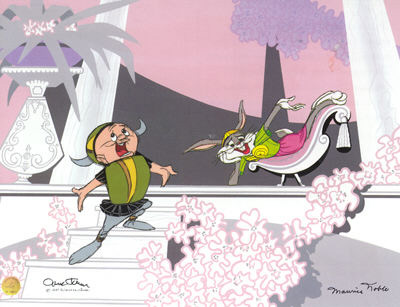
Return My Wuv

What's Opera, Doc?, directed by Chuck Jones, written and with lyrics by Mike Maltese, and designed by Maurice Noble. Featuring the voices of Mel Blanc as Bugs Bunny and the underrated Arthur Q. Bryan as Elmer Fudd (although it's Blanc who yells "SMOG!!!")

Since Dave Hilberman passed away in the last few days, it bears noting that both Chuck Jones and Maurice Noble were active in organizing the animation industry under the Screen Cartoonists Guild back in 1940-41. Chuck was among those locked out at Warners/Schlesinger, and Maurice hit the bricks at Disney, thereby bringing his flourishing career at the Mouse House to an end.

Happily, being active union lefties didn't slow down either of their careers.

(Interesting list in the above link, by the way. Seventeen Warners cartoons in the top fifty versus nine for Disney. And only one, The Band Concert, in the top ten.)

Click here to read entire post

Two 50-Year Careers. Two Different Stories.

In the time I've been a union biz rep, I've heard life narratives similar to the ones below. I've just never heard them in one two-hour span...

Story One: Last week I had lunch with an animation veteran I've known a long time. He's worked at one studio for the bulk of his career, and he's one of the chosen few. Long term employment, good health, regular paychecks. He wondered how much longer he should work, I said "until it starts boring you." Then he had a question for me:

"Steve? I got a letter and forms from the Motion Picture Industry Pension Plan. They say they want me to start taking monthly retirement payments. I hadn't given it much thought but I guess I should. Oh. They also have this thing called the IAP." What's IAP?"

I explained that IAP stood for Individual Account Plan, that it was a lump sum amount earning interest as we spoke, and that in his case the lump sum was probably substantial.

He quoted me the figure. I made a mental note: Substantial.

I told him he'd get the monthly payout in addition to the big lump sum. This was news to him, but he was (big surprise here) pleasantly astonished. I told him he should apply for the monthly pension -- called a "Defined Benefit" -- as quickly as possible, since he was the age where he could keep working and draw the pension, so there was no point in waiting around. He said he would.

Now. The gentleman above has had a number of blessings, career-wise. He's been in the right place at the right time (a big plus), he's been skilled at what he does (another plus), and he's very pleasant (a helpful character trait when you're seeking long-term employment.)

But I won't b.s. you. Not everybody gets the breaks, not everyone has a skill set that's continually marketable (with a personality to match), not everyone makes the right choice when there's a crucial fork in life's road.

Yet I kind of believe the champion golfer Sam Snead, who once remarked after a major tournament win: "Yeah, I had some luck out there today. But I've found out that the harder I work, the luckier I get."

Which leads in to Story Two:

A couple of hours after the lunch, I took a phone call from an artist who's had about the same length career as my dining companion. He's worked as an animator, board artist, t.v. animation director, you name it. Worked at a plethora of studios, both here and abroad. He called up wanting to know where work was, as he's waiting for payment for some freelance work and the little company who's supposed to cut the check is... slow. And he needs the money.

"Social Security, it doesn't go very far. I got expenses and I got to keep working. You work a long time and you end up nobody. Nobody knows who you are."

I made consoling noises about the crappiness of gray-listing and the unkindness of thirty-year-old execs, how he deserves better and how tough the industry is. Etc., etc. During the course of the conversation I found out that he'd worked non-union here as well as out of the country, all without benefit of any pensions. So his monthly payout from the industry pension plan is minimal.

I didn't have any bright ideas about finding work, since I didn't know any studio that was hiring just then. When we finished and hung up, he probably thought it had been a waste of time talking to me. I wouldn't have blamed him if he'd decided I was as crappy and useless as the animation industry.

But I learned a lot. Again. The animation business -- like most of the entertainment biz -- is cold, uncaring, and often brutal. One year it showers you with money and tells you what a fabulous talent you are; the next year it doesn't return phone calls. And you're on unemployment wondering what the hell happened.

I know it's not like this for everybody. Sometimes God smiles down while you're still in the womb and gifts you with monster talent. And sometimes the career ball bounces just right and you are standing in the proper doorway in front of the key supervisor at the correct time. And sometimes you work your tail off 24/7 and expand your career universe that way.

If you've got huge amounts of talent or luck, maybe you don't need a frenetic work ethic. Conversely, a big passion for work could mean you don't need as much of the other two things.

But face it. Most human beings don't end up precisely where they expected. Or wanted. Excrement, as the wise man says, occurs. Which is why it's crucial to save and participate in pension plans, mandatory to push your learning curve upward at every point of your career, and crucial to run your professional life like you're in the regional finals of a popularity contest.

I mean, since you're here on earth breathing anyway, you might as well maximize your prospects.

Click here to read entire post

Tuesday, July 10, 2007

Around the Working Dream

Today was the DreamWorks day. Jeffrey K.'s car in its usual spot, with me wandering around through the buildings on campus...

The Bee Movie crew is down to its last few weeks of work on the Jerry Seinfeld movie, doing overtime on weekends as the film wraps in mid August.

Kung Fu Panda is at the halfway mark in animation, finishing up early in '08.

(When I first heard the title of this flick, I thought "Gad. How can they make anything out of this?" But the crew has been uniformly enthusiastic about this property, so what do I know?)

Click here to read entire post

$600 Million Ogre

Shrek the Third has now crossed the $600 mill mark:

DreamWorks Animation's "Shrek the Third" continued its stellar box office performance around the globe, with the cumulative worldwide gross now surpassing the $600 million mark. The history making U.S. opening of "Shrek the Third" -- the largest domestic debut ever for an animated film -- was duplicated in many key territories around the world, with #1 animated openings of all time in such countries as the U.K. (where it remains at the top of the box office charts for the second week of release), Russia, Korea, Mexico, Brazil, Argentina, Singapore and others.

Some commenters have said Shrek 3.0 isn't their most favorite animated film. And that's fine. But as the estimable Robert S. Birchard told me at lunch yesterday: "Know what Hollywood considers a good movie? A movie that makes lots of money."

And as I've said elsewhere, I want to see lots of good animated movies come out of Hollywood. It means more animation employment.

Click here to read entire post

Monday, July 09, 2007

Dave Hilberman, RIP

A day on Buena Vista Street, Burbank California. June, 1941.

Dave Hilberman, one of the great veterans of the animation industry, who worked everywhere and did everything, died this past week. He follows his wife Libbie, who passed away last year....

Dave played a large part in the unionization of Southern California's animation industry. TAG President emeritus Tom Sito recounts:

In summer 1940, [Screen Cartoonists Guild] secretary Charlotte Darling asked Disney layout man Dave Hilberman if the Disney employees would go union. Hilberman held a secret meeting at his Beachwood Canyon house. He explained to the artists assembled that if a majority of the studio employees were to sign representation cards, the federal government would acknowledge their union, and Walt would have to agree. To Hilberman's surprise, the artists started to sign cards by the dozen.

Ten months later, Disney employees went on strike for union recognition, changing the industry for decades to come.

Dave never again worked for Walt Disney Productions. Back to Mr. Sito:

Dave Hilberman (1907-2007) - Artist, designer, and union activist. Hilberman worked at Disney, where he was one of the strike leaders. In 1947, Walt Disney denounced Hilberman to the House Un-American Activities Committee, saying he was a Communist. Dave was one of the founders of UPA and later Tempo Productions in New York. He later settled in Palo Alto, California, and had a long teaching career at San Francisoc State College.

So long, Dave. Few people stay true to principle, but you were one of them. You'll be missed.

Click here to read entire post

Pro Duck Tivity

Rubber ducky

The title above means a lot for the iPods, iPhones and Roombas that are being stamped out. The higher the productivity, the lower the unit cost. Therefore the higher the profit for Apple, Dell or whomever.

On the other hand, "unit cost" means less in the making of animated entertainments. If you turn out animated product at a cheap price, the resulting ninety minutes of Technicolor hilarity via Mumbai doesn't do the company that financed it much good if it's not particularly funny and nobody goes to see it.

In other words, if you spent a mere four million dollars on the feature about the Wacky Wombat, but it's unreleasable, that's four million dollars down the mongoose hole.

So we see that in Movieland, productivity takes on a different meaning and dynamic than it does in manufacturing. A director and production crew who turns out a smash hit is more "productive" -- in the sense that their product makes lots of money -- than the crew that does it cheap but creates a turkey. Even if they burn through ninety or a hundred million getting that product out.

This is why, despite lower costs elsewhere, so much animated feature production has remained in California. And it's why a business model that keeps production "in house" has prevailed: Its the approach that's produced the most hits, and creating something that will attract as many eyeballs as possible on the all-important opening weekend is, first and always, priority number one. Staying under budget is farther down the list.

It explains why, in the early nineties, a Disney Animation honcho bragged how the blockbuster features the studio was then turning out required lots of overtime "but it only added two or three million dollars to the budget," so who cared? Two or three million bucks was, in those golden times, a drop in the budgetary bucket, and the o.t. money was microscopic compared to what the pictures were pulling in.

Television animation, of course, is a different animal. In TV, time is of the essence but quality isn't, so the feature model doesn't come into play. These days, with budgets for half hour-shows smaller than they were in the frenetic nineties, studios find new and creative ways to economize: scripts get free-lanced, boards get free-lanced, and the animation is shipped overseas.

Then the stateside studio fights with the sub-contracting studio over who has to pay for retakes.

But even in television, the talent pool still matters. Few studios are willing to ship everything out. Even with all the runaway production, Los Angeles has more animation employment in 2007 than it did in 1967, when 100% of American television and feature animation was done domestically. There's more product, and more need for artists that can design and produce winners for the U.S. and world markets.

Shanghai might be cheaper, but California has a leg up on inspiration.

This applies to more than traditional animation. Not for nothing did gaming company Electronic Arts set up a big studio in Playa Vista. Costs might count, but so does talent, education and depth of expertise. The Hong Kong studio Imagi has a development studio in the San Fernando Valley because it knows what its competitors know: In creative enterprises, having the right talent working for you is the most productive move you can make, even it if costs more.

In the final analysis, Pinocchio and Little Mermaid, Toy Story and Ratatouille are not iPhones or computers that can be stamped out anywhere. They are fragments of time that require a specific and peculiar type of talent to produce well. And producing features well (and television shows well enough) is ninety percent of the struggle.

The big animation companies, despite all their faults, understand this. So the gadgets and toys that are tied to animated tent poles are produced in Asia. And the tent poles themselves are made here.

Click here to read entire post

Sunday, July 08, 2007

Transformers Reconstituted

Our great old pals from the '80s, those wild and whacky rampaging robots, get a freshening courtesy of Cartoon Network (it's more than just live-action cgi, don't you know):

"Transformers" is transforming — again.

Even before the bigscreen incarnation, shaped for broader appeal by Michael Bay and Steven Spielberg, hit theaters July 3, toymaker Hasbro was gearing up to reach another aud: young children.

The durable toon franchise will return with 26 half-hour episodes on the Cartoon Network, kicking off with a 90-minute special in January.

"It's going to be different from what it has been," says Hasbro's global VP for "Transformers" Samantha Lomow. "The storytelling full of humor — we didn't really have much of that in the past. We want to make the show a lot more fun for a younger audience."

In its most recent incarnations, the "Transformers" cartoon has been produced in Japan and overdubbed for syndication in the U.S. This time, Matt Youngberg, Sam Register and Derrick Wyatt (all of whom worked on "Teen Titans") will be reworking the characters for Cartoon Network; Marty Isenberg ("Teenage Mutant Ninja Turtles" ) will be head writer. Designs are reminiscent of the "Teen Titans," with stylized bodies and a fluidity lacking in the last Transformers cartoon, "Cybertron."

As we know, Transformers is/are a joy forever, particulalry if you're male and between oh, six and sixteen.

I, for one, think that a great big "thank you" is due to Mr. Bay and Mr. Spielberg for propelling this latest iteration.

Click here to read entire post

IM Digital Snags Jim Carrey

Robert Zemeckis's cgi house IM Digital will be doing a Dickens epic in the near future. And the principal voice talent will be... Mr. Carrey:

LOS ANGELES (Reuters) - Jim Carrey, who brought Dr. Seuss' Grinch to life on the big screen, will soon play another holiday curmudgeon, Ebenezer Scrooge, and three ghosts who haunt him, in a computerized remake of "A Christmas Carol," the Walt Disney Co. said on Friday.

Oscar winner Robert Zemeckis will direct the movie from his own script, based on the Charles Dickens classic novel, a Disney spokeswoman said.

The movie will blend live action with 3-D digital animation and a computer-graphics style called "performance capture," which Zemeckis used in his 2004 holiday adventure "The Polar Express" and his upcoming film "Beowulf," the spokeswoman said.

The IATSE (our mother international) organized IMD several months back. The company's principal facility is in the bay area. No idea when Christmas Carol is going to be released, let alone completed.

Watch this space.

Click here to read entire post

Saturday, July 07, 2007

Your Weekend B.O.

Forbes/AP takes a doleful look back at summer box office through early July:

Summertime in Hollywood is not as hot as it looked at the beginning...

In fact, attendance is running behind last summer's and has even fallen below that of summer 2005, a year of box-office duds that had some analysts predicting audiences were abandoning movie houses in favor of home theaters and other entertainment options.

But let's not worry our pretty little heads over the turnstile traffic of two weeks ago. Let's take a look at what's happening now:

The Friday totals are in, and Mike Bay is back on top (after the disastrous Island) with the new, monster smasheroo Transformers. Robot cars live! And live well! ($107.4 million after 3/4 of a week in theatres.)

Ratatouille has an excellent $9.5 million Friday as it climbs to $90 million starting weekend #2.

Bruce Willis returns to full potency in his signature role as John McLane as Live Free of Die Hard roars ahead with $5,350,000 Friday gross and a $72.1 million total.

Update: The weekend estimates are in, and it's plain to see that the big robots collected a tall pile of coin ($67,000,000), and $152,500,000 in one week. High art and quality filmmaking win out every time.

Ratatouille drops 38.3% and crosses the $100 million threshhold after two weeks, with a total of $109.5 million.

Five films in the top ten have entered the $100 million club. I'm guessing that Live Free or Die Hard -- #3 with a $17.4 million total for the weekend -- and possibly Evan Almighty will get there. (But having seen Almighty, I won't be shocked and amazed if it fades out at $89.3 mill.)

Okay, now you know what the grosses are. Go out and watch a film, maybe the #1 film. Make Steven Spielberg happy.

Click here to read entire post

Friday, July 06, 2007

Extra Crispy Links of Patriotic Toonisms

Another weekend of animation links, beginning with the heavy, technical side of Ratatouille: a five-star chef teaching the animation crew to cook:

"Ratatouille," Pixar's new film about one rat's dream of haute cuisine, came by its acting chops the old-fashioned way, turning to real-life chef Thomas Keller for the inside dish on kitchen kinetics.

Keller's stint as rat-a-tutor was part of an intensive prepping effort that included signing up the Pixar crew for cooking classes and sending filmmakers to dine in fine French restaurants.

The idea was to make sure the computer animation turned the gourmet goodness cooked up by Remy—the lead rat in "Ratatouille"—into a feast for the eyes.

As we noted yesterday, Rupert's Rangers are rolling out the publicity machine for Bart, Homer, et al. But as Hollywood Reporter notes, they are playing a sly, non-traditional game:

Just like the irreverent Bart and Homer Simpson, 20th Century Fox's promotional program for "The Simpsons Movie" seems to break all the rules.

The studio has lined up only four tie-in partners for what is considered to be one of the summer's tentpole films, and only one -- Burger King -- is a traditional major advertiser buying TV ads to support the film.

(And here's more and yet more on The Simpsons Movie.)

Roy Disney comes out of retirement to take the helm of....the good yacht Pyewacket:

Roy Disney, conqueror of Michael Eisner, nephew of Walt Disney, longtime Disney Studio fixture, famous yachtsman, is on the line from his home in Toluca Lake...

"...one of the reasons I'm back [participating in the TransPacific yacht race] is to regain the record," says Disney, who will be skippering a 21-man crew on the Pyewacket - he has rented it back from Orange Coast College and lengthened it from 86 feet to 94 - in the Transpac [race] that will commence on July 15. "With the modifications we've made on the boat, it should be a lot faster. And if the winds are right, there's no reason why we can't set a new record."

And just to prove you can't keep an old Roy D. nemesis (and former Mouse House CEO) down, we have this:

On the heels of making webisodic history, Michael Eisner's "Prom Queen" has been repurposed as a full-length feature and will be featured exclusively on Amazon.com's download service Unbox.

According to a report from Variety, "Prom Queen" will be made available for 30-day rentals or for sale, and the film version runs 130 minutes long.

Which has led to this:

Former Walt Disney Co. chairman Michael Eisner's new-media studio Vuguru said Tuesday it is producing its second original series.

Dubbed "The All-for-Nots," the Internet-based comedy series documents the travails of a fictional indie rock band as it travels the United States in search of success.

The old animation standby Transformers transforms into a live-action/animation hybrid and smashes box office records:

Hollywood's box office record books have been transformed. The sci-fi adventure "Transformers" had an unprecedented Tuesday haul of $27.4 million in its official debut, beating a record of $15.7 million set last year by "Pirates of the Caribbean: Dead Man's Chest."

"It's the biggest Tuesday ever," said Mike Vollman, spokesman for Paramount, which released "Transformers" along with fellow Viacom Inc. unit DreamWorks. "It's playing very broadly. It's the kind of summer movie that's drawing families and we're very excited for its progress going into the rest of the weekend."

At the Disney Animation Studio, Musker, Clements and associates have found their villain for The Princess and the Frog.

Regarding Disney, stock analysts take another look at Disney's purchase of Pixar throug the prism of Ratatouille's opening:

CNN/Money predicted that the film will end up with about $189 million, "becoming the third consecutive Pixar release to under-perform its predecessor." Some analysts suggest that if there is worrying to do among investors it should come if the film fails to generate strong ticket sales over the upcoming Fourth of July holiday.

So, they must be breathing easier after the strong ticket sales, no? (Motley Fool weighs in on the subject here.)

Down in Glendale, DreamWorks Animation reduced its credit card limit:

The animation studio had been able to borrow up to $200 million under the 2004 agreement, but on June 29 decided to reduce its limit to $100 million, according to the filing with the Securities and Exchange Commission.

The cash flow from Shrek the Third is no doubt helping with the above.

We'll end with something different: a link to Turner Classics Movies and their notes on 1940's Pinocchio:

...According to a New York Times article, Cliff Edwards, who provided the voice of Jiminy, was originally tested for the voice of Pinocchio, "but Disney had turned him down because there was a 'drop of adult' in his voice."

"Drop of adult." Nice. So why link to this? Because the TCM site (www.tcmdb.com) is an entertaining and educational place to go. (And I just ran across it.)

Have a joyous weekend.

Click here to read entire post

Thursday, July 05, 2007

Imperfect Simpsons

Now that The Simpsons Movie is pretty much in the can, some of the creators are out making sure the worldwide movie-going public knows it's coming:

Simpsons creator Matt Groening has revealed the long-awaited film version of the popular US cartoon series will be deliberately "imperfect".

The long-awaited movie is believed to have an environmental theme Speaking at a press launch in central London, he said The Simpsons Movie was "a tribute to the art of hand-drawn animation, which is basically disappearing".

"All the animated movies these days are computer generated," he said, adding that his film had been created in "the old-fashioned, clumsy, 'erase it if you don't do it right' way".

"It's not a CGI movie with a thousand perfect penguins dancing in unison," he continued - a reference to Happy Feet, the winner of this year's Oscar for best animated feature.

Uh, there's plenty of CG images in The Simpsons Movie. They might be covered with ink-and-paint type skin, but they're still CGI. There is also a lot of pencil drawings, so big chunks of it were crafted by hand. But let's not kid ourselves. This puppy wasn't created the way Snow White was created. Far from it. But I'm thinking that Fox is expecting Snow White type revenues...

[W]ith a goody-bag of merchandise awaiting journalists as they arrived for Wednesday's event - including watches, drinking straws and even a stress relief aid shaped like a donut - the film is clearly viewed as a major summer cash cow.

In the immortal words of Fox founder Darryl F. Zanuck, Rupert's brigades probably anticipate "opening their own mint" soon after the film premieres.

Click here to read entire post

Wednesday, July 04, 2007

Work for Free!

I took two days off in front of the July 4th holiday. But before I left the office, a studio that isn't paying its vendors, sub-contractors and is only barely paying its staff hit TAG's radar screen. (Multiple calls from multiple angry artists underpin the "radar screen" metaphor.)

The company is non-signator, but that's not the issue here, since I've known signator studios that have also missed money payments. The issue is: when a studio bugs out of paying what it owes, what does an artist do?

Based on long observation, I can tell you what most artists' first impulses are: Hang in. Be a team player. Keep working until the check that is endlessly promised finally arrives.

Short-term, this is sort of reasonable.

Long-term, this is insane.

Here's my definition of long-term: for free-lancers, anything longer than six weeks. For staff persons, anything longer than six business days.

I've arrived at this formulation after years of observation and experience. Seeing artists getting stiffed is one thing. It happens to everybody at one time or another. But to see artists get stiffed and then hang around for more stiffing makes me nuts.

So here's the deal. When you get two hard-luck stories back to back instead of a check or envelope filled with cash, put down your pencil, brush or computer mouse and get out of there.

If you're a free-lancer working on a new assignment and you haven't been paid for the old assignment you turned in and invoiced two months before, don't -- and I mean don't -- turn in the new stuff until you get paid.

And if you're accused by some pompous, self-righteous production manager of being disloyal and not trustworthy enough, try hard not to laugh as you walk out the door.*

Because you'll probably run into the production manager later, at some other studio.

*And remember to give the Animation Guild a call, because we can advise you of your legal rights and what next step to take.

Click here to read entire post

Tuesday, July 03, 2007

The Harrison and Gould Krazy Kat crew, circa 1928

Harrison and Gould studio, circa 1930
Click on the thumbnail for a full image

From left to right: Mike Balukas, inker; Al Woodley,cameraman; Al Windley, cameraman; Ira Gould, painter; Al Gould, painter; Berny Wolf, then an inker (who died in September 2006 at the age of ninety-five); Al Rose, animator; Harry Love, assistant animator; Manny Gould, animator-director; Sid Marcus, animator; Ben Harrison, animator-director; Jimmy (later Shamus) Culhane, inker and assistant animator; Art Davis, animator; unknown painter; office boy; Dave Tendlar, inker and assistant animator.

The Charles Mintz studio was the third to produce cartoons based on George Herriman's Krazy Kat comic strip. This picture was taken the year that Mintz bought out the rights to Walt Disney's Oswald the Lucky Rabbit, forcing Disney and Ub Iwerks to come up with a mouse character instead ...

Under the supervision of animator-directors Ben Harrison and Manny Gould, the Krazy Kat crew abandoned Herriman's free-flowing style in favor of a generic assembly-line approach closer to Felix the Cat. According to Shamus Culhane:

If you had a gag where somebody was hit by something, you automatically had it happen three times, because you used the drawings over again.

Good thing no one makes cartoons that way any more ;)

In 1930 Mintz moved his studio from Manhattan to L. A. Many of the same artists appear in this photo, adapted to the West Coast style.

More about the Mintz Studio here.

Click here to read entire post

Pixar vs. DreamWorks

As Ratatouille knocks Shrek 3.0 out of the Top Ten domestically, the green ogre and associates ascend the pinnacle of foreign box office:

Despite the trio of fresh summer tentpoles nipping at its heels, "Shrek the Third" dominated the international circuit for the weekend, grossing an estimated $69.6 million from 6,489 screens in 52 markets to push its overseas total to $259 million.

The DreamWorks Animation/Paramount Pictures International release, which began a graduated international rollout May 17, hit full stride by recording its biggest weekend yet, grossing $4.2 million more than its two closest competitors combined. It is the No. 1 overseas attraction for the third consecutive weekend.

By our calculations, the latest Shrek is closing in on a $600 million worldwide gross. Not quite up to Shrek the 2nd's high standard, but not shabby.

Click here to read entire post
Monday, July 02, 2007

One More Big Summer Toon Opening

Kwik-E-Mart sign

Ratatouille is successfully launched, but yet another major animated feature is on its way, and Rupert's movie studio is leaving no donut unholed:

Over the weekend, 7-Eleven Inc. turned a dozen stores, including ones in Burbank and Los Angeles, into Kwik-E-Marts, the fictional convenience stores of "The Simpsons" fame, in the latest example of marketers making life imitate art. Those stores and most of the 6,000-plus other 7-Elevens in North America will sell items that until now existed only on television: Buzz Cola, KrustyO's cereal and Squishees, the slushy drink knockoff of Slurpees.

It's all part of a campaign to hype the July 27 opening of "The Simpsons Movie," the big-screen debut for the long-running television cartoon, which loves to lampoon 7-Eleven as a store that sells all kinds of unhealthy snacks and is run by a man with a thick Indian accent.

Kwik-E-Mart Squishee machine

I drove down to the Burbank Kwik-E-Mart (one of twelve nationwide) and the place was pretty much a madhouse. Burbank police. Traffic co-ordinators. Lots of Kwik-E-Mart execs inside.

Parking sign

Fox is getting a lot of publicity from this tie-in, and the response seems to be strong.

I'm thinking there's another $47.2 million opening in animation's near future.

Update: Ted Kennedy, an object of fun on The Simpsons for some years, isn't letting pride get in the way of helping his home state:

Ted Kennedy is turning the other cheek.

For years, the Massachusetts senator and his family have been lampooned on the cartoon series "The Simpsons" by Joe Quimby , the skirt-chasing Democratic mayor of Springfield who speaks with a Boston accent, throws money at political problems, and vacations in a coastal resort called the "Quimby Compound." Now Kennedy wants to make peace with his yellow, four-fingered foe.

"We cordially invite all the Simpsons -- Homer, Marge, Bart, old 'Diamond' Joe Quimby, Grampa, Lisa, and Abe -- to join us in Springfield, Mass.," Kennedy announces in a video that will be posted online today . "Just think: After 400 episodes, you'll be able to enjoy some real 'chow-dah.' "

Click here to read entire post

Sunday, July 01, 2007

Stateside Animators Directing Overseas...

I noted an interesting wrinkle buried in Britain's Guardian. To wit:

A Bollywood studio that has backed productions starring Shilpa Shetty will join Aim today, having successfully raised $70m (£35m) to fund a series of films...UTV Motion Pictures will be valued at $302m and the company is hoping to use the cash to raise its profile in the Hollywood studio system and capitalise on the growth of the Indian film market.

...UTV also wants to work more closely with the Hollywood studios,...and has a two-film deal with Overbrook Entertainment, founded by actor Will Smith and producer James Lassiter.

UTV, chaired by Indian media entrepreneur Ronnie Screwvala, hopes the deal with Overbrook will result in a full length animation feature for global markets. It is already working on four Indian animation movies for world markets, including one with director Simi Nallaseth, one of the animators of Ice Age.

Ms. Nallaseth follows a long line of American-trained animators into directorhood: Clements, Musker, Lasseter, Bird, the list is extensive.

But of course she falls into the category of foreign-born, American-experienced animators like Richard Williams. And Woolfgang Reitherman.

And lastly there are American animators-turned-directors with overseas gigs: Don Bluth is one. Mike D'Isa-Hogan is another (on the upcoming Hoodwinked 2: Hood Vs. Evil.)

I guess Ms. Nallaseth falls into the foreign-born-with-American-experience- returning-to-the-homeland-to-direct category.

Click here to read entire post

Weekly Wages, Hourly Wages

A few studios are now holding hourly wages down with a simple strategy: they are putting some employees under "on call" or "prepaid overtime" deals, wherein said employee makes a pretty good weekly salary ($1800, $2000, maybe $2200), but works extra hours Monday through Friday without additional compensation, what we normally call overtime.

Now. The above examples aren't necessarily bad deals. In fact, sometimes they're pretty good deals. But artists shouldn't fixate on their weekly payroll rates while ignoring the fact that they work a hell of a lot of hours to get them...

This was driven home to me a decade ago when an angry young CGI tech confronted me at Disney Animation's Lake Street studio and said: "What's the big deal with this union job? I was making way more at the last place I worked. It was like, almost two grand!"

We went back and forth about this for a few minutes, until I finally coaxed out of him that he was working 80 to 100 hours per week to get the two grand. Then the two of us sat down and pencilled out his hourly pay; he was amazed to discover that he was, after stripping away all the time-and-a-half and double time he hadn't gotten with his flat deal, making less than trainee wages at Disney Animation.

Moral of today's sermonette: It's always a fine idea to look at what your hourly rate is, because studios often strive to focus employees attention on their overall (that is, weekly) wages when the studio is holding down the hourly pay.

My advice: know what your hourly rate is. Know what your peers' hourly rates are. Because the hours you spend at the studio, and the amount you get paid for each one, is the marker of your true worth.

Click here to read entire post

Site Meter