Monday, April 21, 2008

Financial Core

Financial Core is one of those things that unions and guilds are generally loath to talk about. (For the uneducated, "F.C." is a legal category where an employee working under a union collective bargaining agreement can resign from union membership and take "financial core" status. He or she will still be under the union contract for wages and benefits, and will still pay all or most union dues, but they won't be subject to union discipline or rules, and won't have to strike or honor a union picket line.)

I bring this up because during the recent W.G.A. job action, a number of Writers Guild members resigned and took "financial core" status. And on Friday last, the WGAw and WGAe pilloried them in a joint e-mail:

... In the face of enormous personal and financial hardship on the part of many, you sacrificed in the knowledge that your refusal to work would reap benefits not only for yourselves but countless others in the creative community, now and in the future. Your stalwart resolve paid off. Yet among the many there were a puny few who chose to do otherwise, who consciously and selfishly decided to place their own narrow interests over the greater good. Extreme exceptions to the rule, perhaps, but this handful of members who went financial core, resigning from the union yet continuing to receive the benefits of a union contract, must be held at arm’s length by the rest of us and judged accountable for what they are – strikebreakers whose actions placed everything for which we fought so hard at risk ...

The two guilds then go on to publish some of the strikebreakers' names*.

Ouch.

Screenwriters Craig Mazin and John August give their opinions about the e-mail on their respective blogs. They're not complimentary.

But you can go read them for yourself. My purpose here is to give you my take, and here it is:

People go fi core for a whole raft of reasons, but usually it's because they are under duress.

Like living check-to-check and on the verge of losing their house.

Or being thrown out of their apartment.

Or having children to support.

The point is, Verrone and Winship likely don't know, and certainly I don't know, what motivated each of these writers to break ranks and return to work during the strike. But I remember a lengthy strike in which I participated during the 1980s, and the desperation in a lot of people's eyes as the thing went on ... and on ... and on.

And some people finally couldn't take it any more, sent letters to TAG about their choice to go financial core, and returned to work.

And a week later, the picket signs came down and everyone still out -- including me -- returned to their jobs.

And a couple of days after that I found myself sitting on the patio of the Disney commissary eating lunch, and one of the line-crossers came up to me. Sheepishly. He said:

"Steve? You don't hate me, do you? I mean, because I came back in early? Because I had to have some money? Get back to work?"

I shrugged and shook my head, saying that everybody had to do what they had to do, that life was too short to hold grudges, and nothing would change between us, at least as far as I was concerned.

The guy looked relieved, shook my hand and went in to lunch. And we got along cordially from then until he retired and moved to the other side of the country. I never forgot that he went "fi core", but I forgave him for it there on the commissary patio, days after the strike he'd "broken" had ended.

And here's my thoughts on the actions of Writers Guild Presidents Veronne and Winship: What they did on Friday -- cherry-picking the names of (mostly) soap-opera writers, the least powerful and among the lowest paid of WGA members, and making them public -- was churlish, infantile, and counter productive. And really, really shitty.

* I considered linking to the list of financial core writers that the WGAw and WGAe so thoughtfully provided, but then reconsidered. Why be that petty and small-minded?

Click here to read entire post


The Wealth Trajectory ... In Animation and Other Places

The New York Times had several interesting points about wealth and the distribution thereof in its Sunday newsprint edition:

... It's a great time to be rich ... Thomas Piketty of the Paris School of Economics and Emmanuel Saez of the University of California [report] ... that one out of every 10,000 American families has income in excess of $10.7 million. These lucky duckies number less than 15,000. Put together, they could all fit into a modest-size town. (We could call it Aspen or Nantucket.)

What’s more, the superrich have been getting an increasing slice of the economic pie. In 1980, the top 0.01 percent of the population had 0.87 percent of total income. By 2006, their share had more than quadrupled to 3.89 percent, a level not seen since 1916 ...

[T]he government’s Current Population Survey, which covers about 50,000 households and is best known for producing the monthly unemployment rate. Like ... tax return data, the C.P.S. also shows rising inequality. From 1980 to 2005, the earnings of the 90th percentile full-time male worker increased 49 percent more than the earnings of the 10th percentile worker. Among full-time female workers, there has been a similar divergence between high and low earners ...

At this point you're thinking: "Oh goody. Hulett's doing another "class warfare" post. About how The People are getting shafted, about what dungholes the dripping-with-money elites are."

Uh, no.

As I've gotten older, I've moved past a lot of that crap, because it's pointless to whine about it. The only things that work are actions you take, either political or personal, to remedy inequality. And since political action can be lengthy and endlessly frustrating, it's often better to work on the personal.

One of the better things you can do for yourself on that micro personal level is getting a good education.

... Simply going to college and graduate school is hardly enough to join the top echelons with Lloyd Blankfein and Bill and Hillary Clinton. But neither is education irrelevant. If Mr. Blankfein had left the New York public school system and gone directly to work, instead of attending Harvard College and Law School, most likely he would not be the head of a major investment bank today.

If the Clintons had been content with high school diplomas and not attended Georgetown, Wellesley, Oxford and Yale, they most likely would not have reached the White House and Senate, and it is a good bet that they would not now be getting multimillion-dollar book deals and $100,000 speaking dates. A top education is no guarantee of great riches, but it often helps.

What I've seen in animation is, those with better educations end up having the skills that lead to more lucrative career opportunities. For instance, director John Musker went to Northwestern and Cal Arts. John Lasseter, Brad Bird and Joe Ranft were also Cal Arts alumni (maybe there's a trend here?)

Star animator Fred Moore made it on a high school education and a few Chouinard Art Institute night courses, but most ordinary mortals today need more. Computer software programs can't be mastered via two months of night school.

While it's true that a good education isn't the only solution (benevolent fortune and persistent networking help too), knowledge and command of your craft is the single most important element you can do for yourself. Or as the Times says:

... Maybe educational levels are like Willie Wonka’s chocolate bars. A few of them come with golden tickets that give you opportunities almost beyond imagination. But even if you aren’t lucky enough to get a golden ticket, you can still enjoy the chocolate, which by itself is well worth the price.

Click here to read entire post

Sunday, April 20, 2008

Can't Get Into Cal Arts?

We've got the solution for you right here.

Just get comfortable wearing a burqa. And know where the nearest bomb shelters are ... in case some superpower becomes unpleasant.

Click here to read entire post

Box Office! Foreign and Domestic!

Stateside, Rob "Lion King" Minkoff's Chinese epic The Forbidden Kingdom lands at the top of the box office pile with $20,870,000 in weekend #1.

Forgetting Sarah Marshall comes in second with $17,348,000 ...

Prom Night takes the usual horror-flick dropoff of 56.3%, dropping to third. Prom has now earned a grand total of $32.5 million through its sophomore frame.

And Horton Hears a Who descends gently from sixth place to eighth while running its domestic box-office total to $144,407,000.

Meanwhile, on the foreign front:

The Dr. Seuss toon won the weekend of April 11-13 overseas, grossing $9.1 million from 4,707 playdates for a foreign cume of $104.9 million in its fifth sesh. The appetite for family fare is proving just as robust abroad as it is in North America, where “Horton” has grossed $139.5 million through April 13.

“Horton” has done far more biz internationally than the two previous Dr. Seuss pics, “How the Grinch Stole Christmas” ($85 million) and “The Cat in the Hat” ($35 million).

The toon enjoyed good hold over the frame, posting a 15% gain in its French sophomore sesh to $3.8 million and a 7% gain in its fourth British frame to $1.2 million. It was the third consecutive weekend “Horton” took the top crown.

Which means, of course, Fox will be manufacturing more animated features ...

Click here to read entire post

Corporatist America vs. The Artist

A little while back, a commenter below raised the spectre of artists getting ripped off. And three days ago, a DreamWorks artist brought the same issue up. So clearly it's a subject worth exploring:

An Orphaned Work is any creative work of art where the artist or copyright owner has released their copyright, whether on purpose, by passage of time, or by lack of proper registration. In the same way that an orphaned child loses the protection of his or her parents, your creative work can become an orphan for others to use without your permission.

If you don't like to read long articles, you will miss incredibly important information that will affect the rest of your career as an artist. You should at least skip to the end to find the link for a fantastic interview with the Illustrators' Partnership about how you are about to lose ownership of your own artwork.

Currently, you don't have to register your artwork to own the copyright. You own a copyright as soon as you create something. International law also supports this. Right now, registration allows you to sue for damages, in addition to fair value.

What makes me so MAD about this new legislation is that it legalizes THEFT! The only people who benefit from this are those who want to make use of our creative works without paying for them and large companies who will run the new private copyright registries.

These registries are companies that you would be forced to pay in order to register every single image, photo, sketch or creative work.

It is currently against international law to coerce people to register their work for copyright because there are so many inherent problems with it. But because big business can push through laws in the United States, our country is about to break with the rest of the world, again, and take your rights away ...

(Update: Commenters below -- in particular the estimable Kevin Geiger -- point out how misleading this article is ... and by extension, how wrong I am (was?) for buying into it. For a full airing of the issue, continue on to the "comments" thread.)

Of late, the U.S. of A. has become an expert at breaking the rest of the world's laws, so why shouldn't we go break another one?

Here's the reason: This time, we're not making mischief overseas, but robbing American citizens, in particular citizens who draw, photograph, paint, those kinds of things.

"This will devastate the livelihood of artists, photographers and designers in a number of ways. ... That at the behest of a few hugely rich corporations who got rich by selling art that they played no part in the making of, the U.S. and U.K. governments are changing the copyright laws to protect the infringer instead of the creator. This is unjust, culturally destructive and commercial lunacy. This will not just hurt millions of artists around the world" ...

Not good. Not necessary. And doesn't Bill Gates have enough money already, without stealing from others?

Go now and write or phone your senator and congress person, and let them know how much this sucks. As I am.

Click here to read entire post

Saturday, April 19, 2008

401(k) Plans, Admin Costs, and Due Diligence

Most working folks in 21st Century America have pension plans with 401(k) in the title. Defined Benefit Plans, those old-style pensions where you started collecting a monthly check right after you were awarded a gold watch, are pretty much o-ver.

What everyone now gets is the opportunity to put aside part of their paycheck into a tax-deferred pension saving account, and if they're lucky, get some kind of matching contribution from the company (which is delighted to provide a match because it's way cheaper than the check-a-month pension system they used to fund.)

But here are some wrinkles you need to know, as they apply to all 401(k) plans across the country ...

By and large, 401(k) plans are more expensive than a low-cost mutual fund like Vanguard or even T. Rowe Price. Why? Because a 401(k) Plan has a layer of expenses on top of the various mutual funds it offers:

* It needs to carry insurance to protect trustees.

* It needs to pay legal counsel (lawyers) to keep the Plan up-to-date with federal and state pension laws, and assist in responding to complaints that might come up.

* It must perform due diligence (reviewing administrative performance and fund performance as required by government regulations). This often requires the assistance of outside financial advisors, often at additional cost.

In TAG's case, this has meant -- at one time or another -- changing administrators and switching funds. Some years back, our original administrator dropped the ball on several occasions so the trustees (half of them corporate, half of them union) set about finding a new administrator who might do better. We approached several different companies, whittled the field down to three, and then had each do full-on presentations, finally choosing the one that offered the most bells and whistles at the highest quality for the lowest cost.

Now, when a 401(k) plan has a large asset base, the extra costs for individual participants are pretty minimal. A plan is probably using an administrator that employs economies of scale, for instance a cheaper, sub-advised version of a retail mutual fund, or lower administrative fees, etc.

With mutual funds, most 401(k) Plans desire an array of asset choices -- without having so many that the average participant is confused and bewildered. (We offer a couple dozen options, which is probably on the high side).

The other thing that 401(k) plans like (and need are well-performing funds. This doesn't mean that each account hits a home-run in absolute terms very year, but that it performs as well or better than funds like it.

So, if you have say, a large company international fund, it better be doing as well as similar large company international funds, and it had better be keeping pace with its benchmark -- which would be a large company international index.

To this end, every three or four months, we sit down and review each of our 401(k) funds (escept for the indexes) and check on style factors (is the fund still a large company domestic growth fund, or has it morphed into something else?), its risk/return factors (is it riskier than the market index to which it's linked?)?), and how does it stack up to similar type funds?

We score each fund based on the above, and if one of the Plan's offerings falls to say, a 6 out of a possible 10, it goes on our "watch list." And if it keeps earning a low score for three or four quarters, we jettison it and replace the thing with a higher scoring fund.

This is part of due diligence (see above), and every 401(k) Plan must do it.

What makes fund reviews an ongoing adventure is, every actively managed fund will falter at one time or another, but you you don't want go replacing funds helter skelter. So, you wait to make sure it's down for the count, and not just for two or three months.

I tell 401(k) participants that, if the time comes when they've been out of the industry for three months and they have the opportunity under Plan rules to move their 401(k) money, they should consider doing so because:

1) They'll probably be able to snag outside funds that have lower costs than similar accounts in their 401(k) Plan, and

2) They'll have a much bigger choice of investment options.

But I think the biggest service 401(k)s perform is that they make it easy to put savings away for retirement, and wrap up the procedure in a tax deferral.

And a 401(k) pension plan is better than no pension plan at all.

Click here to read entire post

Friday, April 18, 2008

Sito Speaks at the TAG Computer Lab

To celebrate its fourth anniversary, the Animation Guild Computer Lab will present a discussion with Tom Sito on Monday, April 21.

Tom is the President Emeritus of the Animation Guild. He has worked as an animator, storyboard artist and director, most recently on Click and Clack's As The Wrench Turns for PBS, and he has taught animation at UCLA and USC. He is the author of Drawing The Line: The Untold Story of the Animation Unions from Bosko to Bart Simpson, published by University of Kentucky Press.

Tom will discuss topics ranging from education to how traditional art is being affected by computer technology; and how the employment side of animation is being affected as well.

The discussion will be held at the Guild's offices at 4729 Lankershim Boulevard in North Hollywood, starting at 7 pm. The event is free of charge, but seating is limited. RSVP to lab@animationguild.org (you will receive a reply from roskotron@hotmail.com).

Click here to read entire post

Animation at Newport Beach

This year's Newport Beach Film Festival, which starts next Thursday, is going to feature twenty-seven different animation programs.

Among the highlights:

  • "An Evening of Disney Animation Rarities with Roy E. Disney and Don Hahn": On April 30, Roy and Don will screen a collection of short animated films that had limited theatrical releases, some of which are not on DVD. Among the highlights will be How to Hook-Up Your Home Theater starring Goofy, The Little Match Girl, Lorenzo, Destino (the Disney/Salvador Dali collaboration), Redux Riding Hood, and Disney's first crack at computer animation, Oilspot & Lipstick.

  • Leslie Iwerks's documentary, The Pixar Story, will be screened on April 26 and 27.

Click the above links for screening and ticket information.

Click here to read entire post

3-D Animation and 48 Frames Per Second

James Cameron* is high on the wonders of visual stereo.

Several days back, I was reading director James Cameron's interview with Daily Variety about the many advantages of filming movies in 3-D, and how much he thinks creating cinema in three dimensions will end up being What Every Filmmaker Does. Then I came to this:

I'm hearing that there are already calls to increase the frame rate to at least 30 fps for digital 3-D because certain camera moves, especially pans, look jumpy in 3-D. I saw that in the Imax 3-D "Beowulf." You've been an advocate for both 3-D and higher frame rates. Have you seen the problem and do you have any thoughts on it?

For three-fourths of a century of 2-D cinema, we have grown accustomed to the strobing effect produced by the 24 frame per second display rate. When we see the same thing in 3-D, it stands out more, not because it is intrinsically worse, but because all other things have gotten better. Suddenly the image looks so real it's like you're standing there in the room with the characters, but when the camera pans, there is this strange motion artifact. It's like you never saw it before, when in fact it's been hiding in plain sight the whole time. Some people call it judder, others strobing. I call it annoying. It's also easily fixed, because the stereo renaissance is enabled by digital cinema, and digital cinema supplies the answer to the strobing problem.

The DLP chip in our current generation of digital projectors can currently run up to 144 frames per second, and they are still being improved. The maximum data rate currently supports stereo at 24 frames per second or 2-D at 48 frames per second. So right now, today, we could be shooting 2-D movies at 48 frames and running them at that speed. This alone would make 2-D movies look astonishingly clear and sharp, at very little extra cost, with equipment that's already installed or being installed.

Increasing the data-handling capacity of the projectors and servers is not a big deal, if there is demand. I've run tests on 48 frame per second stereo and it is stunning. The cameras can do it, the projectors can (with a small modification) do it. So why aren't we doing it, as an industry?

Because people have been asking the wrong question for years. They have been so focused on resolution, and counting pixels and lines, that they have forgotten about frame rate. Perceived resolution = pixels x replacement rate. A 2K image at 48 frames per second looks as sharp as a 4K image at 24 frames per second ... with one fundamental difference: the 4K/24 image will judder miserably during a panning shot, and the 2K/48 won't. Higher pixel counts only preserve motion artifacts like strobing with greater fidelity. They don't solve them at all.

If every single digital theater was perceived by the audience as being equivalent to Imax or Showscan in image quality, which is readily achievable with off-the-shelf technology now, running at higher frame rates, then isn't that the same kind of marketing hook as 3-D itself? Something you can't get at home. An aspect of the film that you can't pirate.

When I read that, the first thing into my mind was: Oh, hey. Fine for live-action, just crank up the camera speed, shoot at 48 fps, no problemo. But what the hell happens to animation?

Visions of Frank, Ollie and the other Nine Old Men animating Sleeping Beauty (and the rest of the Disney hand-drawn canon) at 48 frames per second of celluloid dancing in my fevered brain, I drove to DreamWorks and sat down with an experienced CG renderer. And I asked him the 48 fps question: How would rendering 48 frames per second instead of 24 impact his job? How would it affect equipment? Here's a truncated version of what he said:

Forty-eight frames? Right eye, left eye? Oh yeah, that would mean quite a bit more work for a renderer and the render farm. I'd estimate that the work load for a renderer would increase 50-60% ...

And certainly more work for an animator, yes?

So what happens if, one day in the not-far-off future, Mr. Cameron's dream of the 48 frame-per-second 3-D or 2-D movie becomes standard across the exhibition world? I'm thinking it could well happen, since the capacity is there. And if audiences like it, and big-name directors demand it, then viola. 48 fps is the norm.

Methinks it will create an interesting challenge for animation ... and animated visual effects.

* Actually, that isn't J. Cameron up top there. It's somebody else who sort of looks like J. Cameron. But I thought it was a funny visual.

Click here to read entire post

Thursday, April 17, 2008

The Joys of Testing

Here's a missive regarding the issue of lengthy tests for board artists applying for jobs:

I honestly don't expect an answer, in fact I have yet to get one from anyone, but as an animation professional (board artist) I have been giving a lot of thought to board "tests" which are handed out regularly by places like Film Roman, Nick, Cartoon Network, etc.

It is my impression, after talking to a lot of people and also taking tests myself (and I'm not some burned out hack, I'm a pretty good board artist) that these tests are not "real." Meaning, they are busy work. They are passed out because of some union obligation to make it seem like the job positions are open to outside people and not already given to people who either work at the studio currently or are friends of the directors that are going to be pulled in.

Many of these tests take a week to do and can be as long as 40+ pages once completed. I have never gotten a job either by portfolio drop or by test. In 18 years! I started to talk to other artists about this last year and I have found the story to be the same. No one taking tests ever gets hired. One guy even told me he had been promised an in house promotion, and later saw that very job being advertised as available! In a panic, he demanded his director to explain why his job was being advertised as available for test takers to compete for. The director assured him it was only a formality, and that he did have the job.

I think I've gotten enough proof that test taking and portfolio drops are a waste of people's time, and I wish I could get a solid answer from people like you who are advertising these sort of things thru the TAG e-mails. This doesn't make you a "bad" person for doing it, I just want to know the truth. I think this is one of the best kept secrets in the business. Tests are merely busy work, legal obligations. I even contacted a recruiter at a major studio and asked them this same question. Of course, I was met with dead silence.

What is really going on here? It's not going to change anything on my end one way or another if I finally know the truth, because I've decided not to take tests anymore. Not only is it demeaning, but I also think it's worthless..I have no proof otherwise.

I'd love for you to shed some light on this subject but it's probably something you can't talk about for fear of breaking open a giant can of worms.

Thanks.

From a "no more tests" artist

Thanks for your note. Maybe you don't expect an answer, but I'll give you one anyway.

Just so you know, there is NO "union requirement" for any studio to test applicants. It's the studio's idea, first and always.

Testing has been an issue for years. I've said the following to various studios:

"We understand that your company needs to make sure that the work in applicants' portfolios is their own, and so a short test -- of a few hours -- is appropriate to determine that the work the artist submits in the portfolio has actually been created by the artist.

"But a test that is days or a week long? That's too much."

We've gone around about this for freaking years. The push-back we get is constant. I once got into an argument with a management attorney over the length of their test. The attorney's reasoning: "Okay, so it's long ... but the person can do it in little bits and pieces! Over a couple of months if they want to! They don't have to do it all at once! We want to see how they handle a long scene!"

I've debated this until I'm mauve in the face. We have some language about it in the contract, p. 94:

"...the bargaining parties discussed the concern raised by ... Local 839 that ... tests administered by the Producers in making hiring, prmotion and or assignment decisions were excessive.

"The bargaining parties agreed that such evaluations should required only a reasonable amount of work to complet and should be rleated to the hiring, promotion and/or assignment decision. Evaluations which do not meet this crieteria should be discontinued or redesigned ..."

I know of a few cases where tests have led to jobs (King of the Hill, The Simpsons Movie), but I agree with you that often the tests lead to nothing. Many studios that test often end up hiring somebody from within. I've asked them: "Why do you bother?"

I know at least one board artist who flat-out refuses to take tests. He says: "Here's my portfolio, I have plenty of commercial work, so if you can't hire me on referrals and the portfolio, see ya bye."

TAG is always happy to take up this issue, always happy to file a grievance. We've filed no grievances about it because nobody wants to step forward as the "plaintiff" and be labeled a problem person. And the Animation Guild can't file a grievance if it doesn't have a grievant.

The simplest, most direct way for abusive testing to end is for artists to refuse to participate in it.

Click here to read entire post

Belated Linkorama

Some weeks we just don't get around to a links festival. Some weeks there just aren't enough hours in the day ...

Another animated feature rolls down under at Animal Logic:

Zack Snyder is set to direct "Guardians of Ga'Hoole," an animated feature film based on the series of children's books by Kathryn Lasky ...

The intention is to execute in Sydney, Australia, through Animal Logic, which worked with Village Roadshow and WB on "Happy Feet." The film is on a fast track and is likely to be ready by 2009 or 2010 ...

It is the first animated film for Snyder, who followed the stylized hit "300" by reteaming with WB and Legendary on "Watchmen," an adaptation of Alan Moore's DC Comics creation.

Brad Bird takes another victory lap as The Writers Guild and Animation Writers Caucus honor him:

The WGA West's Animation Writers Caucus has awarded its animation writing award for lifetime achievement to writer-director Brad Bird.

"Brad's work has put him in the pantheon of animation creators for whom the art and craft of animation writing are elegantly (and sometimes literally) drawn together," [WGAw President Patric] Verrone said.

And another Pixar director, John Lasseter, unspools one of his favorite films at UCLA next Monday:

... "I have studied [Dumbo] from every aspect, from story, to story structure, to art direction," Lasseter says. "It's very funny. It's emotional. It's the most cartoony [of Disney's animated features]. It's very short.

"It's like 64 minutes, and it's so concise in its storytelling. I learned a lot from it, as a student at CalArts and a young animator at Disney."

If you're in Westwood, drop on by.

All Emeryville, all the time. The new teaser for Wall-E.

In the future projects department, I don't know how this got past us:

Rumor has it that Blue Sky Studios, the Academy Award winning computer animation subsidiary of 20th Century Fox (responsible for Ice Age, Robots and Horton hears a Who!) might have optioned a small press book called The Anubis Tapestry for one of their next projects.

Written and illustrated by Bruce Zick, The Anubis Tapestry deals with “a young lad who must become a mummy in order to rescue his father from the ancient Underworld ...

Lastly, one of the vocal regulars of The Simpsons tries his hand at mocap animation (and yes. There's ongoing debate if it is animation):

... Harry Shearer is a multimedia kind of guy. His talents are on display on film, TV, radio, CDs, the Internet, video games -- you name the medium, he's there. And soon, he'll be working a yet another format: motion capture animation. At the National Assn. of Broadcasters conference in Las Vegas today, Shearer gave attendees a sample of the work to come, showing a brief skit that integrated Shearer's voice, expressions and gestures into a pair of computer-generated figures. The official version, due later this year on My Damn Channel, will have Shearer lampooning the presidential candidates, political leaders and media figures who populate the 2008 campaign ...

The demo shown at NAB wasn't Pixar-grade material, yet it was still impressive. It compared favorably with video game animation, only with more expressive characters ...

Please don't havve any midweek crises. Life's tough enough already.

Click here to read entire post

Wednesday, April 16, 2008

At the Salerno Animation Fest

Perusing News in the Animation World, I came across this snippet from the "Cartoons on the Bay" Festival, just concluded in that country shaped like a boot:

... Disney's "My Friends Tigger and Pooh" won a special mention for its screenplay ...

MFT and P is out of the Disney TVA stable (like you didn't know). And I point out this award here because Nicole Dubuc, one of the show's talented writers, is also a TAG board member.

So. I guess this is a shout-out.

Click here to read entire post

Tuesday, April 15, 2008

The Wellsian Disney

Visiting Disney TVA at the Frank Wells Building this afternoon, I found the remaining staffers on The Replacements near the end of their gig:

"We've done fifty-two episodes, and it doesn't look like we're gonna get picked up for more" ... "The producer plans to pitch some ideas for a new season and told me: 'They didn't laugh me out of the room when I floated the idea'" ... "It kinda seems like we're done, my last day is Friday."

On the brighter side, Phineas and Ferb have just gotten a big pickup order:

"The buzz around the building is we get another 26 and 13, bringing our total to over sixty half-hours" ...

So P & F looks to be in production for a good little while yet. There are some other series at Frank Wells that look like they could go past their initial orders, but no official word on extensions have been passed on to the crews.

Click here to read entire post

Farewell Ollie

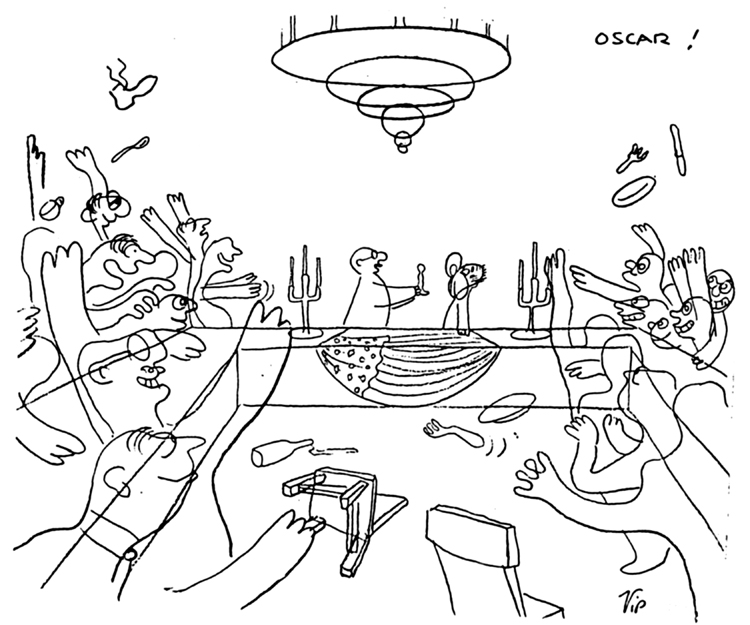
Virgil "VIP" Partch, one of Johnston's assistants, depicts Ollie receiving a compliment from a director on a well-done scene.

Word reaches us that Ollie Johnston passed away yesterday. He was the last of the Disney animation pillars, and he crossed the big river at age 95 ...

I knew Ollie for years, working with him on The Fox and the Hound before his retirement at the tail end of the 1970s.

Ollie was, first and foremost, a tyro animator. When Woolie Reitherman tried to drag him up to one of Woolie's patented, all-day story meetings around the big director's desk in Woolfgang's office, half the time Ollie would not show up. Ollie once told me:

"Gee, those meetings. They go on and on, and we argue over dialogue, and I've got a scene I should be doing down in my office. You guys can do all that without me ..."

Ollie was gentle, gentlemanly, considerate of other people's feelings. I never knew him to utter an unkind word to a co-worker. When he and Frank retired from their first-floor animation duties and moved to a big third-floor office to write "The Illusion of Life," Ollie asked me to read an early draft. I did, and thought it was terrific. He expressed gratitude that I had taken the time. In reality, I was the grateful one, being allowed to read it at all.

He was the last of nine charmed lives that made magic on movie screens for a half-century, and now he's gone. Thanks for everything, Ollie. All of us are the richer because you graced the planet.

Addendum: The Disney press release lionizing Mr. Johnston is here.

Click here to read entire post

Monday, April 14, 2008

Wages In That Other Animation Business: GAMES

Since video games dwarf the movie business, it's probably a good idea to pay attention what wage rates are over in that neck of the woods.

Game Developer Magazine has done a wage survey (not unlike TAG's own), and it's kind of instructive.

...[B]usiness and marketing leads the pack, with an average annual salary of $101,848, and experienced executives pulling in $132,305.

Okay, not exactly what a high-level television or movie exec makes, but not at all shabby. But what do Tech Directors (programmers) and animators (game division) make? Per the survey:

Programmers are a distant second with an average annual salary of $83,383, but they're also one of the most educated groups: 50% hold bachelor's degrees and 26% have completed some graduate work ... [A]nimation [is] at $66,594, Game Design at $63,649 ...

By way of comparison, rates from our most recent animation wage survey are a teensy bit different.

The annual wage for a programmer/technical director is $94,233.50

The annual wage for a 3-D modeller is $78,545.50

And the annual wage for 3-D animator is $87,272.50

To what do I attribute the difference? Part of it's that the 'toon business is more mature, and the age of people in it are older. Also that a large swath of television and feature animation is unionized, which makes a considerable difference, particularly in Los Angeles. Travel to other parts of the country where there is a minimal union presence, and the rates are lower.

The game industry has very little unionization.

Click here to read entire post

Sunday, April 13, 2008

Horton Keeps On Trucking

As noted below, there's one film in the world marketplace that continues to triumph:

With foreign box office in a pre-summer holding pattern, "Horton Hears a Who!" stayed on top for the third consecutive frame with $10.6 million at 5,300 playdates in 56 markets ...

Besides "Horton" and "21," only four other pics topped the $4 million mark ... Underlining the foreign appetite for family fare, "Horton" posted decent holdover numbers with a 15% gain in its French soph sesh to $3.8 million and a 7% hike in its fourth British frame to $1.2 million. The tale of the big-hearted elephant's hit $104.9 million offshore, joining "10,000 BC" and "Jumper" as the third U.S. title released this year to top the $100 million mark overseas.

Fox noted that "Horton" has far exceeded foreign perfs for previous Dr. Suess pics "How the Grinch Stole Christmas" ($85 million) and "The Cat in the Hat" ($35 million). With openings still coming in Italy, Japan and South Korea, the studio expects the CGI toon's final foreign cume to nearly match the domestic total, now at $139.6 million ...

So we know at least one thing. It's not live-action versions of Seuss for which overseas markets hunger, but the animated variety.

This bodes well for future employment in the 'toon biz, wouldn't you say?

Click here to read entire post

Saturday, April 12, 2008

El Box Office

The horror remake Prom Night sails to the top of the list despite the slashing lacerations given it by film critics. (And if it runs true to genre, it will nose dive in its second weekend.)

Nothing else seems to be busting the turnstiles. Horton now has $135.2 million in its domestic till, which makes it the only Top Ten flick north of the $100 million mark.

Update: Variety weighs in on the Sunday finals:

Sony and Screen Gems’ “Prom Night” terrorized the competish at the weekend box office, grossing an estimated $22.7 million from 2,700 theaters and scoring the best bow for a horror pic so far this year.

“Prom Night,” starring Brittany Snow and Johnathon Schaech, pulled off the move despite a generally soft marketplace for horror pics. More suspense than gore orgy, film won the B.O. crown by a wide margin on the strength of teens who took advantage of the pic’s friendly PG-13 rating.

Placing No. 2 in its bow, Fox Searchlight and New Regency’s Keanu Reeves-Forest Whitaker cop actioner “Street Kings” grossed an estimated $12 million from 2,467 runs, according to Rentrak.

Continuing to play a strong hand, Sony’s gambling drama “21” came in No. 3 in its third sesh, declining a narrow 28% to an estimated $11 million from 2,736 runs for a cume of $62.3 million. That gave Sony two pics in the top five.

But the overall slump at the domestic B.O. continued, sans the breakout hits enjoyed during the first part of 2007, including “300” and “Wild Hogs.” (“Dr. Seuss’ Horton Hears a Who!” is the only 2008 film to cross the $100 million mark; last year there were four.) ...

So there you have it. Except for the occasional animated feature, the movie business is having a sucky year.

Click here to read entire post
Futurama and The Simpsons

The London Sunday Times has a lengthy piece on Matt Groenig and his thoughts on his major and minor cartoon creations.

(And why would old Rupe be allowing one of the cornerstones of his media empire waste ink and pixels on an unregerate Lefty? Because the Lefty has made old Rupe mountains of money.)

... Futurama is simply an alternative perspective on the primary dynamic of the Groening psyche. So, since The Simpsons perspective has been such a global success for so long, why isn’t Futurama? Well, for a start, the latter isn’t exactly real. “In the course of doing Futurama, I came to the realisation that one of the reasons The Simpsons resonates the way it does is because people relate to human beings, even though they have car-toonishly yellow skin, more than they can relate to robots and cyclops and alien crab creatures.” As a result, Futurama ran for just four years on Fox – The Simpsons will hit 20 years in December 2009 – before moving to the Cartoon Network. The latest deal between Fox and Comedy Central is for four feature-length DVDs, which will be shown on TV as 16 episodes. This is scarcely a failure, but the contrast with The Simpsons is stark. Yet now it’s back.

Of course, TAG's wants are simple. We desire that Matt Groenig's Yellow Family goes on for a dozen more seasons on the teevee, and that Futurama one day soon come under an Animation Guild contract.

Few things could be more simple than that.

Click here to read entire post

Unpaid O.T. ... It Ain't Just Animation

One small anecdote I neglected to recount about the recent IA negotiation.

During contract talks, you do a lot of sitting around and waiting. And while you wait, you talk. During one such lull I fell into conversation with a representative from a live-action union who told me the following:

"We've had problems with unpaid overtime for years. Producers expect our people to take work home, or work until two in the morning, and show up for work again at 7:00 a.m., all without extra compensation. Our union didn't even try to police the contract violations for a long time. Now that we are trying to police them, production companies are getting mad.

If our people refuse to work off-the-clock, they get accused of not being 'team players'."

I responded with: "It never occurs to these people that their company agreed in a contract to pay overtime. So maybe they're not team players when they refuse to pay wages that corporations have pledged in writing to pay."

But hey. Many companies make a practice of ignoring state and federal labor codes. Why should collective bargaining agreements be any different?

(And aren't you glad to know there's so much of this crap going around?)

Click here to read entire post

Friday, April 11, 2008

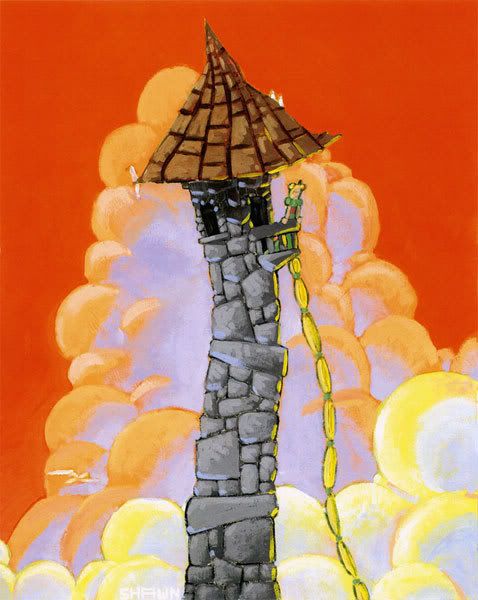
Rapunzel!

Since the last entry was about Disney features, let's stay on that roll for one more post.

The New York Review of Books takes a long look at the story that will be Disney animator Glen Keane's first directorial effort:

... Individual fairy tales change in popularity over time. "Rapunzel," for instance, was once much less widely known than "Hansel and Gretel," "Cinderella," "Beauty and the Beast," or "Snow White." Currently, however, it is becoming more popular, with nearly three thousand entries on Amazon alone ... It is a complex story, which includes many classic themes, including a witch who is serially both kinds of bad parent: first imprisoning and then rejecting her daughter ...

... Already a full-length animated Disney film is in production and scheduled to be released in 2009. The director, Glen Keane, has declared that it will be "a story of the need for each person to become who they are supposed to be and for a parent to set them free so they can become that." Clearly, there are parallels here to recent young-adult versions. But Keane has also said that the movie's visual style will be based on the painting The Swing, by the French Rococo artist Jean-Honoré Fragonard. Since the point of this painting, also known as Les hasards heureux de l'escarpolette, is that the young man standing below the swinging girl (though not the viewer) can see up her foaming skirts, Disney's new "Rapunzel" may turn out to have an unexpectedly erotic undertone.

Uh, I tend to doubt it, but I guess we'll have to wait and see.

I do know that the feature's story development has gone through stages: Glen's original, more straight-forward rendering of the Rapunzel fairy tale became -- under Michael Eisner's influence -- the more Shrek-like Rapunzel Unbraided. Now, under John Lasseter's leadership, I'm informed that it's closer to the flavor of the original tale again.

Those who claim to know say the current incarnation of Rapunzel is in solid shape. Doubtless we will discover how true that is when the Girl with Long Hair is released.

Click here to read entire post

At Disney Animation Studios

A short report on the hat building, where I whiled away the middle of Thursday afternoon.

Bolt is moving into higher gears as more of the staff begings getting overtime. As one artist said:

"I caught a screening of the film, mostly story reels now, a few days ago. I hadn't seen it in some time, and they've revamped the story a lot since January. And I really thought it worked well ..."

Princess and the Frog now has production animation going on, as well as experimental animation. The studio formed a study group to analyze the hand-drawn features of the nineties to sort out what elements worked and what didn't, how they can get the most bang for their production buck, etc.

I know next to nothing about the pictures themselves, and wouldn't say much about them if I did.

Click here to read entire post
Thursday, April 10, 2008

All Roads Lead to Mumbai

The global cartoon workplace and market is always with us:

... Turner International India is now chalking out aggressive growth strategies for India.

Turner will independently launch its animation theatrical business in the country and is also planning a Hollywood-centric entertainment channel in partnership with Warner Bros.

For its animation business, Turner will establish a new “multi-million dollar business unit” to develop and produce animation films to be released primarily in the Indian market and expand its current output of live-action television series ...

This morning, I was on the phone with an Imagi exec, listening to what that Hong Kong-based company's needs are for L.A. animation artists:

"Imagi really wants a relationship with L.A.-based talent for animated films it wants to produce. And it wants longer-term employment contracts to make sure people stay on board through the whole production ..."

What I see on a weekly basis, with board artists, with c.g. supervisors, is how animation is more and more a global enterprise. And how, if you've got the chops, cartoon companies here or abroad will hire you, and you'll find a job somewhere. Some employment will be in L.A. Other jobs will be in Canada, France, or India. The interlocking networks are pushing the labor markets in all directions. Said Steve Marcopoto, president, Turner Broadcasting System Asia Pacific and Anshuman Mishra - MD South Asia:

“This is a natural progression to our expertise in kids’ television through Cartoon Network and POGO. Our animation production unit will be set up in Mumbai and will target producing about two full-length animated movies in a year and the first movie will be released in 2009,” he said. Marcopoto did not rule out a possibility of co-productions with either Warner Bros or local animation studios for these films.

I see a steady stream of O-1 visas flowing across my desk. I also have lunch with American technical directors up for jobs in Shanghai on Chinese animated features. It's a big, interconnected world out there. And sometimes it works for local talent, and sometimes not.

Click here to read entire post

Negotiations -- Three Days and Recess

We wrapped the talks after three full days. Lots of progress toward a new 2009-2012 contract, but we're not over the goal line:

IATSE and AMPTP have concluded three days of productive negotiations on a new Hollywood Basic Agreement. The parties held extensive discussions on new media, minimums and the pension and health plans, including the impact of the 2006 Pension Protection Act on funding standards. IATSE and AMPTP have agreed to recess the negotiations to accommodate previously agreed-upon bargaining sessions with SAG and AFTRA. A news blackout will remain in effect until the conclusion of the negotiations.

"These talks have been extremely helpful in understanding the fundamental issues before us in an environment that has been conducive to bargaining," IATSE International President Thomas C. Short said. "We look forward to the resumption of negotiations with AMPTP and to securing a contract that will benefit our membership."

"We've covered a lot of ground in an opening round that's been both respectful and mutually beneficial," AMPTP President Nick Counter said. "We remain confident that we can build on the new economic partnership that we've reached with DGA, WGA and the AFTRA Network Code, enabling all of our creative and behind-the-scenes talent to share in the emerging new media revenue while giving the industry the flexibility needed to adapt and change in a challenging marketplace."

So why didn't the IA and AMPTP reach a deal?

It came down to time colliding with financial complexities. The 2006 "Pension Protection Act" -- a sparkly new Federal law -- set up a new (and different) set of benchmarks for multi-employer pension plans. This has meant that old pension calculations have to be replaced with new ones dictated by the '06 regulations. And the recalculating simply took more time than the negotiators permitted themselves.

That, I think, is the big reason an agreement wasn't struck yesterday. Everything else seems to be on track. My best estimate: a new contract will be wrapped up with a bow sometime in early summer.

Click here to read entire post

Wednesday, April 09, 2008

Disney and Pixar peer into the future

The front page of yesterday's Variety featured a detailed breakdown of Disney and Pixar's theatrical feature plans for the foreseeable future. Some of this parallels our post from yesterday, except that for the first time The Powers That Be are getting specific about some previously unconfirmed release dates ...

Here's a (very) brief list of the upcoming titles. Further details in the above-linked article:

  • Summer 2008: Pixar's Wall-E, directed by Andrew Stanton.
  • Thanksgiving 2008*: Disney's Bolt, formerly American Dog, directed by Chris Williams & Byron Howard.
  • May 29, 2009: Pixar's Up, directed by Pete Docter, which as was reported here yesterday will be their first 3-D title.
  • Christmas 2009: Disney's The Princess and the Frog, directed by John Musker and Ron Clements.
  • June 28, 2010: Pixar's Toy Story 3, directed by Lee Unkrich.
  • Christmas 2010: Disney's Rapunzel, directed by Glen Keane and Dean Wellins.
  • 2011: Pixar's newt, directed by Gary Rydstrom.
  • 2011: Pixar's The Bear and the Bow, directed by Brenda Chapman, breaking Pixar's glass ceiling for what Variety refers to as "femme helmers".
  • Summer 2012: Pixar's Cars 2, directed by Brad Lewis.
  • Christmas 2012: Disney's King of the Elves, directed by Aaron Blaise and Robert Walker.

*rumors to the contrary ...

Click here to read entire post

Tuesday, April 08, 2008

The 3-D 3-D Future!

Good to see that the Mouse House (and affiliated studio), is following Jeffrey Katzenberg down the 3-D 3-D rabbit hole:

In a big boost for the exhibition of films in 3-D, Walt Disney Co. said it would release all feature animation films from its Pixar unit in the format beginning next year ...

Disney also fleshed out its animation film schedule through the summer of 2012. Releases include a third installment of Pixar's "Toy Story" franchise and a sequel to Pixar's 2006 release "Cars" that is slated for the summer of 2012. Other releases include this June's non-3-D Pixar feature "Wall-E," the tale of a robot's quest for love; a Thanksgiving release of "Bolt," about a show-business dog featuring the voices of John Travolta and bankable Disney teen star Miley Cyrus; as well as a planned four-movie slate in its new "Tinker Bell" direct-to-DVD franchise ...

I got a call from a reporter about all this earlier today. He wanted to know, "Is it going to be tough for Pixar to produce more than one feature film a year?"

I said to him (paraphrasing here): "Not if they have enough competent story people to handle development, and not if story development goes smoothly.

"Trouble is, 84% of the time, story development doesn't go zip-bang-boom. There's always a snafu somewhere, and then you have the option of a) stopping forward movement on the production until story and character troubles are fixed or b) trying to fix story holes on the fly as production keeps thundering along."

In other words, there are no simple, one-size-fits-all solutions. If good stories were that easy and simple to develop, Hollywood would have a lot more homeruns and a lot fewer foul outs and bloop singles.

Click here to read entire post

Negotiations --- Day Two

The thing to know about most big-time entertainment union - entertainment conglomerate negotiations is, there's a lot of waiting around in the caucus rooms ....

The way it works is, the players (i.e. top union officials, pension-health fund trustees, etc.) go into side-bar after a (usually) short and perfunctory meeting of everyone on both sides of the table in the BIG conference room.

These negotiations are running true to form. Big meeting ... followed by a caucus ... followed by side-bars (with everyone not in the side-bars cooling their heels in one of the caucus rooms).

Then, with side-bars concluded, everybody meets again in the big room where the leaders give a short summation of "where we are." And then its back to waiting as more side-bars happen.

In other words, a thrill a minute.

There's been a lot of slogging through financial minutia as regards the wage and benefit proposals, there's also the "new media" issues. The I.A. leadership has been very good updating all the locals about general progress and "where we are" in the contract talks.

Another round of negotiations happen tomorrow starting at 9:30. Perhaps by the end of Wednesday there will be triumphant press releases issued.

One can hope, anyway.

Click here to read entire post

The Mighty Horton (and Feature Animation Industry)

Why do I know that American animated features will continue to be drivers in animation employment? This:

'Horton Hears a Who!' has performed well at the foreign box office even though the original Dr. Seuss book is relatively unknown outside the U.S.

"Horton Hears a Who!" wore the international crown for the second straight weekend, easily topping a moderate frame with $11.7 million at 6,583 playdates in 54 markets. ... [F]antasy adventure "The Spiderwick Chronicles" and caveman actioner "10,000 B.C." -- were the only other films cracking the $5 million mark during the frame.

... "Horton" has totaled $223 million worldwide so far, underscoring the ongoing strength of CGI animated fare. The last major animated entry, "Bee Movie" totaled $286 million worldwide, including $160 million overseas ....

Big animated films from the United States have been consistent winners at the world box office, and my take is this:

Studios are almost always squirrely about breaking the mold of a winning formula. And c.g.i. features produced stateside have been big winners over the past several years.

If the time comes when a big animated film made in say, Bangladesh makes an international splash by raking in heavy coin, then corporate calculations may change, but until that happens, the domestic animated feature industry will stay robust.

Click here to read entire post

Monday, April 07, 2008

Over at Film Roman ...

... some Yellow Family staffers' nerves are on edge.

Since I didn't have to be sitting in negotiation this afternoon, I drove over to the Starz Media/Film Roman facility, where I discovered (via the employees) that Fox and the six voice actors on The Simpsons are deep in talks for a renewal of contracts. And that all parties, according to the artists, have imposed a news blackout.

Which makes the artists a bit anxious.

"We sort of assumed they'd reach a deal, but since they haven't, we don't know what's up. And nobody else around here has much of an idea about what's going on, either."

Added to that, Fox has a number of shows from the current Simpsons season it plans to hold over to the next, so there might not be a full season (22 episodes) order next time around.

Assuming there is a next time around.

Small wonder that artists came up to me and said: "So. What other animation projects are going on around town?"

Click here to read entire post

Negotiations ... Day One

We assembled in the "union caucus room" a bit after nine to go over the Game Plan which will, for obvious reasons, remain a closely guarded secret. (This caucus room was the "all-purpose" room when the building -- originally a May Co. department store -- was Warner Bros. Animation. I trekked in and out of the building almost weekly for years and years, and it's weird to see it changed to the AMPTP-MPAA headquarters where old work areas have been converted into big conference rooms.)

Around ten we went into the Big Room for the traditional rollout, which consisted of everyone saying their name and company or union affiliation: "Steve Hulett, eight-three-nine" and so on. (Exciting, no?)

Then Nick Counter and Tom Short made their opening statements, ground rules were set, and each side retired to their respective caucuses.

Committees were going to be meeting in side-bars* with management through the afternoon. Reps not on a committee -- and I'm one of those -- were instructed to return to the caucus room the following morning.

Negotiations are scheduled to continue through Wednesday.

*Side-bars: smaller negotiating sessions with representatives from labor and management (but not the entire group) are often where bigger progress toward an agreement is made.

Click here to read entire post

Let the Negotiations Begin ...

Later this morning, the International Alliance of Theatrical Stage Employes (and affiliated crafts) commences negotiations with the Alliance of Motion Picture and Television Producers.

This sit-down will be a trifle early as these things go; the current contract doesn't expire until the middle of next year. But since hammering out new agreements seems to be all the rage, that's what the parties will be doing.

With SAG waiting in the wings to start its contract talks, the majors will begin three days of negotiations today with the Intl. Alliance of Theatrical & Stage Employees. The below-the-line union is expected to emerge Wednesday with a new contract -- even though its current deal doesn’t expire for another 16 months.

... Neither IATSE nor the Alliance of Motion Picture & Television Producers would comment on the IATSE negotiations, first disclosed a month ago (Daily Variety, March 3). But it would be a surprise if the talks don’t lead to a deal, which will cover about 25,000 below-the-line employees in 18 West Coast locals. IATSE topper Thomas Short has indicated to associates he’ll come in with a focused proposal ...

I've seen the focused proposal, but I'm keeping my yap shut about it until the bargaining parties hammer out a new agreement (2009-2011) and roll out their own press release.

'Round about 9:30 this A.M., all the locals in the bargaining unit will be assembling in the caucus room at the new AMPTP headquarters in Sherman Oaks. TAG will be there, even though we're not in the unit (we were thrown out in 1985; it's a long, involved story with which I won't bore you). All we've been for the past twenty-three years is an interested observer rather than a participant. Since the final package impacts TAG in a major way, we will be in attendance.

I expect that the back-and-forth will be energetic, obviously I'll know more later this afternoon ... and Tuesday ... and Wednesday.

Click here to read entire post

Sunday, April 06, 2008

The Simpsons' Ride!

The L.A. Times has a short piece outlining the new Simpsons' amusement park adventure, coming soon to Universal Studios, Hollywood and (I assume) eventually Universal Studios, Orlando.

The six-minute simulator ride follows the Simpsons clan as they are plucked from the crowd at the Krustiest Place on Earth to be the first family to tackle the “upsy-downsy spins-aroundsy teen-operated ride thrilltacular.” Naturally, things go awry.

... The ensuing journey takes riders down the carnival midway, on thrill rides, through dark rides, past musical revues and even around Springfield. The vengeful Sideshow Bob plays a key role in the mayhem.

The chaotic scenes play out in digital imagery and Dolby sound on a 90-foot-tall, domed screen as riders sit in an eight-seat simulator vehicle that climbs, dives, spins and seems to loop (although riders never go upside-down).

The Simpsons ride will be moving into what used to be Back to the Future's playpen, a large, multi-stories tall building at the hub of Universal Studio CA. There's a large, open area in front of it, with restaurants to the right and banks of escalators to the left, the escalators carrying the crowds down to the lower park.

My teenage son is ticked off that Back to the Future will be going bye bye, but that's show biz. The first Zemeckis installment of that franchise came out twenty-three years ago, and the Simpsons Movie is less than a year old.

Commerce marches on.

But I've been watching this attraction develop over at Starz Media for the better part of a year, and the designs and layouts have been pretty wild. When the writers were on strike over the winter, a couple of artists working on the ride said: "Oh, there's writers on this, and they're happy for the gig. The WGA doesn't cover amusement park attractions." Seems natural, I guess. Drawing a paycheck while writing dialogue for the six-minute spectacular now taking shape at Universal beats carrying a picket sign for nothing most days of the week.

Anyway, I hope Simpsons, the Ride has the same magnitude of success and Simpsons, the Movie.

Click here to read entire post

Saturday, April 05, 2008

A small RANT!

It never effing ends, you just fight the same frigging battles over and over. Forever.

Last week an animation designer walks into my office, wanting me to review his Personal Service Contract (sometimes known as an "employment agreement.") Nothing new or extraordinary about that, I look at members' PSCs all the time ...

And this one isn't particularly different than most of the others. It gives the weekly salary amount; it describes the term (the length of employment; "at will" in this case, since the company reserves the right to lay the person off when the spirit moves or, as the contract says: "the producer guarantees no minimum number of weeks of employment.")

Then there's the usual boilerplate about the job being "work for hire" and the company owning all rights throughout the universe and on every type of machine or distribution network known to Man ... and blah, blah and blah.

So far so good. Then the guy says to me:

"They don't want me to ... ah ... tell other people my salary."

I look up. "That's against California state law.

"Oh?"

"There's specific rules against that."

And then I look at the boiler plate on the last page and there it is: "Everything in this agreement is confidential"

Meaning, of course "Keep your yap shut about the money you make."

Neato jet, in writing yet. No matter how many damn times you put up a post saying "That's illegal," no matter how often you complain to one studio or another, here comes another company telling employees: Don't ... DO NOT ... share wage information! The fact that the law says "Can't do that!" means nothing. The fact that I will call the company's labor relations department whining about it and they will make soft cooing noises about how "it was a mistake" and how they will "talk to the production people about it" also means nothing.

Six months from now, after this little "error" gets corrected, some corporation will pull the same maneuver yet again, some employee will come to his union rep, and once more we will be off to the races.

Going 'round ... and 'round ... and 'round.

Click here to read entire post

The April B.O. Derby

21 stays on top for a second Friday, collecting $5.250,000.

Leatherheads enters the ranks at #2. The movie that caused George Clooney to resign from the WGA and go financial core cellected $4,540,000 of a Friday evening, and we'll see how it performs the rest of the weekend ...

Nim's Island is in the third slot, having collected $3,850,000.

And Horton descends to fifth position, raking in $2.5 million for a domestic total of $124.5 million. Interestingly, the big elephant is the only 100+ million feture in the Top Ten.

Update: For the weekend, 21 remains on top with $15.1 million, with newbies Leatherheads ((13.3 million) and Nim's Island ($13.3 million) close behind.

The durable Horton, although dropping 48.7% in its fourth week, colected $9.1 million and now has a grand total of $131 million (U.S. and Canada).

New entry Shine a Light -- Martin Scorcese's rock documentary on the Rolling Stones -- debuted on 276 screens with the second highest per-screen average ($5,474).

Click here to read entire post

Friday, April 04, 2008

A job listing from DreamWorks

When U.S. studios wish to import an animator, technical director or other worker from overseas under an H1-B immigration visa, they need to insure that there is nobody in the domestic talent pool available.

Since we've been sent the job posting below from DreamWorks Animation, we thought it would be beneficial for all concerned to let qualified citizens have a shot at the job. (You'll find the criteria for the DreamWorks position after the break.) ...

TITLE: Lighter(s) (Job Code SC08)

DUTIES:

For feature length animated films, responsible for lighting and compositing shots to maintain continuity of a sequence and fulfill the vision of the Directors, Production Designer, Art Director and VFX Supervisor, while meeting the production schedule. Ensure quality of final frames and cleanliness of setups. Checks for continuity problems in shots within the sequence. Optimizes shots for rendering. Manages image files and associated disk space. Maintain current versions of movie files and OMFs. Works with Production Supervisor and CG Supervisor to to meet sequence schedule milestones. Collaborates with other departments such as Layout, Modeling, Surfacing, Matte Painting and Effects.

EDUCATION AND EXPERIENCE REQUIREMENTS:

Bachelor's degree (or foreign equivalent) in Computer Arts, Computer Graphic Design, or closely related field.

** Employer will accept 2 years experience in job offered or related field in lieu of degree.

REQUIRED SKILLS: Experience with rendering, lighting and compositing; graphics software.

JOB SITE: DreamWorks Animation, LLC 1000 Flower Street Glendale, CA 91201 40 hours/week; $104,000 per year (see update below)

If offered employment must have legal right to work in U.S. EOE

CONTACT: Send resumes to: DreamWorks Animation, LLC Attn: Recruiting -- Lighter, Job Code SC08 1000 Flower Street Glendale, CA 91201 (818) 695-5000 jobs: (818) 695-6080

jobs@dreamworks.com -- Must reference job code when applying

UPDATE as of 5/8/2008: DreamWorks has informed us that the salary of $104,000 is based upon a fifty-hour week (not forty hours).
Click here to read entire post

Toony Links

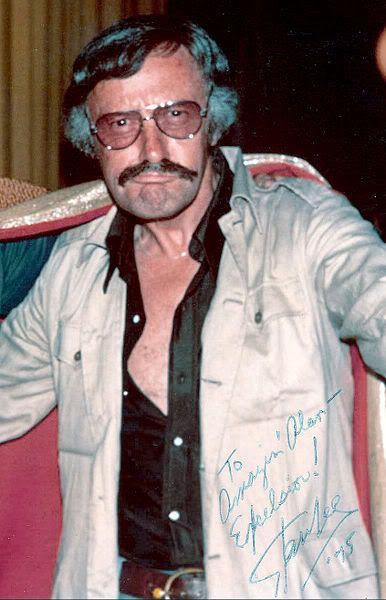
Mr. Lee in a slightly younger incarnation ...

More end-of-week linkage, starting with ...

Stan Lee, a seasoned citizen still churning out new ideas and products, sets up three with the Mouse House:

Comic book legend Stan Lee has set up three projects at Disney, which houses his production shingle POW! Entertainment.

The projects are based on stories and ideas from the 85-year-old man behind Spider-Man and the Hulk, who will executive produce with his POW! partner Gill Champion ...

DreamWorks Animation announces the music composers for its June animation release:

Dreamworks Animation confirmed to Upcoming Film Scores today that the upcoming Kung Fu Panda gets an original score co-written by Hans Zimmer and John Powell. This marks the first collaboration in eight years between the highly prolific composers, who worked together on Dreamworks' The Road to El Dorado and the action thriller Chill Factor in 1999 ...

And Nickelodeon wants us all to visit Monkey World(c)!

Nickelodeon is building a virtual world in a bid to increase revenue in the real world.

The company is expected to announce Thursday that it is developing an entire virtual world, involving games, avatars and a strong social-networking component, based on network hit "SpongeBob SquarePants."

Nick also is expected to announce that it is developing Monkey World, a social-networking and massive multiplayer game based on an original concept and not tied to any of its existing franchises.

The network also will announce that it will increase the interactivity on its Neopets site through a new virtual world called World of Neopia, and will add a paid tier to Nicktropolis ...

Crest Animation (of India) and the owner or RichCrest Animation (of Burbank, California) plans to start producing and releasing one animated feature per year for the U.S. and world markets:

Its first international co-production with Lionsgate (LGF.N: Quote, Profile, Research), 'Alpha and Omega', is targetting a 2010 release and the animation producer is looking for more such tie-ups, said A.K. Madhavan, chief executive officer, on Friday.

"We have already started talking five projects with them," Madhavan said. "The slate will continue to grow so long as the movies are well done and getting box office hits."

"There are at least two other major distributors, who we are talking to," he said, without identifying these companies.

Crest's U.S.-based subsidiary, RichCrest Animation, entered into the deal with Lions Gate Entertainment in August 2006 for three animation films.

RichCrest was founded by former Disney director Rick Rich. The company produced, among many other films, the hand-drawn feature The Swan Princess before being purchased by Crest.

Pixar director Andrew Stanton talks about the upcoming Wall-E with the college crowd:

The concept for "Wall-E" first swam around Stanton's head as he was writing "Finding Nemo," which won him the Academy Award for Best Animated Feature in 2003. "Wall-E" was a long time in the making though, because Stanton felt that he "needed a few hits under his belt" before he could sell the idea to producers. Because Wall-E speaks his own language, much like R2-D2, Stanton felt the project was riskier.

"That's just enough of a radical idea for a conventional movie," Stanton said.

Another Pixar topkick, computer scientist Tony DeRose, discusses production techniques and pipelines with a rapt audience at Hamilton College:

DeRose, who holds a doctorate in computer science from the University of California, Berkeley, and won a 2006 Academy Award for his animation work, began his talk discussing the production pipeline of Pixar films ... Much of the modeling is done using software packages written in-house, with more than 10 million lines of code. To make their creations easier to animate, animators "rig" the characters, or define the ways in which parts of the body can move relative to each other in a fashion similar to putting strings on a marionette. The process is exhaustive; in the case of the face, Pixar's models typically have 300 points of articulation, whereas a real-life human face can move in only 30 ways ...

The trades have been filled with speculation about where a large shareholder of DreamWorks Animation might be going with his career in the near future:

...there's already talk that Spielberg might look for funding to begin rebuilding DreamWorks for life after Par[amount].

Such a DreamWorks II would no doubt be a smaller business than its progenitor, with a smaller slate and maybe no animation -- unless it were to merge with DWA. Insiders at DWA insist that there's been zero discussion of that latter possibility, which is just one of many scenarios spun by industryites on the periphery of the situation.

I'm now out the door and off into Friday's business. I come across something truly awesome, I will add it here.

Addendum: Chris Wedge receives the Tex Avery Animation Award:

... [Wedge] also says that Mr. Avery's "crazy and chaotic" cartoons made an impression on him that seems contradictory to today's 'toon world. "They were like dreams or hallucinations where anything could happen at any moment. That seems a far cry from what animation has become in this age of big business and cutting-edge technology.

"You think about the environment those shorts were created in. There was very little pressure for those things to be anything but hilarious. I happen to work in an environment where there is a lot of pressure to operate within a very demanding business model. But maybe I'm just talking as someone who's seen what's behind the curtain. And I probably shouldn't underestimate how difficult it was to put those films together. But they sure feel carefree.

Addendum II: A fine profile of the trials and travails of the cartoon voice actor, as exemplified by cartoon voice actor Bob Bergen:

"I have done almost every Disney animated feature since 'The Hunchback of Notre Dame,' " Bergen explained. "I've done most of the Pixar films. I've been Comet the Reindeer in the 'Santa Clause' movies and Luke Skywalker on 'Robot Chicken' and in Star Wars video games. I'm not Tim Allen. I'm not Don Rickles. I'm not Tom Hanks. They're going to play the leads. And I'm fine with that. I play the squirrel. I play the robot. I play the baby.

"Would I like to play the lead?" he continued. "Sure. Will my name on the marquee bring people in? No. Do studio executives care if I'm the squirrel or not? No. Am I happy to be working and getting paid my residuals? You bet. Look, if you're really interested in this, it really doesn't matter what's involved or what the obstacles are. If you're meant to do it, you're going to do it."

In the meantime, be excellent to each other.

Click here to read entire post

Thursday, April 03, 2008

The Old Squeeze Play

The AMPTP's new home. Funny, but it doesn't look like a baseball diamond.

A couple of weeks back, SAG and AFTRA were marching as one negotiating entity -- just as they've done for decades -- and it looked like later ... rather than earlier ... negotiations with the AMPTP were preordained.

But a funny thing happened on the way to the conference table at the Alliance of Motion Picture and Television Producers. SAG and AFTRA went through an ugly separation, and my how times (and well-laid plans) do change:

Less than 24 hours after the Screen Actors Guild (SAG) announced it would begin negotiations with the Alliance of Motion Pictures and Television Producers (AMPTP) on April 15, the American Federation of Television and Radio Artists (AFTRA) said it will enter talks of its own with the conglomerates on April 28. The decision to schedule separate talks comes after a particularly ugly weekend of finger-pointing between the two unions, which led to AFTRA's decision to effectively divorce SAG ...

I thought AFTRA would charge into negotiations first, but I was wrong.

AFTRA National President Roberta Reardon said on Wednesday: "AFTRA has decided to let SAG go first because we feel it is in all of our interests for SAG to maintain its momentum and because we want to give the guild a reasonable opportunity to meet with the AMPTP ...

This sounds all sisterly and high-minded, but don't anybody kid themselves. SAG starts negotiations with the AMPTP in mid-April; two weeks later, AFTRA gets its turn at the Alliance's shiny new headquarters in the Sherman Oaks Galleria. What happens if SAG still has issues when its alloted time runs out?

I'll tell you. The AMPTP will smile and say, "So sorry, but we have to go talk to AFTRA now, catch you later." And then the Alliance of Motion Picture and Teleivsion Producers will negotiate with AFTRA, and most likely reach an agreement with AFTRA.

And SAG, despite any screams and wails that "they can't live with!!" Provision D or Provision F, will have to live with them, because the DGA, WGA, IATSE, and AFTRA will have already gone before them, and (by then) the mold (made of high-strength stainless steel) will have been set. And SAG -- like it or not -- will get the same party platter as everyone else.

The AMPTP, you see, has set up a squeeze play. SAG can strike, but SAG will be undercut by the cold reality that every other labor organization is on board with the basic deal. And the Alliance will be uninterested in changing it in any significant way for the Screen Actors Guild. Plus, AFTRA won't be lending a helping hand by delaying its talks. As AFTRA's Roberta Reardon says:

"... we cannot abdicate our responsibility to our own members to engage with the employers in a strong, deliberate, and timely manner so we can negotiate the best possible agreement for primetime performers."

So unless I miss my guess, SAG will have its work cut out for it. Because the guild will be running like hell as it's chased down by second baseman Nick Counter, shortstop Robert Iger and pitcher Peter Chernin.

Click here to read entire post

At Cartoon Network

Just now Cartoon Network -- housed next to the Burbank Police Department in fabled "Downtown Burbank" -- has the Chowder crew developing new episodes on an upper floor and the Foster's Home for Imaginary Friends animators working on half-hours of that serious on another ...

Foster's, since the beginning of its run, has produced a goodly number of its episodes in-house. CN doesn't produce all of the series locally, but splits animation duties between crews in California and Ireland.

Back when the show started production, management told me that the Irish animation crew had a narrow edge in cost-per-ep. (With the stellar performance of the American dollar over the past year, I don't know if this remains true.)

There are a number of empty cubicles on different floors just now, but last week one of the CN artists told me:

"Word is that the development people in Atlanta will be moving here to Burbank, so we'll have all the development under one roof. That sounds like a good thing to me. Maybe we'll get more shows developed and into production. We could use them."

Maybe the oncoming shorts program, ramping up this summer, will be a shot in the 'Toon Network's arm.

Update: Cartoon Network has just wrapped its presentation for CN's 2008 season, the details for which can be found here:

At the Cartoon Network Upfront presentation held today in New York, the network announced its programming line-up for 2008. On the heels of February's announcement that Star Wars: The Clone Wars will come to Cartoon Network as a series in the fall, George Lucas, the creator and steward of the Star Wars brand, attended the Upfront event to provide additional details on this highly anticipated offering. Building on the unprecedented success of last fall's live-action movie Ben 10: Race Against Time-the highest-rated telecast in Cartoon Network history-and the standout new series Chowder ...

Cartoon Network has designated Thursday nights as the new destination for comedy. Anchored by its new animated hit Chowder, which the network announced today has been picked up for a second season, Thursdays will also feature existing laughers Foster's Home for Imaginary Friends, Camp Lazlo and George of the Jungle and offer a platform for new series launches including this summer's The Marvelous Misadventures of Flapjack ...

Click here to read entire post

Wednesday, April 02, 2008

Eye Movements 3

Continuing his posts on animating eyes, Kevin writes:

Eye movements can be classified into seven different types:

Convergence is a motion of both eyes relative to each other that ensures that an object is still foveated by both eyes when its distance from the observer is changed. The closer the object is, the more the eyes point towards each other. This movement can be voluntarily controlled, but is normally the result of a moving stimulus.

Saccades are the principal method for moving the eyes to a different part of the visual scene, and are sudden, rapid movements of the eyes. Saccades can be initiated voluntarily, but are ballistic: that is, once they are initiated, their path of motion and destination cannot be changed. Visual input is suppressed during a saccade ...

Pursuit motion is a much smoother, slower movement than a saccade; it acts to keep a moving object foveated. It cannot be induced voluntarily, but requires a moving object in the visual field. One frequent failing of thoughtless animation is having the eyes demonstrate pursuit motion when there is no object being followed by the character’s eyes.

Nystagmus is a saw-toothed pattern of eye movements that occurs as a response to the turning of the head (acceleration detected by the inner ear) or the viewing of a moving, repetitive pattern (the train window phenomenon). It consists of smooth `pursuit’ motion in one direction to follow a position in the scene, followed by a fast motion in the opposite direction to select a new position. This is an eye movement that has probably never been animated, and if it was, it would probably get rejected by the supervisor or director because it would look so odd ...

Click on the link above for Kevin's complete post on lall seven types of eye movements ... and his take on animation of those little round orbs in the upper part of the face ...

Click here to read entire post

Tuesday, April 01, 2008

CGI's Slow March Into TeeVee Land

Iron Man, the television version, will soon visit a home-viewing unit near you:

Marvel has commissioned Gallic animation concept and content creation company Method Animation to make 26 half-hour “Iron Man” shows. Marvel and Method are co-producing with U.K. animation production company Cinnamon Entertainment.

Series is currently in production and the first episode is due to be delivered in a month ...

Now, I'm not here to wring my hands and whine about how IM is being produced in Europe and Oh How Awful! What I want to focus on is that another t.v. animated CGI show is rolling down the pike, but there's still plenty of hand-drawn product ...

Like, what's interesting to me is how slow and tentative C.G.I.'s encroachment into the flat, cartoony world of animated television has actually been, when the growth of c.g. features has been rapid and downright overwhelming in the theatrical realm.

Consider: a decade ago, Sony produced the theatrical feature Starship Troopers,; shortly thereafter, Sony-Adelaide created a c.g. series of the same name, which was big-time expensive and didn't come anywhere near the success Sony Adelaide hoped for.

So Sony didn't produce it for long.

Then there was the prime time c.g.i series Father of the Pride five years back. Big things were expected for that, too, but it quickly went to DVD land and was never heard from ... on network television ... again.

The problem, as it was explained to me by studio wise men, is that c.g. was (is) hugely expensive and, on television at least, the fact that it's computer generated images prancing around on the small screen doesn't necessarily mean big ratings.

And ratings, girls and boys, is what the game is all about. Programmers and studio development execs aren't in the exercise for their general all-around jollies or health. Their eyes are always riveted on the big prize: M-O-N-E-Y. And when the hand-drawn Simpsons and Family Guy are doing big business in the home entertainment area, who needs c.g.i.?

It's only been in the last couple of years that c.g. series have finally gained traction. Nick is producing Tac. Disney TVA has Mickey's Clubhouse and My Friends Tigger and Pooh, with Inspector Oso waiting in the wings. There are other scattered examples, but you get the idea. Computer-generated cartoons have established a strong beachhead in television, but they're a long way from taking the whole country over.

(And Disney's direct-to-video feature franchise has only now sloughed off the traditional-looking sequels that made the company so much heavy coin and is making c.g.i. Tinkerbell films.)

The point is, c.g. animation has been far less robust in television because, unlike its theatrical cousin, the cost-benefit hasn't been apparent. Kids, by and large, are happier watching hand-drawn 'toons like Fairly Odd Parents and Sponge Bob Square Pants than they are Star-Ship Troopers. And unless and until the comgloms see a big benefit to creating computer-generated television product (like higher ratings or lower costs), hand-drawn product will continue to flourish on the home screen.

Addendum: It's pointed out in comments that there have been a boatload of c.g.i. television shows, and that some have been successful. Absolutely right. But the success hasn't reached critical mass (at least, not quite yet) the way it has on the feature side.

Click here to read entire post
Site Meter